


When it comes to metal core PCBs, aluminum PCBs are the most widely used option. They typically combine a conductive copper layer, an electrically insulating dielectric layer, and a sturdy aluminum base that transfers heat away from critical components. This structure makes aluminum PCBs an effective choice for high-power applications where efficient heat dissipation, stable performance, and temperature control are essential. As a result, they are widely used in LED lighting, power electronics, automotive systems, and other heat-intensive products.
At PCBgogo, we carefully control thermal conductivity, dielectric thickness, copper weight, board thickness, and dimensional accuracy throughout the manufacturing process. This helps customers achieve consistent and dependable quality, from initial prototypes to volume production. Read on to explore PCBgogo's aluminum PCB manufacturing capabilities, material options, process controls, and quality standards.
Lightweight and strong: Aluminum sheets have a low density while offering excellent strength and toughness. They reduce overall product weight and make transportation and installation easier.
Excellent corrosion resistance: A dense protective oxide layer forms naturally on the surface, helping the material withstand moisture, oxidation, and various environmental conditions.
Outstanding workability: Aluminum sheets can be easily cut, bent, stamped, welded, and surface-treated to meet a wide range of size, shape, and appearance requirements.
Sustainable and recyclable: Aluminum can be recycled repeatedly while retaining its valuable properties, helping conserve resources and support sustainable development.
Most aluminum PCBs are built around three functional layers:
Copper Circuit Layer: Creates the conductive paths that connect components and carry electrical signals or power.
Thermally Conductive Dielectric Layer: Electrically isolates the copper circuit from the metal base while transferring heat efficiently.
Aluminum Base Layer: Provides mechanical support and spreads heat away from temperature-sensitive components.
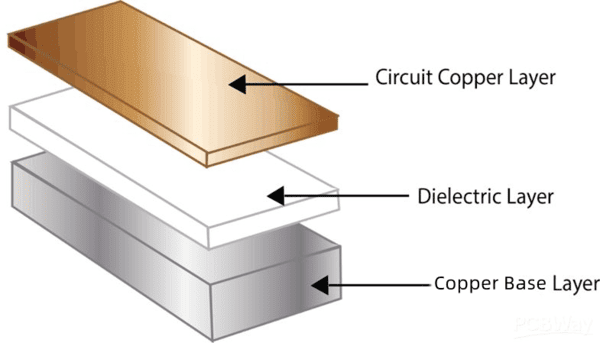
Together, these layers form the basic structure of an aluminum PCB. Depending on the required circuit density, additional copper, dielectric, and prepreg layers may be added to create double-layer or multilayer designs. A solder mask is also commonly applied to protect the outer circuit surface.
| No. | Item | Capability Parameter |
|---|---|---|
| 1 | Base Material | Aluminum core |
| 2 | Layers | 1-8 Layers |
| 3 | PCB Size | Max:427*1170 mm Min:5*5 mm |
| 4 | Materials | 1100/1050/2124/3003/4045/5052/6061 |
| 5 | Thermal Conductivity (ω/m-k) | 0.3-12 W |
| 6 | Board Thickness | 0.5-5.0 mm |
| 7 | Min Tracing/Spacing | 4/4 mil |
| 8 | Plated Through-hole size | ≥1.0 mm (±0.10 mm) |
| 9 | Non-Plated Through-hole size | ≥0.5 mm (±0.05 mm) |
| 10 | Copper Thickness | 0.5-10 oz |
| 11 | Solder Mask | Green, Red, Yellow, White, Black, Blue, Purple, Matte Green, Matte Black, None |
| 12 | PCB Surface Finishes | Leaded / Lead-free HASL; OSP; ENIG / ENEPIG; Electroplated (Nickel) Soft / Hard Gold; Electroplated Tin |
| 13 | Metal Base Surface Finishes | Anodizing, Hard Anodizing, Chemical Passivation Mechanical Treatment: Sandblasting, Brushing |
| 14 | Forming Method | Laser cutting: ±0.05 mm Routing: ±0.15 mm |
| 15 | Accuracy of metal machining | ±0.03 mm |
| 16 | Other Options | Countersinks, Castellated Holes, Custom Stackup and so on. |
| 17 | Testing | Fly probe testing, X-ray, A.O.I. |
| 18 | Certification | ISO9001, IATF 16949, ISO 13485, IPC-6012 Class 2/3, UL, RoHS, REACH |
Note: If you have any special requirements regarding materials, stack-up, or other manufacturing processes, please specify them when requesting a quote. We can evaluate your specific needs and provide customized material selection and manufacturing solutions.
PCBgogo - Reliable, High-Quality PCB Manufacturing
Save time and money with an all-in-one solution for PCB fabrication, assembly, and parts. Reduce vendor coordination, avoid split shipments, and get consistent, reliable quality.
Get Free Quote >
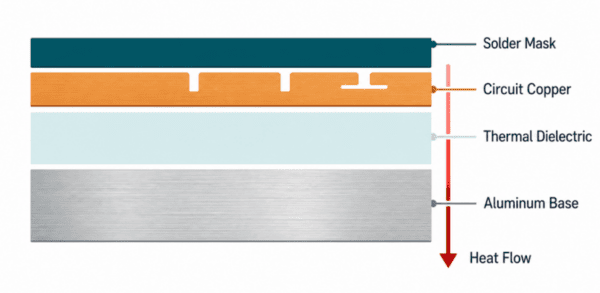
Aluminum PCBs are classified as single-layer, double-layer, or multilayer according to the number of conductive copper layers—not the total number of physical material layers.
A single-layer aluminum PCB uses one copper circuit layer bonded to an aluminum base through a thermally conductive dielectric. A solder mask is normally applied over the circuit to protect the copper surface.
Because the heat-transfer path is short and direct, this structure offers efficient thermal dissipation, straightforward manufacturing, and competitive production costs. It is commonly used in LED lighting, power supplies, motor controls, and other applications with relatively simple circuit layouts.
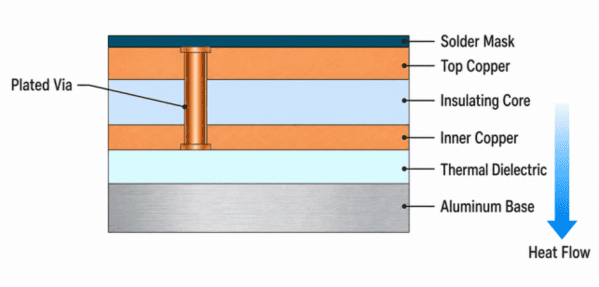
A typical double-layer aluminum PCB contains two copper circuit layers separated by an insulating core or prepreg. Plated vias provide electrical connections between the two copper layers, while a thermal dielectric isolates the circuit from the aluminum base.
Compared with a single-layer board, this construction provides more routing space and supports more complex circuit designs without sacrificing effective heat dissipation.
A multilayer aluminum PCB combines several copper layers with dielectric or prepreg materials. Plated-through vias connect the required circuit layers, and the completed circuit stack is bonded to the aluminum base through a thermally conductive dielectric layer.
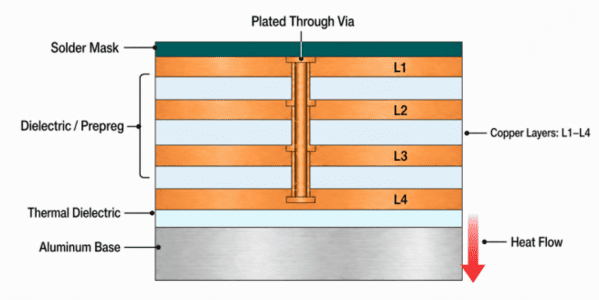
This construction supports higher component density, advanced signal routing, and the integration of power and control circuits. It is suitable for demanding applications such as automotive electronics, industrial control systems, high-power LED modules, and communication equipment.
The exact layer stack can be customized according to electrical isolation, thermal conductivity, copper thickness, and via requirements.
LED Lighting: Aluminum PCBs efficiently transfer heat away from LEDs used in streetlights, automotive lamps, grow lights, commercial lighting, and display backlights.
Automotive Electronics: They provide reliable thermal management for headlights, motor controls, power converters, charging systems, and electronic pumps.
Power Electronics: Aluminum PCBs dissipate concentrated heat generated by AC/DC converters, DC/DC converters, inverters, voltage regulators, MOSFETs, and IGBTs.
Industrial Equipment: They support stable operation in motor drives, automation equipment, industrial power supplies, robotics, and welding systems.
Renewable Energy and EV Systems: Aluminum PCBs are used in solar inverters, EV chargers, battery-management systems, and energy-storage equipment.
Communication Equipment: They help manage heat in power-control, signal-amplification, and network-infrastructure systems.
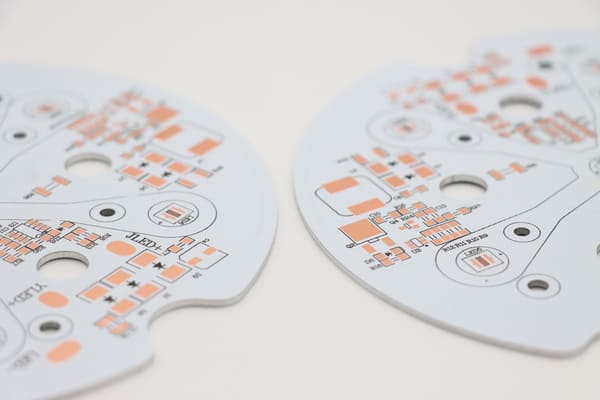
From single-layer LED boards to eight-layer aluminum PCB constructions, PCBgogo provides flexible manufacturing options for thermally demanding electronic products.
Our team can support material selection, stack-up evaluation, prototype fabrication, and production manufacturing based on your electrical, thermal, and mechanical requirements.
Upload Your Design & Get a Quote
MCPCB is the broader term for a printed circuit board that uses a metal core or metal base. An aluminum PCB is an MCPCB that specifically uses aluminum as the metal substrate.
PCBgogo supports aluminum PCB constructions with up to eight conductive layers. Multilayer designs are reviewed according to their stack-up, dielectric system, via structure, copper weight, and overall thickness.
Not necessarily. Overall cooling performance also depends on dielectric thickness, copper area, component placement, thermal interface material, heat-sink contact, enclosure design, and airflow.
Yes. Plated through-holes can be used in appropriate aluminum PCB structures. The hole wall must remain electrically isolated from the conductive aluminum substrate.
PCBgogo supports copper weights from 1 to 4 oz for aluminum PCB projects. The suitable option depends on current capacity, conductor width, circuit density, and etching requirements.
The right finish depends on the component package and assembly process. Lead-free HASL is economical for standard designs, while ENIG provides a flatter surface for fine-pitch components. OSP may be suitable for cost-sensitive boards with straightforward assembly requirements.
Yes. Aluminum PCB prototypes allow engineers to verify component temperature, mechanical fit, soldering performance, and heat-sink contact before moving to volume production.

 日本語
日本語
 한국어
한국어

