


At PCBgogo, we are committed to providing high-quality, efficient, and reliable PCB assembly (PCBA) services. Before you order a PCB with components, make sure the PCB data, bill of materials (BOM), and pick-and-place file describe the same revision. Confirm DNP and polarized parts, prepare the required PCB component overages, review panelization, and provide clear silkscreen, paste-layer, and substitution instructions.
Clear production data, correctly prepared components, and an assembly-ready board design help us reduce avoidable questions and keep your project moving.
This guide summarizes the main PCB assembly requirements to review before placing an order. Whether you choose turnkey, partial-turnkey, or consigned assembly, this PCB assembly checklist can help prevent material shortages, incorrect placement, and production delays.

PCB component overages are spare parts supplied in addition to the exact placement quantity. They cover feeder setup, unusable tape leader, pick-up loss, and the occasional component rejected during handling or inspection. Without enough spares, one inexpensive missing capacitor can hold up an otherwise completed order.
For a consigned build, first calculate the net requirement:
QUICK ANSWER Net component quantity = quantity fitted on each board × number of boards to be assembled.
On top of that net requirement, plan to supply extra spare pieces to cover feeder loss, tape leader waste, and inspection rejects. How many extra pieces are needed depends on the component's package type, value, and the overall build quantity; smaller passives generally call for a higher spare ratio than large-package parts, while low-quantity or high-value components such as ICs, BGAs, QFPs, and certain connectors often need little or no standard overage.
Because the right overage varies by part, we don't apply one fixed ratio across a BOM. Send us your BOM and packaging details before shipping the consignment kit, and our team will confirm the recommended spare quantity for each line item during order review.
SMT parts that are not supplied on reels should remain on one continuous strip of tape. Do not divide the same part number into short strips for different boards. Keep parts on the original reel or continuous tape whenever possible.
For smoother receiving and traceability, use the following packing practices:
Keep each manufacturer part number in its own labeled bag, reel, tube, or tray.
Show the PCBgogo order number, BOM line, manufacturer part number, and actual quantity on the label.
Preserve ESD and moisture-barrier packaging where the component requires it.
Do not mix substitutes under one label, even if the electrical value is the same.
Tell the engineering team in advance if a part is supplied loose, has very short tape, or requires baking or other special handling.
By default, any unused or surplus parts supplied by you or purchased by us will not be returned. If you would like us to return these parts together with the assembled circuit boards, please contact us or specify this in the relevant order.
PCBgogo - Reliable, High-Quality PCB Manufacturing
Save time and money with an all-in-one solution for PCB fabrication, assembly, and parts. Reduce vendor coordination, avoid split shipments, and get consistent, reliable quality.
Get Free Quote >
Panelization combines multiple boards into a larger array so the assembly line can print solder paste, place components, and transport the boards consistently. For mass production, PCBgogo requires panelization when an individual PCB is smaller than 50 mm × 100 mm or has a non-rectangular outline.
When both PCB fabrication and assembly are handled by PCBgogo, the CAM and assembly teams can coordinate the production panel and matching solder-paste data. If you provide your own panel, show the array, spacing, routing method, break-away structure, and finished-board orientation in the fabrication data.
PCBgogo's online quotation tool currently provides V-scoring, tab routing, or a combination of both as panel-routing options and lists 5 mm as the minimum edge-rail width. The final panel design is still subject to engineering review because board thickness, component weight, copper-to-edge clearance, depaneling method, and downstream testing can change the best solution.
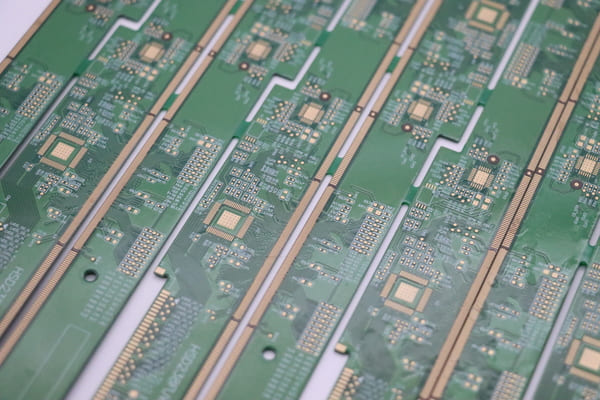
Break-away rails, also known as break-away tabs or PCB process edges, are temporary extensions added to a PCB panel so that automated SMT equipment can securely transport, clamp, and position the board. If the clearance between the PCB edge and copper features—such as traces or pads—is less than 3.5 mm (138 mil), or if the PCB requires panelization, break-away rails should be added along the two longer parallel edges. PCBs smaller than 50 mm × 100 mm and circular or irregularly shaped boards generally require panelization and may therefore also need break-away rails.
Properly designed break-away rails help reduce PCB vibration, warping, and positioning errors during solder paste printing, component placement, and reflow soldering. They can also prevent production delays caused by boards that cannot be securely handled by SMT equipment. Before submitting your PCBA files, confirm the required rail width, V-score or tab-routing method, fiducial marks, and tooling-hole specifications with your assembly provider. The panel Gerber and solder-paste data should also remain consistent. After assembly, the rails are removed during depanelization and do not form part of the finished PCB.
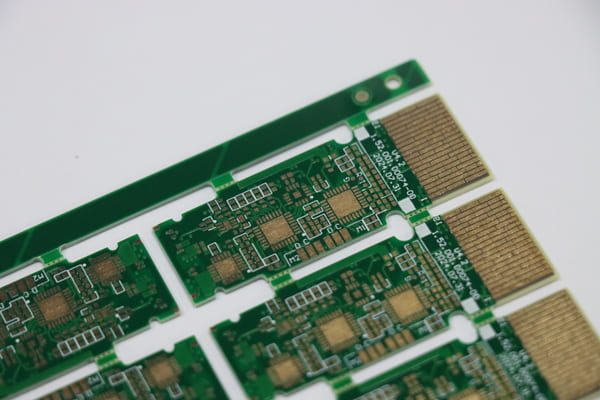
Silkscreen reference designators help operators and inspectors confirm component location and orientation. Keep the marks readable and place them where they will not be completely hidden after assembly whenever the layout allows.
At minimum, check that:
every fitted component can be matched to a reference designator;
pin 1 and polarity marks agree with the footprint and datasheet;
top and bottom side markings cannot be confused;
connector names and orientations are clear;
no silkscreen overlaps exposed pads or other solderable surfaces.
If assembly silkscreen is not provided, accurate visual verification becomes more difficult. Some inspection steps may have to be bypassed, which increases the risk of assembly errors. When board space is limited, provide a clear assembly drawing instead of relying on silkscreen alone.
For turnkey PCB assembly, PCBgogo sources components according to the approved BOM and requests customer approval before making a substitution. Help the sourcing team respond quickly by adding an Approved Alternative or Substitution Allowed column to the BOM.
For parts that may be substituted, define the characteristics that cannot change. Depending on the component, these may include:
package, footprint and pinout;
resistance, capacitance or inductance value and tolerance;
voltage, current and power rating;
dielectric type, temperature coefficient and operating-temperature range;
frequency, timing or switching performance;
regulatory, lifecycle or traceability requirements;
manufacturer restrictions.
Use "no substitution" for safety-critical, calibrated, RF-sensitive, firmware-dependent or mechanically constrained parts unless a named alternative has already been qualified. A part with a similar description is not automatically a form-fit-function replacement.
Standard production data does not explain every product-specific need. Add a separate instruction file when the assembly requires IC programming, selective soldering, hand-installed hardware, conformal coating, controlled lead length, a special cleaning process or a defined functional test.
For testable assemblies, include:
the test method and pass/fail limits;
power-input limits and required loads;
connector pinout and cable information;
firmware version, programming file and checksum where applicable;
required test fixtures or customer-supplied accessories;
the required report or traceability output.
PCBgogo's published PCBA capabilities include visual inspection and AOI, with X-ray inspection for BGA placement. If your project needs a specific inspection method, acceptance standard, test coverage, or report, confirm it during quotation.
PCBgogo requests the PCB or Gerber data, a complete BOM, and a pick-and-place/CPL file. An assembly drawing is strongly recommended. Schematics, 3D data, programming files, and test instructions should also be included when they clarify the build or define a special requirement.
Yes. Choose PCBgogo's PCB assembly service and select turnkey, partial-turnkey, or kitted/consigned sourcing. Turnkey service combines PCB fabrication, component sourcing, and assembly.
Provide the PCB or Gerber data, a complete BOM, and a pick-and-place/CPL file. Include an assembly drawing, schematic, programming file, or test procedure when it clarifies the build.
Extra parts cover feeder setup, tape leader, and normal placement loss. Small passives usually require more spares than large or high-value components. Confirm exact quantities before shipping an expensive or limited-stock part.
For mass production, PCBgogo requires panelization when a PCB is smaller than 50 mm x 100 mm or has a non-rectangular outline. Other designs may also need panels for stable handling.
No. For turnkey assembly, PCBgogo requests customer approval before using a substitute. Adding pre-approved alternatives to the BOM can shorten the sourcing process.

 日本語
日本語
 한국어
한국어

