


When a PCB needs to carry higher current, dissipate heat efficiently, and remain reliable under demanding operating conditions, copper quality and manufacturing precision make all the difference. At PCBgogo, every copper PCB project is engineered to meet your exact design requirements, including copper thickness, layer structure, fine lines and spacing, and surface finish. Explore our copper PCB manufacturing capabilities below to learn how we transform complex designs into reliable boards ready for production.
To better understand its manufacturing requirements, let's begin by looking at what a copper core PCB is and how it differs from a conventional PCB.
A copper core PCB, also called a copper-based PCB or copper substrate PCB, is a metal-core printed circuit board built on a solid copper base. Unlike a conventional FR-4 PCB, which uses copper mainly for conductive traces and planes, a copper core PCB incorporates the copper substrate into the board structure.
A typical single-sided construction contains three functional layers:
Circuit layer: Etched copper forms the traces, pads, and electrical connections. The copper weight is selected according to current and layout requirements.
Thermally conductive dielectric: This layer electrically isolates the circuit from the metal base while allowing heat to pass through it. Its thickness and thermal conductivity have a direct effect on insulation and thermal resistance.
Copper base: The solid substrate supports the board, absorbs heat from the circuit area, and spreads it across a larger surface for transfer to a heat sink or enclosure.
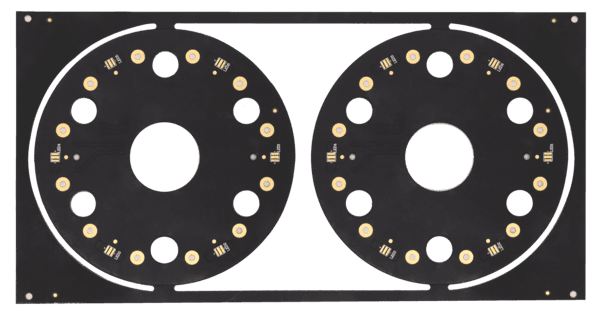
When components generate heat, the dielectric layer conducts it downward into the copper base. The copper substrate then spreads the heat more evenly across the board, reducing localized hot spots that could affect component performance, stability, and service life. Compared with an aluminum-core PCB, a copper core PCB generally offers better thermal and electrical conductivity. This makes it particularly suitable for designs involving concentrated heat, high current, high power density, or limited cooling space. Thanks to its combination of efficient heat transfer, electrical insulation, and mechanical strength, a copper PCB can be used in power electronics, automotive systems, LED lighting, industrial controls, renewable energy equipment, and other thermally demanding applications.
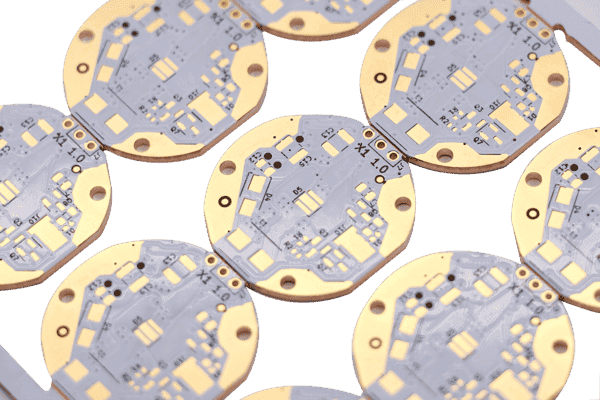
At PCBgogo, every critical detail—from copper thickness and dielectric selection to base thickness, stack-up, and manufacturing tolerances—is carefully controlled to meet your electrical and thermal requirements. With flexible manufacturing options and professional engineering support throughout production, we help turn demanding copper PCB designs into reliable, high-performance boards. Below is a detailed overview of PCBgogo's copper core PCB manufacturing capabilities.
| No. | Item | Capability Parameter |
|---|---|---|
| 1 | Base Material | Copper core |
| 2 | Layers | 1-8 Layers |
| 3 | PCB Size |
Max:427*1170 mm Min:5*5mm |
| 4 | Materials | T2 copper |
| 5 | Thermal Conductivity (ω/m-k) | 0.3-12 W |
| 6 | Board Thickness | 0.5-5.0 mm |
| 7 | Min Tracing/Spacing | 3/3 mil |
| 8 | Plated Through-hole size | ≥1.0 mm (±0.10 mm) |
| 9 | Non-Plated Through-hole size | ≥0.5 mm (±0.05 mm) |
| 10 | Copper Thickness | 0.5-10 oz |
| 11 | Embedded Copper Block | 3*3 mm-70*80 mm (±40 μm) |
| 12 | Embedded copper block tolerance | ±40 μm |
| 13 | Distance from embedded copper block to hole wall | ≥12 mil |
| 14 | Solder Mask | Green, Red, Yellow, White, Black, Blue, Purple, Matte Green, Matte Black, None |
| 15 | Surface Finishes | Leaded / Lead-free HASL; OSP; ENIG / ENEPIG; Electroplated (Nickel) Soft / Hard Gold; Electroplated Tin |
| 16 | Mechanical Treatment | Mechanical Treatment: Sandblasting, Brushing |
| 17 | Forming Method |
Laser cutting: ±0.05 mm Routing: ±0.15 mm |
| 18 | Accuracy of metal machining | ±0.03 mm |
| 19 | Other Options | Countersinks, Castellated Holes, Custom Stackup and so on. |
| 20 | Testing | Fly probe testing, X-ray, 4-wire low-resistance test, A.O.I. |
| 21 | Certification | ISO9001, IATF 16949, ISO 13485, IPC-6012 Class 2/3, UL, RoHS, REACH |
Note: If you have any special requirements regarding materials, copper thickness, stack-up, or other manufacturing processes, please specify them when requesting a quote. We can evaluate your specific needs and provide customized material selection and manufacturing solutions.
PCBgogo - Reliable, High-Quality PCB Manufacturing
Save time and money with an all-in-one solution for PCB fabrication, assembly, and parts. Reduce vendor coordination, avoid split shipments, and get consistent, reliable quality.
Get Free Quote >
Copper core PCB performance depends on far more than the published capability numbers. PCBgogo provides advanced copper core PCB manufacturing across a wide range of constructions, including single-sided boards, double-sided sandwich structures, multilayer sandwich boards, thermoelectric separation designs, and custom hybrid-laminated copper core PCBs. Heavy copper conductors and COB-compatible structures are also available for projects with higher current, concentrated heat, or compact assembly requirements.
PCBgogo combines flexible construction options with focused engineering and process control to help demanding thermal designs perform as intended.
Multiple copper core structures and custom stack-ups
PCBgogo supports single-sided, double-sided sandwich, multilayer sandwich, thermoelectric separation, and hybrid-laminated copper core PCBs. Custom stack-ups, heavy copper conductors, and COB-compatible constructions are also available for specialized designs.
Engineering evaluation of every thermal layer
Copper weight, core thickness, dielectric material, insulation thickness, and thermal-path position are reviewed as one connected system. This helps balance heat transfer, electrical isolation, current capacity, board thickness, and manufacturing cost.
Process control for complex copper core constructions
Sandwich and thermoelectric separation designs require accurate lamination, resin-insulated holes, precise metal-core openings, and reliable alignment between electrical and thermal areas. PCBgogo controls these critical processes to protect both heat dissipation and electrical reliability.
Consistent results from prototypes to volume production
A successful PCB prototype should not become a different product when order quantities increase. PCBgogo keeps the approved materials, stack-up, and critical manufacturing requirements consistent as the project moves into production.
DFM support that catches problems early
PCBgogo's engineering team checks for issues such as insufficient insulation clearance, unsuitable trace spacing for thick copper, difficult via structures, copper imbalance, and conflicts between the stack-up and component layout. Resolving these details early helps avoid unnecessary redesigns, production delays, and reliability problems.
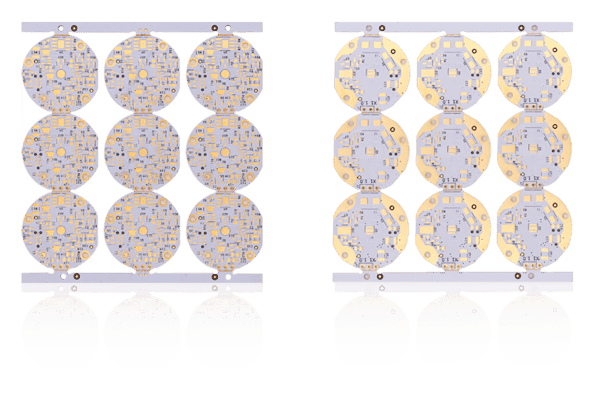
The result is more than a copper core PCB that matches the drawing. It is a board built to manage real current, real heat, and real operating conditions throughout the life of the product. Ready to move your copper core PCB design forward? Send your Gerber files, stack-up, copper thickness, dielectric requirements, and thermal specifications to PCBgogo. Our engineering team will review your design and help you select a reliable, manufacturable copper core PCB solution.
Upload Your Gerber file & Get a Quote
A copper core PCB contains a solid copper substrate for heat spreading and structural support. A heavy copper PCB is defined by the thickness of its conductive circuit layers and may use FR-4 or another base material. Both technologies can be combined when a design requires high-current traces and a metal thermal base.
Yes. A copper core can be placed between circuit layers in double-sided or multilayer constructions. These boards offer more routing space but require additional control of via insulation, lamination, registration, and thermal expansion.
It separates the electrical connection path from the main thermal path. Component terminals connect to the circuit layer, while the thermal pad transfers heat more directly into the copper base, reducing thermal resistance around the heat source.
Yes. Copper core PCBs can be manufactured for bare-die attachment and wire bonding, and PCBgogo provides these assembly services. Pad geometry, surface finish, cleanliness, flatness, and the thermal interface must be matched to the selected die and bonding process.
Provide the Gerber and drill files, stack-up, copper-core thickness, circuit copper weight, dielectric requirements, board thickness, thermal conductivity, and surface finish. For sandwich, thermoelectric separation, embedded-copper, or COB designs, include drawings that identify critical insulation and heat-transfer areas.

 日本語
日本語
 한국어
한국어

