日本語
日本語
 한국어
한국어

BGA Chip Explained: Types, Benefits, Design & Assembly
Modern electronics keep getting smaller, faster, and more powerful, and much of that progress comes down to a single component-packaging innovation: the BGA chip. From the processor in your laptop to the memory module in a 5G base station, Ball Grid Array packaging is the technology that lets engineers pack thousands of connections into a footprint the size of a postage stamp. This guide breaks down what a BGA chip is, how it's built, why it outperforms older packages, the challenges it introduces on the PCB, and what to look for in a manufacturing partner when your next design uses one.
What Is a BGA Chip?
A BGA (Ball Grid Array) chip is a surface-mount integrated circuit package that uses a grid of tiny solder balls on its underside, instead of the metal pins or leads found on older package types, to connect the chip to a printed circuit board (PCB). Because the connections are spread across the entire bottom surface of the package rather than just around its edges, a BGA chip can fit far more input/output (I/O) connections into the same amount of board space.
This higher connection density, combined with shorter electrical paths and better heat dissipation, is why BGA packaging has become the standard choice for processors, GPUs, memory chips, FPGAs, and networking silicon in everything from smartphones and laptops to automotive control units and telecom infrastructure.
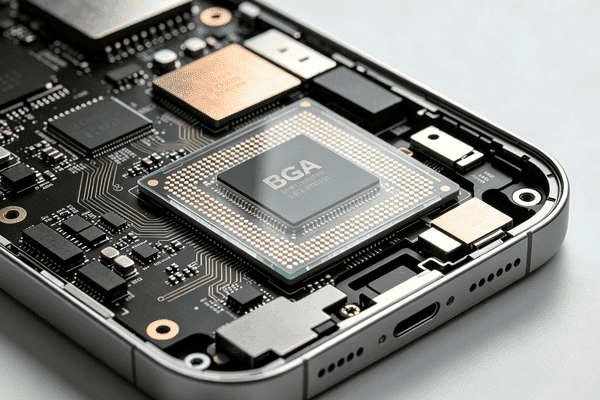
BGA Chip Structure: What's Inside the Package
A BGA package looks simple from the outside, but it's actually a miniature multi-layer assembly engineered to manage signal integrity, heat, and mechanical stress at the same time. The main components are:
Silicon die – the active semiconductor at the heart of the package, containing the transistors and circuitry that perform the chip's function.
Interconnection layer – fine gold or copper wires (wire bonding) or, in higher-performance chips, direct solder micro-bumps (flip-chip) that link the die to the substrate.
Substrate – a miniature multi-layer circuit board inside the package that fans the die's dense connections out to the wider grid of solder balls, while also carrying power and ground planes.
Solder ball array – the grid of spherical solder contacts on the underside of the package that forms the electrical and mechanical connection to the PCB. Ball pitch (the center-to-center spacing) typically ranges from about 1.0 mm down to 0.4 mm or finer.
Encapsulation – a protective epoxy mold compound (and, in flip-chip designs, an underfill epoxy) that shields the die and connections from moisture, contamination, and mechanical stress.
Together, these layers let a BGA chip deliver hundreds or even thousands of connections in a package that can be smaller than a coin.
Common Types of BGA Packages
Not every BGA chip is built the same way. The substrate material and internal construction change depending on the performance, thermal, and cost requirements of the application.
| BGA Type | Substrate | Thermal Performance | Typical Use | Relative Cost |
|---|---|---|---|---|
| PBGA (Plastic BGA) | BT resin / plastic laminate | Moderate | Consumer electronics, microcontrollers, memory | Low |
| CBGA (Ceramic BGA) | Ceramic | Excellent | Aerospace, defense, telecom, high-temperature industrial | High |
| TBGA (Tape BGA) | Flexible polyimide tape | Very good | Ultra-thin laptops, space-constrained designs | Medium |
| FCBGA (Flip-Chip BGA) | Organic / resin, flip-chip die | Excellent | CPUs, GPUs, high-speed networking silicon | High |
There's also Fine-Pitch BGA (FBGA), used where board space is extremely tight, such as in smartphones and wearables, and Package-on-Package (PoP), which stacks a memory package directly on top of a logic package to save even more space.
Advantages of BGA Chips
High connection density – using the full underside of the package instead of just the perimeter allows hundreds or thousands of I/O connections in a compact footprint.
Shorter, cleaner signal paths – solder balls create a much shorter path between chip and PCB than traditional leads, reducing parasitic inductance and capacitance for better high-speed performance.
Better thermal management – heat generated by the die travels straight down through the substrate and solder balls into the PCB's copper planes, letting the board itself act as part of the cooling system.
Self-alignment during reflow – molten solder's surface tension naturally pulls a slightly misplaced BGA chip into correct alignment with its PCB pads, improving assembly yield.
Efficient use of board real estate – critical for smartphones, wearables, and any device where every square millimeter counts.
Common Challenges of BGA Chips
BGA packaging delivers major performance benefits, but it also introduces some real engineering challenges that a design and manufacturing team needs to plan for:
Hidden solder joints – because the connections sit underneath the package body, they cannot be checked with a standard visual or optical inspection.
Thermal and mechanical stress – differences in thermal expansion between the package and the PCB (CTE mismatch) can fatigue solder joints over repeated heating and cooling cycles.
Complex PCB routing – routing signals out from underneath a dense BGA footprint typically requires HDI techniques such as microvias, via-in-pad, and additional board layers.
Rework difficulty – reballing or replacing a defective BGA chip requires specialized equipment, precise temperature control, and skilled technicians.
These challenges are exactly why choosing an assembly partner with real BGA experience, X-ray inspection capability, and tight process control matters as much as the chip itself.
BGA vs. QFP vs. LGA: How Do They Compare?
Selecting the right IC package affects PCB layout complexity, signal performance, thermal behavior, and manufacturing cost. Here's how BGA stacks up against two other common package types:
| Feature | BGA | QFP | LGA |
|---|---|---|---|
| Connection method | Solder balls under the package | Gull-wing leads around the edges | Flat metal contact pads |
| Pin density | Very high | Moderate | High |
| Electrical performance | Excellent | Moderate | Good |
| Thermal performance | Very good | Limited | Good, with heat spreader |
| PCB routing complexity | High, often needs HDI | Low | Moderate |
| Inspection method | X-ray required | Visual/AOI possible | Visual/AOI possible |
| Typical use | CPUs, GPUs, FPGAs | Analog ICs, MCUs | Socketed processors, RF |
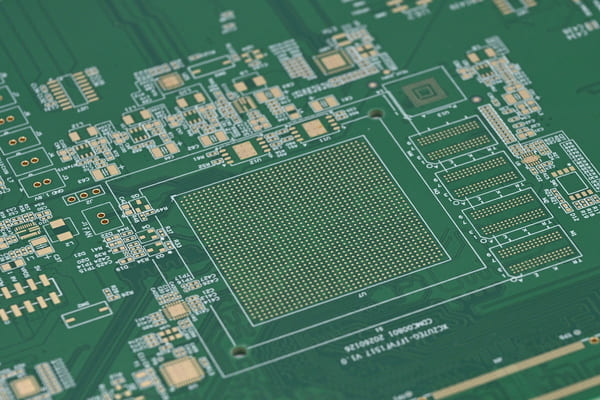
PCB Layout and Pad Design for BGA Chips
Getting a BGA design right starts long before parts hit the assembly line. A few layout decisions have an outsized impact on reliability:
NSMD vs. SMD pads – Non-Solder Mask Defined pads, where the mask opening is slightly larger than the copper pad, are generally preferred because they let solder wrap around the sides of the pad for a stronger mechanical bond.
Escape routing – larger-pitch BGAs typically use "dog-bone" fan-out, routing a short trace from each pad to a nearby via. Fine-pitch BGAs often need via-in-pad techniques to fit routing under the package.
Stack-up and layer count – dense BGA designs frequently require additional layers and controlled impedance routing to fan out signals cleanly.
Thermal vias and copper planes – placing thermal vias under the package and tying them into internal copper planes helps move heat away from the die efficiently.
Because these decisions directly affect manufacturability, it's worth running a Design for Manufacturing (DFM) check before finalizing your layout, so any pad, via, or clearance issues are caught before the board goes into production.
BGA Assembly and Inspection Process
Mounting a BGA chip is far less forgiving than placing a leaded component, which is why the process depends on tight automation and verification at every step.
Solder paste printing – solder paste is deposited through a precision stencil, with aperture size and paste volume calibrated to the BGA's ball pitch.
Automated placement – pick-and-place equipment with optical alignment positions the chip accurately over its pads.
Reflow soldering – the board passes through a controlled thermal profile so the solder balls melt, self-align, and form solid joints without damaging nearby components.
X-ray inspection (AXI) – because BGA joints are hidden beneath the package, Automated X-ray Inspection is used to check for voids, bridging, insufficient solder, and open connections that a camera simply can't see.
Skipping or shortcutting any one of these steps is one of the most common causes of field failures in BGA-based products, which makes assembly partner selection just as important as the design itself.
Applications of BGA Chips
1. Consumer electronics – smartphones, tablets, laptops, and wearables rely on fine-pitch BGA packages to fit powerful processors and memory into thin, compact enclosures.
2. Computing and networking – CPUs, GPUs, FPGAs, routers, and switches use BGA packaging for the high I/O counts and signal integrity that high-speed data demands.
3. Automotive electronics – ECUs, ADAS modules, and infotainment systems use BGA chips for their space savings and reliable performance under vibration and temperature swings.
4. Medical devices – compact, reliable BGA packaging supports portable and wearable diagnostic and monitoring equipment.
5. Industrial and aerospace systems – ceramic and enhanced BGA variants hold up in harsh-temperature, high-reliability environments.
Get Your BGA Design Manufactured Right, the First Time
A well-designed BGA layout can still fail in production if the fabrication and assembly aren't handled with the right process controls. At PCBgogo, we build PCBs and provide turnkey PCB assembly specifically suited to BGA and other fine-pitch components, including:
HDI fabrication with microvias and via-in-pad for dense BGA fan-out
Precision SMT stencil printing and automated pick-and-place for accurate BGA placement
Controlled multi-zone reflow profiling tailored to your BGA's ball pitch and thermal requirements
Automated X-ray inspection (AXI) on every BGA joint to catch voids, bridging, and opens before they become field failures
Free DFM checks to flag pad, via, and clearance issues in your BGA layout before production starts
Whether you're prototyping a single board or scaling up to volume production, PCBgogo's engineering team can help you move from a BGA-based schematic to a reliable, tested board without the guesswork.
Ready to build your BGA design? Upload your Gerber files and BOM to get an instant PCB fabrication and assembly quote, backed by free DFM checking and full X-ray inspection on every BGA joint. Get an Instant Quote at PCBgogo.com
Frequently Asked Questions
What does BGA stand for?
BGA stands for Ball Grid Array, referring to the grid pattern of solder balls on the underside of the package that connect it to the PCB.
What is the difference between a BGA and an LGA chip?
A BGA chip comes with solder balls already attached and is permanently reflow-soldered to the board. An LGA (Land Grid Array) chip has flat contact pads instead of balls and is often mechanically clamped into a socket rather than soldered directly, which is common with many desktop CPUs.
Can a BGA chip be hand-soldered?
It's technically possible with a hot air rework station for simple, low-pin-count BGA chips, but it is not recommended for production work. The hidden solder joints need precise alignment and temperature control that only automated placement and reflow equipment can reliably deliver.
Why does BGA inspection require X-ray?
Because the solder joints sit underneath the package body, they're completely hidden from standard visual or optical inspection. X-ray imaging lets inspectors see through the package to check for voids, bridging, and open or insufficient solder connections.
What is BGA reballing?
Reballing is a rework process that removes the old, oxidized solder balls from a BGA chip and replaces them with new ones using a stencil and controlled heating. It's typically done to salvage expensive or hard-to-source components.
What ball pitch should I design for?
Standard BGA pitches range from about 1.0 mm to 1.27 mm, while fine-pitch BGAs can go down to 0.4 mm or smaller. Finer pitches allow more I/O in a smaller footprint but require tighter PCB fabrication tolerances and more advanced routing techniques, such as via-in-pad.
Final Thoughts
BGA chips have become the backbone of high-density, high-performance electronics, but their benefits only translate into a reliable product when the PCB design, fabrication, and assembly are handled with real precision. From pad geometry and escape routing to reflow profiling and X-ray inspection, every step matters.
If you're working on a design that includes BGA components, PCBgogo offers fast PCB fabrication, precision SMT assembly, free DFM checking, and full X-ray inspection to help make sure your board performs the way it was designed to, from prototype through production.