日本語
日本語
 한국어
한국어

What's the Real Difference Between SMD and SMT?
Anyone involved in electronics manufacturing will quickly come across the terms SMD and SMT. They are often mentioned together in PCB assembly, which can make it seem like they refer to the same thing. But they describe two different aspects of the process.
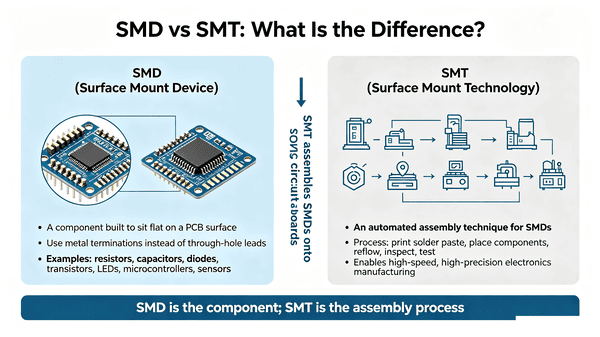
SMD (Surface Mount Device) refers to the actual electronic component — such as a resistor, capacitor, transistor, or IC — designed with flat metal contacts instead of traditional wire leads. SMT (Surface Mount Technology) refers to the manufacturing process used to place and solder these components directly onto the surface of a PCB without drilling holes for leads. This article will explain the key differences between SMD and SMT, helping you gain a clearer understanding of what they are, how they work together, and why both are essential in modern PCB assembly.
What Is SMD (Surface Mount Device)?
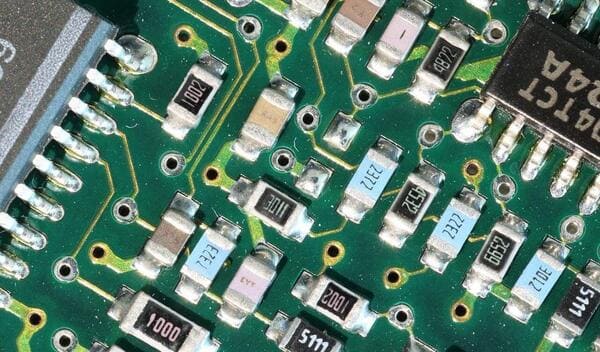
A Surface Mount Device is any electronic component built to sit flat on a board's surface and bond to a copper pad, rather than having legs that thread through drilled holes. Instead of wire leads, SMDs use small metal terminations, tabs, or ball-shaped contacts on their underside or edges.
SMDs cover a huge range of part types, including:
Passives: Passive components — resistors, capacitors, and inductors used to manage current, store charge, and filter signals.
Discretes: Discrete devices — diodes, transistors, and LEDs used for switching and signal control.
ICs & modules: Integrated circuits and modules — microcontrollers, sensors, connectors, and other complex packages that pack advanced functionality into a tiny footprint.
Because SMD packages are significantly smaller than their through-hole counterparts, they enable compact designs in today's electronics, including smartphones, wearables, and IoT sensors.
What Is SMT (Surface Mount Technology)?
Surface Mount Technology is the assembly technique used to place and solder SMD components onto a PCB. It replaced the older through-hole method, in which component leads were pushed through drilled holes and hand-soldered on the opposite side of the board.
SMT relies on automated equipment and a repeatable multi-step process:
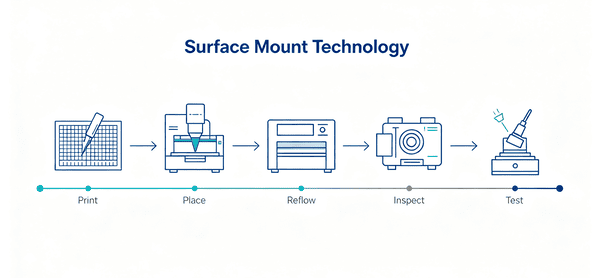
1. Solder paste printing: Solder paste is printed onto the board's pads through a stencil.
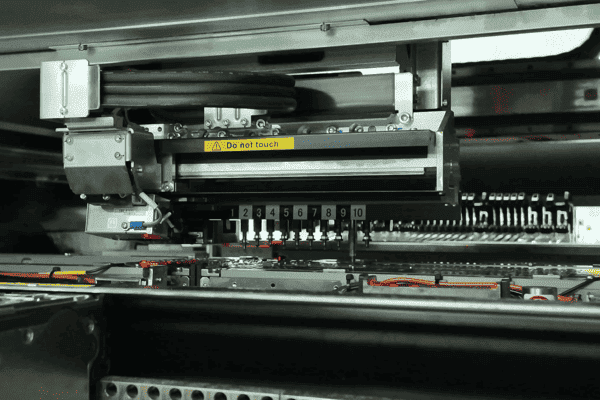
2. Component placement: High-speed pick-and-place machines position components onto the wet paste with micron-level accuracy.
3. Reflow soldering: The board passes through a temperature-controlled oven, melting the paste to form permanent solder joints.
4. Inspection: Automated optical inspection (and sometimes X-ray) checks alignment, polarity, and solder quality.
5. Testing: The finished board undergoes functional and electrical testing.
Because the whole process is automated, SMT lines can place thousands of components per hour with far less labor and error than manual assembly.
SMD vs. SMT: What's the Difference?
| Property | SMD (Surface Mount Device) | SMT (Surface Mount Technology) |
|---|---|---|
| What it is | A physical electronic component used on a PCB | A manufacturing and assembly process for mounting components |
| Category | Hardware — resistors, capacitors, ICs, LEDs, and other surface-mount parts | Assembly method — solder paste printing, component placement, and reflow soldering |
| Main goal | Enable miniaturization and support high-density PCB designs | Achieve automated, precise, and high-volume PCB assembly |
| Mounting style | Uses flat contacts or pads instead of long wire leads | Places components directly onto PCB pads without requiring drilled holes |
| Analogy | The "ingredient" placed onto the circuit board | The "recipe" or technique used to assemble the circuit board |
Why the Two Terms Get Confused
SMT production lines run almost exclusively on SMD components, so in everyday conversation people often use the terms as if they were synonyms — saying a factory "does SMT" when they really mean it assembles SMD parts, or calling a part "SMT" when it's technically an SMD. The overlap is understandable, but the distinction matters in a professional context: a supplier's SMT capability describes their assembly process and equipment, while their SMD offering describes the parts they can source or place.
How SMD and SMT Work Together
In real PCB manufacturing, these two ideas are inseparable partners rather than competing options:
Design engineers select SMD packages to keep a layout small, lightweight, and electrically efficient.
PCB assembly providers use SMT equipment and processes to mount those SMD parts onto the board quickly and reliably.
Together, they enable the efficient, high-volume production of modern electronics such as smartphones, wearables, industrial equipment, and medical devices.
Neither concept is useful without the other: SMT equipment has nothing to assemble without SMD components, and SMD components have no way onto a board without an SMT process.
Key Advantages
Advantages of SMT (the process)
Enables automated, high-speed assembly with far less manual labor.
Supports components on both sides of the board for higher density.
Shorter interconnections improve signal integrity, especially at high frequencies.
Improves consistency and yield compared with manual through-hole assembly.
Advantages of SMD (the component)
Much smaller footprint, enabling compact, lightweight products.
Better thermal performance thanks to flat, board-mounted contacts.
Short leads reduce electrical losses, making SMDs well suited to RF and high-speed circuits.
Available in an enormous range of package types and functions.
Why This Distinction Matters
SMD and SMT are closely related, but they are not the same thing. Confusing the two can lead to inaccurate quotes, manufacturing delays, communication issues, and unnecessary design revisions. Understanding the distinction will help you make better design decisions and work more efficiently with your PCB manufacturer.
1. Getting an Accurate PCB Assembly Quote
When you request a quote, a contract manufacturer typically prices the SMT assembly process separately from the SMD components. Assembly costs usually include stencil fabrication, machine setup, component placement, and reflow soldering, while SMD components are quoted or sourced based on the bill of materials (BOM). If you ask for an "SMD quote" expecting it to include assembly costs, or an "SMT quote" expecting it to cover component costs, the quotation may not match your expectations. To avoid confusion, always confirm whether the quote includes assembly only, components only, or both.
2. Choosing Between SMD and Through-Hole (THT) Parts
A common follow-up question when researching SMD is whether it's always the better choice versus older through-hole (THT) components. In practice, the two are chosen for different jobs:
Use SMD when the priority is small size, high component density, or automated high-volume production.
Use through-hole when a part needs to survive mechanical stress or vibration (connectors, large capacitors, terminal blocks), or when it will be hand-soldered or frequently reworked.
Many boards mix both: SMD for the bulk of small components, THT for a handful of ruggedized or user-facing parts.
3. Estimating Cost and Lead Time
SMT assembly is cheaper per unit at volume because pick-and-place machines work far faster than hand soldering, but it has higher upfront setup costs (stencils, machine programming). This means SMT is very cost-effective for medium-to-large production runs, but for a one-off prototype with only a few boards, some manufacturers may hand-place SMD parts instead of running a full SMT line — worth asking about if you're only ordering a handful of units.
4. Package Size and Hand-Assembly Difficulty
Not all SMD components are equally easy to work with. Passive packages like 0402 or 0201 (measured in hundredths of an inch) are extremely small and difficult to place or solder by hand without magnification and a fine-tip iron or hot air rework station. If your project involves manual prototyping rather than machine assembly, it's worth choosing larger SMD packages (0805, 1206) or leaded/through-hole alternatives to save time and reduce defects.
5. Communicating Clearly With a Factory or Supplier
Using the right term prevents confusion when discussing capabilities: asking whether a factory "does SMT" is really asking about their placement equipment, reflow ovens, and inspection process — not about which parts they stock. Asking whether a part is "SMD" is a question about its physical package, unrelated to who will assemble it. Keeping these separate makes technical conversations with vendors faster and less error-prone.
In Summary
SMD and SMT describe two different but closely related aspects of modern electronics manufacturing. SMD refers to the components, such as resistors, capacitors, and integrated circuits, that are designed for surface mounting. SMT refers to the manufacturing process used to place and solder those components onto a printed circuit board with high precision and efficiency. Together, they form the foundation of virtually all modern electronics manufacturing, enabling smaller, faster, and more cost-effective electronic products.
By the way, with advanced SMT production lines, high-precision pick-and-place equipment, and rigorous AOI and X-ray inspection at every stage, PCBgogo delivers consistent, high-quality SMT assembly for both SMD and through-hole components, whether you're ordering a handful of prototypes or scaling up to full production.
Ready to turn your design into a finished board? Upload your files and get an instant PCB assembly quote from PCBgogo today, and see the difference professional SMT capability makes.
Frequently Asked Questions
Is SMD the same as SMT?
No. SMD is the physical component (e.g., a resistor or IC with flat contacts), while SMT is the process used to mount that component onto a PCB. The terms are related but not interchangeable.
Which is better, SMD or SMT?
This isn't really a fair comparison, since one is a part and the other is a process. In general, SMD components are preferred over through-hole parts for compact, high-volume electronics, while SMT is preferred over manual through-hole assembly for speed and consistency.
Can SMD components be soldered by hand?
Yes, especially larger packages like 0805 or 1206, or ICs with visible leads (SOIC, QFP). Very small packages (0402, 0201) or leadless chip packages (QFN, BGA) are difficult or impractical to hand-solder reliably and are best reflowed using SMT equipment.
What does SMT stand for, and what does SMD stand for?
SMT stands for Surface Mount Technology (the assembly process). SMD stands for Surface Mount Device (the component).
Is SMD cheaper than through-hole (THT)?
SMD components themselves are often cheaper per unit and take up less board space, and SMT assembly is cheaper at volume due to automation. However, THT can be more economical for very low quantities, rework-heavy prototypes, or parts that need extra mechanical strength.