日本語
日本語
 한국어
한국어

Top 10 Types of IoT Sensors: Applications & How to Choose Guide
The global IoT sensors market is on an explosive trajectory — and for good reason. From factory floors and hospital wards to smart homes and precision farms, IoT sensors are the invisible workforce that keeps modern systems running intelligently. But with dozens of sensor types available, choosing the right one starts with understanding what each does and where it excels.
This guide covers the top IoT sensors in use today, their key IoT sensor applications, and what makes them indispensable in connected systems.
What Are IoT Sensors?
IoT sensors are electronic devices that detect and measure physical or environmental conditions — such as temperature, motion, pressure, or light — and convert those measurements into digital signals. Those signals travel through a network to cloud platforms or edge devices, where the data is processed, analyzed, and acted upon.
What separates an IoT sensor from a traditional sensor is connectivity. Traditional sensors produce a reading; IoT sensors share that reading in real time with other devices, dashboards, or automated systems. This continuous, remote data stream enables predictive maintenance, automated responses, and data-driven decisions at a scale that manual monitoring can never match.
Modern IoT sensors range from microscopic chips embedded in wearables to industrial-grade units engineered to withstand extreme heat, vibration, or corrosive environments. The hardware has become dramatically cheaper and more energy-efficient over the past decade, accelerating adoption across every industry.
Types of IoT Sensors: A Comprehensive Overview
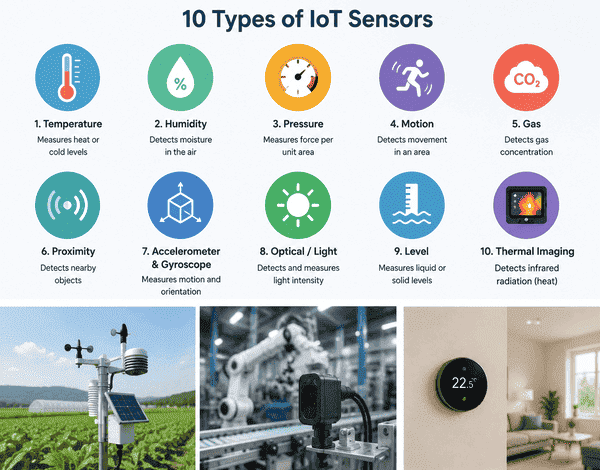
The ten most widely deployed types of IoT sensors each address a distinct physical phenomenon. The sections below describe how each one works, and the summary table at the end of this section maps every sensor type to its real-world applications at a glance.
1. Temperature Sensors
Temperature sensors are the most common IoT sensors deployed globally. They measure thermal energy and report changes continuously. Thermocouple, RTD (resistance temperature detector), and thermistor variants each suit different accuracy and range requirements. From ?200°C cryogenic storage to 1,700°C furnace monitoring, there is a temperature sensor engineered for virtually every environment.
2. Humidity Sensors
Humidity sensors measure the concentration of water vapor in air. They are typically paired with temperature sensors since moisture and heat together determine comfort, safety, and material integrity. Capacitive and resistive types are the most prevalent in IoT deployments, valued for their small footprint and low power consumption.
3. Pressure Sensors
Pressure sensors measure the force exerted per unit area in gases or liquids. Piezoresistive and capacitive pressure sensors dominate the IoT market. They are essential wherever system pressure must be kept within safe limits or where changes in pressure signal a critical condition such as a pipeline leak or a blocked filter.
4. Motion Sensors (PIR and Microwave)
Motion sensors detect movement within a defined area. Passive infrared (PIR) sensors detect changes in heat signatures caused by moving bodies. Microwave sensors emit pulses and measure the reflection shift caused by moving objects. Both are valued for their low power draw, reliability, and long operational life.
5. Gas Sensors
Gas sensors detect the presence and concentration of specific gases in the environment. Electrochemical, metal oxide semiconductor (MOS), and photoionization (PID) variants each target different gas families. As air quality and workplace safety regulations tighten worldwide, gas sensors have become one of the fastest-growing IoT sensor categories.
6. Proximity Sensors
Proximity sensors detect the presence or absence of objects without physical contact, using infrared, ultrasonic, or capacitive methods. They are workhorses of industrial automation and a key component in contactless user interfaces, enabling machines to react to their surroundings without mechanical switches that wear out over time.
7. Accelerometers and Gyroscopes
Accelerometers measure changes in velocity along one or more axes; gyroscopes measure rotational rate. Used together in inertial measurement units (IMUs), they provide a complete picture of an object’s motion and orientation. MEMS (micro-electromechanical systems) technology has made these sensors tiny, low-cost, and low-power, enabling mass-market use in wearables and smartphones.
8. Optical / Light Sensors
Optical sensors convert light into electrical signals. They encompass photodiodes, phototransistors, LiDAR units, and image sensors. Their range spans simple ambient-light detection to sophisticated machine-vision systems capable of reading submillimeter defects at high speed on a production line.
9. Level Sensors
Level sensors measure the amount of liquid or bulk solid material in tanks, silos, and containers. Ultrasonic, radar, and float-based variants are common. Accurate level data underpins supply chain reliability, overflow prevention, and automated replenishment in industries where running dry or overflowing carries significant cost or safety risk.
10. Thermal Imaging Sensors
Thermal imaging sensors detect infrared radiation emitted by objects and render it as a heat map. Unlike visible-light cameras, they operate in total darkness and see through smoke, dust, and light fog, making them invaluable in safety-critical and predictive maintenance applications.
IoT Sensor Types at a Glance: Key Applications Summary
| Sensor Type | How It Works | Key Applications |
|---|---|---|
| Temperature Sensor | Measures thermal energy using thermocouples, RTDs, or thermistors | Cold-chain logistics, HVAC systems, data centers, smart buildings |
| Humidity Sensor | Detects moisture levels in air using capacitive or resistive sensing | Precision agriculture, cleanrooms, museums, HVAC control |
| Pressure Sensor | Measures force per unit area in gases or liquids using piezoresistive technology | Automotive systems, hydraulics, medical devices, pipeline monitoring |
| Motion Sensor (PIR / Microwave) | Detects movement via infrared heat changes or microwave reflection | Security systems, smart buildings, retail analytics, elder care monitoring |
| Gas Sensor | Measures gas concentration using MOS, electrochemical, or PID sensing | Industrial safety, air quality monitoring, smart homes, agriculture |
| Proximity Sensor | Detects object presence without contact using IR, ultrasonic, or capacitive methods | Automation systems, smart parking, retail tracking, consumer electronics |
| Accelerometer & Gyroscope | Measures acceleration and rotation using MEMS-based IMU technology | Wearables, automotive systems, predictive maintenance, robotics |
| Optical / Light Sensor | Converts light into electrical signals using photodiodes or image sensors | Smart lighting, machine vision, autonomous vehicles, medical devices |
| Level Sensor | Measures liquid or solid levels using ultrasonic, radar, or float methods | Water management, oil tanks, agriculture, food production |
| Thermal Imaging Sensor | Detects infrared radiation emitted by objects to create temperature maps | Industrial inspection, security systems, energy audits, medical screening |
How to Choose the Right IoT Sensor for Your Application
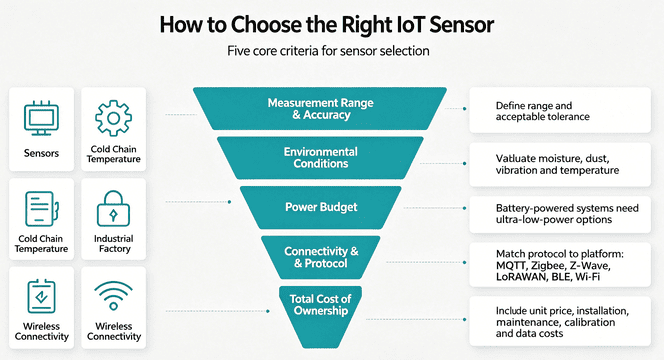
With so many types of IoT sensors available, selection comes down to five core criteria:
Measurement range and accuracy: Define the minimum and maximum values your application will encounter and the tolerance your process can accept. A food cold-chain sensor needs ±0.1°C accuracy; a building HVAC sensor may tolerate ±1°C.
Environmental conditions: Consider exposure to moisture, dust, vibration, chemicals, or extreme temperatures. Industrial-grade IP67/IP68-rated sensors are necessary in harsh environments.
Power budget: Battery-powered remote sensors require ultra-low-power options (e.g., MEMS accelerometers, LoRaWAN-connected units). Mains-powered installations have more flexibility.
Connectivity and protocol: Match the sensor output to your IoT platform. Common protocols include MQTT, Zigbee, Z-Wave, LoRaWAN, BLE, and Wi-Fi, each with different range, bandwidth, and power trade-offs.
Total cost of ownership: Factor in unit price, installation, maintenance, calibration intervals, and data transmission costs over the sensor’s operational lifespan.
The Future of IoT Sensors
IoT sensor technology is advancing on multiple fronts simultaneously. Edge AI is moving inference directly onto sensor nodes, enabling anomaly detection without cloud round-trips. Energy harvesting — capturing ambient vibration, light, or heat to power sensors — is eliminating battery replacement in remote deployments. Multi-parameter sensors that measure temperature, humidity, pressure, and gas in a single compact unit are reducing installation complexity and cost.
5G and Wi-Fi 6 are expanding bandwidth and lowering latency for high-density sensor networks, while standards like Matter are simplifying interoperability across smart home and industrial ecosystems. As manufacturing scales and unit costs continue to fall, expect IoT sensors to penetrate sectors — from aquaculture to space — where deployment was previously cost-prohibitive.
Related Reading: Sensor Technology Future Trends and Full-Industry Application Value
Conclusion
IoT sensors are the sensory layer of every connected system. Whether you need to track temperature across a pharmaceutical supply chain, detect gas leaks on a factory floor, or monitor the structural health of a bridge, the right sensor type makes the difference between reactive incident response and proactive intelligence.
The top IoT sensors — temperature, humidity, pressure, motion, gas, proximity, accelerometer, optical, level, and thermal imaging — each address specific physical phenomena and unlock specific IoT sensor applications. Understanding their strengths, limitations, and ideal use cases is the foundation for building reliable, scalable, and cost-effective IoT solutions.