日本語
日本語
 한국어
한국어

Brass vs Bronze vs Copper: Which Is Best for CNC Machining?
QUICK ANSWER Brass is usually the best choice for fast, economical CNC machining; bronze is better for wear, friction, and demanding service; copper is the clear choice when electrical or thermal conductivity controls the design. The final decision must be made by grade, condition, geometry, and environment rather than color or material family alone. C360 brass, C932 bearing bronze, and C110 copper are useful reference grades, but they are not interchangeable specifications.
This guide compares brass vs bronze vs copper from a CNC perspective, including chip behavior, dimensional control, conductivity, strength, and end use. If the design is already mature, a custom CNC machining service can review the CAD model, drawing, alloy callout, tolerances, and finish as one manufacturing package.
What Is Brass
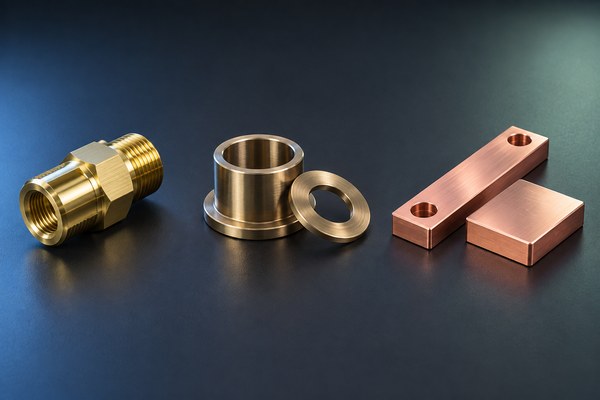
Brass is a copper alloy in which zinc is the main alloying element. Zinc changes copper's color, strength, forming response, conductivity, and cutting behavior. Other additions may improve machinability, corrosion resistance, or hot working. C260 cartridge brass and C360 free-cutting brass therefore should not be quoted as though they were the same stock.
For CNC work, C360 is a common benchmark because it forms short chips, needs relatively low cutting force, and can produce a clean surface at productive cutting parameters. Its lead content improves chip breaking, but leaded material may be restricted in drinking-water, food-contact, medical, or regulated consumer applications. In those cases, specify a compliant low-lead or lead-free grade and expect the machining plan and price to change.
Brass Applications
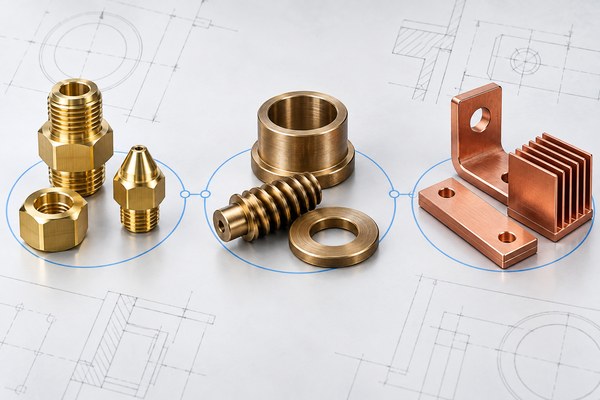
Brass is widely used for threaded fittings, valve bodies, nozzles, fasteners, instrument components, electrical terminals, decorative hardware, and precision turned parts. Its combination of machinability, corrosion resistance, and appearance makes it especially effective for parts with threads, knurls, small bores, and repeated features. Round components such as adapters, sleeves, and connector bodies are natural candidates for CNC turning.
What Is Bronze
Bronze is another copper-alloy family. Tin is the traditional primary addition, but commercial bronzes also include aluminum bronze, silicon bronze, phosphor bronze, and leaded bearing bronze. Each solves a different engineering problem. C932 bearing bronze favors conformability, embedability, and wear performance, while aluminum bronze grades can deliver much higher strength and excellent resistance in marine or industrial environments.
Bronze is generally selected for what happens after machining. Many grades resist galling, carry sliding loads, and survive contaminated or intermittently lubricated service better than copper or general-purpose brass. Machining behavior varies widely: a leaded bearing bronze may cut predictably, while tougher aluminum bronze can raise cutting force, heat, and tool wear. The exact grade therefore belongs on both the CAD-linked drawing and purchase specification.
Bronze Applications
Typical bronze parts include bushings, bearings, thrust washers, worm gears, wear plates, pump components, valve guides, marine hardware, and heavy-duty sleeves.
What Is Copper
Copper is the base metal from which brass and bronze are derived. Commercially pure grades retain high electrical and thermal conductivity, along with useful ductility and corrosion resistance. C110 electrolytic tough-pitch copper is common for general conductive parts, while oxygen-free grades such as C101 may be specified for demanding electrical, thermal, or vacuum applications. Tell the supplier the exact designation; pure copper is not a complete material callout.
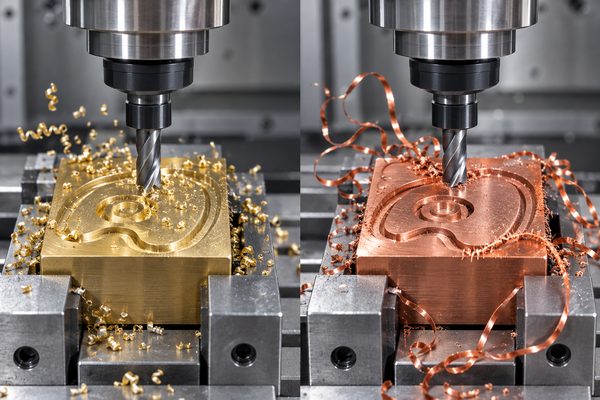
Copper's softness can be misleading. It is easy to deform but often difficult to cut cleanly because the material may smear, create long stringy chips, or build up on the cutting edge. Sharp, polished tools, stable workholding, controlled engagement, and reliable chip evacuation help protect the surface and dimensions. Thin walls and small features need special attention because clamping pressure and cutting heat can move the part. Complex pockets, contact faces, and heat-management geometry may be produced through 3-axis to 5-axis CNC milling when tool access and workholding are planned early.
Copper Applications
Copper is preferred for busbars, high-current contacts, terminals, heat spreaders, heat sinks, electrodes, induction components, and thermal transfer hardware. It can also be used for seals, gaskets, and architectural details. For a machined part, choose copper when current capacity or heat flow has measurable priority over wear resistance and cycle time.
Brass Bronze and Copper Material Differences
The table uses representative CNC grades to show directionally useful differences. Values are typical or approximate, not guaranteed design allowables. Product form, temper, casting method, heat treatment, and supplier specification can shift the result substantially. Confirm the applicable material certificate and governing standard before release.
| CNC factor | C360 brass | C932 bearing bronze | C110 copper |
|---|---|---|---|
| Primary composition | Copper and zinc with lead for chip control | Copper tin lead and zinc bearing alloy | At least about 99.9 percent copper |
| Machinability index | 100 reference benchmark | About 70 | About 20 |
| Electrical conductivity | Roughly 26 percent IACS | Roughly 12 to 15 percent IACS | About 100 percent IACS |
| Strength profile | Moderate and grade dependent | Good compressive and wear performance | Lower strength but high ductility |
| Chip behavior | Short chips and easy control | Grade dependent and often manageable | Long gummy chips are common |
| Best fit | High-rate precision parts and fittings | Bushings bearings and wear parts | Electrical and thermal parts |
| Main caution | Lead rules and dezincification environment | Bronze family varies widely | Burrs distortion and longer cycle time |
Electrical Conductivity Differences
Copper wins decisively when the part must carry current or transfer heat. The International Annealed Copper Standard treats annealed copper as the 100 percent IACS reference, and high-conductivity copper grades cluster near that level. Alloying copper with zinc, tin, aluminum, lead, or other elements disrupts electron flow, so brass and bronze conduct less well. A conductive brass terminal may still be the better total design if it machines faster, holds threads better, or permits a larger cross-section at acceptable resistance.
Do not select from conductivity percentages alone. Check current, allowable temperature rise, cross-sectional area, joint resistance, contact force, plating, duty cycle, and ambient conditions. For thermal parts, include interface flatness, surface roughness, airflow or coolant conditions, and the complete heat path.
Strength and Wear Differences
There is no universal rule that every bronze is stronger than every brass. Copper is usually the softest of the three reference materials, C360 brass provides useful moderate strength with excellent machinability, and C932 bronze is valued more for bearing behavior than for record tensile strength. Aluminum bronze and some phosphor bronzes can be much stronger than those reference grades. Temper and manufacturing route can also change yield strength and hardness within the same alloy designation.
For a static bracket, compare certified yield strength and stiffness. For a bushing, review bearing pressure, sliding speed, lubrication, shaft hardness, clearance, and operating temperature. For a threaded fitting, consider proof load, sealing method, corrosion exposure, and assembly cycles. Strength is a system requirement, not a single row in a material table.
CNC Machinability and Cost
Machinability changes more than spindle speed. It affects cycle time, chip evacuation, tool life, burr removal, dimensional stability, inspection frequency, and scrap risk. Free-cutting brass often produces the lowest machining cost for a complex small part because chips break cleanly and tools can run productively. Bronze cost depends heavily on grade and stock form. Copper may require sharper tools, more conservative finishing passes, and closer control of burrs and distortion.
Raw material price is therefore only one part of the quoted price. Geometry may dominate: deep narrow pockets, thin walls, tiny holes, sharp internal corners, tight concentricity, and multiple setups add time in any of the three metals. If the part is still being validated, use a rapid prototyping workflow to compare candidate grades using the same critical dimensions and test conditions.
How to Choose the Right Material
Start with the part's dominant failure mode, then confirm the exact grade.
Choose copper when electrical or thermal conductivity is the non-negotiable requirement. Consider C110 for general conductive components and an oxygen-free grade when the application or specification demands it.
Choose brass when productivity, fine detail, threads, appearance, and cost are the priority. C360 is a strong CNC default where lead is allowed; use a compliant alternative where regulation or fluid contact requires it.
Choose bronze when sliding wear, low friction, galling resistance, or marine and industrial durability drive the design. Match bearing bronze, phosphor bronze, silicon bronze, or aluminum bronze to the actual load and environment.
Request two material quotes when requirements compete. Comparing the same geometry in two exact grades reveals the real difference in stock cost, cycle time, finishing, and lead time.
Material Selection Checklist
Define the required electrical and thermal performance with measurable limits.
Identify static load, wear, corrosion, temperature, and expected service life.
Specify alloy designation, temper, product form, and any compliance requirement.
Mark only function-critical tolerances, surface roughness, and inspection points.
Confirm plating, polishing, passivation, or protective coating compatibility.
Review stock availability, quantity, traceability, and material certification needs.
Industrial Metal Machining with PCBgogo
PCBgogo supports custom CNC milling, CNC turning, and mill-turn machining for prototypes and production parts in metals including brass and copper. A useful request for quote includes a 3D CAD file, a controlled 2D drawing, the exact alloy and condition, quantity, finish, critical tolerances, inspection requirements, and delivery target. For bronze, confirm grade and stock availability during engineering review rather than entering only a generic family name.
The best quotation is not simply the lowest number. It should reflect tool access, workholding, tolerance risk, deburring, finishing, and verification. Upload the complete package through the CNC machining quote page so the manufacturing review can compare the material requirement with the actual geometry. If appearance or protection matters, define the target surface and review the available CNC surface finish options before production.
PCBgogo - Precision Custom CNC Machining
Save time and money with reliable CNC milling & turning. Get tight?tolerance custom parts, streamlined sourcing, and consistent production quality for your projects.
Get a Free Quote >
Summary
The practical brass vs bronze vs copper decision is straightforward once the primary requirement is clear. Copper provides the best conductivity but is usually the most demanding to machine cleanly. Brass, especially a free-cutting grade, offers the best overall machinability and is often the economical choice for detailed fittings and turned parts. Bronze earns its place in bearings, bushings, and wear components where friction and service life dominate. Specify the exact grade, validate its condition and compliance, and let the drawing communicate the features that truly control function.
Frequently Asked Questions
Is brass or bronze easier to CNC machine
Free-cutting brass such as C360 is generally easier and faster to machine than most bronze grades. Bronze machinability varies widely, so compare exact alloys rather than family names.
Which is strongest brass bronze or copper
It depends on grade and condition. Pure copper is usually softer, while many brasses offer moderate strength and some aluminum or phosphor bronzes provide much higher strength. Use certified values for the specified product form.
Which metal has the best electrical conductivity
Copper. C110 and oxygen-free copper grades retain conductivity close to the IACS reference. Brass and bronze trade conductivity for other properties such as machinability, strength, or wear resistance.
Is bronze better than brass for bushings
Often yes. Bearing bronzes are designed for sliding contact, wear resistance, and resistance to seizure. The correct choice still depends on load, speed, lubrication, shaft material, clearance, and temperature.
Why is copper difficult to machine
Copper can smear instead of forming short chips. Long chips, built-up edge, burrs, heat, and part distortion can reduce consistency. Sharp polished tools, rigid workholding, and good chip evacuation are important.
Can brass bronze and copper be plated or polished
Yes, many grades accept polishing and plating, but pretreatment, alloy chemistry, surface condition, and service environment affect the result. State cosmetic areas, masking, coating thickness, and adhesion requirements on the drawing.
What files are needed for a CNC quote
Provide a 3D CAD model and a revision-controlled 2D drawing when tolerances, threads, surface finish, or inspection requirements matter. Include alloy, condition, quantity, finish, certifications, and any approved substitute.