日本語
日本語
 한국어
한국어

What to Look for in a Reliable PCB Shop Before Placing an Order
As a PCB manufacturing engineer who has worked with prototype and production projects for years, I have seen many customers choose suppliers based only on price. But price is the easiest number to compare and, in my experience, the least reliable predictor of whether a project goes smoothly. A reliable PCB shop is not just about low cost — it's about manufacturing capability, engineering support, quality control, and the ability to deliver consistent results, order after order.
Before we get into what separates a dependable supplier from a risky one, it helps to understand what actually happens between finishing a design and holding a working board in your hand. That process is where most of the risk in a project actually lives — and it's why the choice of shop matters so much.
From Schematic to Finished Board: A Quick Look at the Process
A finished, populated PCB goes through several distinct stages, and each one is a place where a weak supplier can introduce problems that don't show up until much later — sometimes not until the product is in a customer's hands.
Schematic Design
This is where the circuit is defined electrically — components, connections, and signal paths — independent of physical layout. Errors here (wrong footprints, missing decoupling, incorrect pin mapping) are the cheapest to fix, but only if they're caught before fabrication.
Related Reading: How to Convert Schematic to Gerber Files for PCB Manufacturing?
PCB Layout
The schematic is translated into a physical board: trace routing, layer stack-up, component placement, and impedance control for high-speed signals. This stage determines whether the board can actually be manufactured within a shop's tolerance capability, so layout and fabrication capability need to be considered together, not separately.
Component Procurement
Parts are sourced according to the bill of materials. This step carries more risk than people expect — long lead times, part obsolescence, and counterfeit or gray-market components can all derail a project before assembly even starts.
PCB Fabrication
The bare board is manufactured: copper etching, drilling, plating, solder mask, silkscreen, and surface finish. Tolerances and process consistency are set here, and they're very difficult to correct afterward.
PCB Assembly (PCBA)
Components are mounted onto the fabricated board using SMT, through-hole, or a mixed process, followed by reflow or wave soldering.
Inspection and Testing
Finished boards go through visual inspection, automated optical inspection (AOI), and — for components like BGAs where solder joints are hidden from view — X-ray inspection, before the board is considered ready to ship.
Why Choosing a Reliable PCB Shop Is So Important
Every one of the stages above is a handoff point, and every handoff point is a place where quality can quietly slip if the supplier isn't disciplined about their process. A board that looks fine on a datasheet can still fail in the field if tolerances drift across a production run, if a counterfeit part slips through, or if a hidden solder joint under a BGA was never actually inspected.
This is why the choice of PCB shop is not a minor procurement decision — it's a technical risk decision. A weak supplier doesn't usually fail obviously; they fail quietly, in the form of intermittent field failures, yield problems on production runs, or delays that cascade into a missed product launch. A reliable shop, on the other hand, becomes an extension of your engineering process rather than just a vendor you place orders with. Over a multi-year relationship, that reliability compounds — fewer redesigns, fewer returns, and far less time spent troubleshooting problems that were actually manufacturing issues in disguise.
What to Check Before You Hand Your Order to a Supplier
Based on the process above, here is what I actually verify before committing a design to a new supplier — whether it's a one-off prototype or a production run of thousands.
Minimum order quantity and true small-batch capability. Can they comfortably produce 1–2 boards at a reasonable price for prototyping, or do they quietly push you toward panelized minimums once you ask for real numbers?
Whether the quoted lead time is real. Is the delivery date given at the time of quoting accurate, or is it a "standard" estimate that tends to slip once layer count or panel setup comes into play?
Manufacturing tolerance and process capability (Cpk), not just the spec sheet number. A stated tolerance means little without data showing it holds consistently across many boards, not just a best-case sample.
Materials and surface finish options. Do they support the board type you actually need — rigid, flex, or metal-core — and the finish your design calls for (HASL, ENIG, OSP, etc.)?
Assembly capability, not just fabrication. Bare-board fabrication and assembly are different skill sets. If you need populated boards, ask specifically about SMT, through-hole, and mixed-assembly capability, not just fab tolerances.
Component sourcing and traceability. Who is sourcing the parts, and can they trace them? Counterfeit or gray-market components are a real cause of field failures that get mistaken for design problems.
Inspection methods, described specifically. "We do QC" isn't an answer. Ask whether they run visual inspection, AOI, and X-ray inspection for BGA packages — the last one is the only reliable way to verify hidden solder joints.
Communication and engineering support. When a design file has an ambiguity or a DFM issue, does the supplier flag it and ask, or do they run the job as-is and let you find the problem later?
Certifications backing up their claims. ISO 9001 for quality management, UL certification for safety, and RoHS/REACH for environmental compliance are the baseline. For automotive or medical work, ask specifically about IATF 16949 or ISO 13485.
Who actually owns the production line. Some "manufacturers" are really brokers who outsource your job to a third-party factory you'll never have visibility into. Ask directly whether they run their own production line or subcontract it out.
Why PCBgogo Holds Up Against This Checklist
I've evaluated PCBgogo against every point above, and here's where they consistently stand out in my experience:
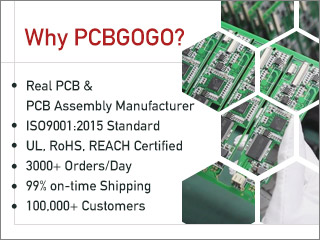
Over a decade of manufacturing experience. PCBgogo has specialized in PCB fabrication and assembly for more than 10 years, which shows in how consistently their process holds up across both prototype and production orders — this isn't a reseller learning as they go.
Their own factories, not outsourced production. PCBgogo runs its own manufacturing facilities rather than brokering orders to third parties, so there's no handoff risk between a quoting company and the actual production line — the people quoting your job are accountable for the people building it.
Certifications that back up the quality claims. PCBgogo's facilities hold ISO 9001:2015 quality management certification along with UL, RoHS, and REACH compliance, with IATF 16949 for automotive projects. With extensive industry experience, PCBgogo provides PCB assembly services across a wide range of sectors, including automotive, security, mining, medical, and entertainment industries.
True 1-piece minimum order quantity. You can prototype with 1–2 boards without an inflated per-unit price, which matters during early design iteration.
Accurate lead times and 24-hour expedited service. Delivery dates are provided at the time of quoting, and PCBA prototype orders are typically completed in 3–4 days, with 24-hour expedited service available when a deadline is tight.
Tight, verifiable tolerances. ±0.035mm (down to ±0.025mm) with a process capability of Cpk ≥ 1.0 at 3σ, across rigid, flex, and metal-core PCBs, with HASL, ENIG, and OSP finish options.
Full fabrication and assembly under one roof. SMT, DIP, and mixed assembly are handled directly, along with component sourcing — including partial kitting and full consignment arrangements when you want to supply your own critical parts.
Layered inspection, including X-ray for BGA. Every order goes through visual inspection and AOI, with X-ray inspection added for BGA packages, so hidden solder joints are actually verified rather than assumed good.
Engineering review on every order. Designs are checked by PCBgogo's own engineers before production, catching DFM issues before they become scrapped boards.
Responsive after-sales support. Round-the-clock customer service and a straightforward policy for resolving quality issues mean that when something does come up — a shipping question, a DFM concern, a reorder — it gets handled instead of stalled, which matters more than people expect once a board is already in production.
Summary
A PCB project succeeds or fails long before the board ever reaches final testing — it's decided by the sourcing, tolerances, assembly process, and inspection standards of the shop you choose. Price is easy to compare; manufacturing discipline is not, and it's the discipline that actually determines whether your boards work the first time and every time after that.
If you're evaluating suppliers for an upcoming project, run them through the checklist above before you commit an order. PCBgogo's combination of in-house manufacturing, transparent lead times, tight tolerances, and layered inspection makes it a reliable partner for PCB projects of all sizes. Contact PCBgogo today to discuss your requirements and discover how their manufacturing capabilities can support your next PCB design and production needs.
FAQ
What is the minimum order quantity for a PCB order?
Many shops require panelized minimums, but a genuinely prototype-friendly supplier should accept orders starting at 1 piece without heavily inflating the per-unit cost. PCBgogo supports 1-piece minimum orders.
How long does a PCB prototype typically take to manufacture?
Standard prototype turnaround varies by supplier and board complexity, but PCBA prototype orders commonly take 3–4 days. Suppliers offering 24-hour expedited service can accommodate tighter deadlines when needed.
What's the difference between PCB fabrication and PCB assembly?
Fabrication is the process of manufacturing the bare board itself — etching, drilling, plating, and solder mask. Assembly (PCBA) is mounting and soldering components onto that finished board. Some suppliers only handle one of the two, so it's worth confirming both capabilities exist under one roof if you need populated boards.
Why is X-ray inspection important for BGA components?
BGA (Ball Grid Array) packages have their solder joints hidden underneath the component body, making them impossible to check with visual inspection or standard AOI. X-ray inspection is the only reliable way to confirm those hidden joints are properly formed before the board ships.
How can I verify a supplier's manufacturing tolerance claims?
Ask for their process capability index (Cpk) rather than just their stated tolerance. A tolerance spec describes a target; Cpk data shows how consistently that target is actually met across a real production run.