日本語
 한국어

How Is PCB Assembly Cost Calculated? A Practical Guide
QUICK ANSWER For standard PCB assembly, a prototype run of 1–5 boards typically costs about $30 to $50 per order. For simple to moderately complex PCBA runs of 10–100 units, assembly costs generally range from $10 to $50 per board. Complex prototypes, expensive ICs, double-sided SMT, BGA or QFN packages, through-hole assembly, and functional testing can increase the cost to $50 to $200 or more per board, while orders of more than 1,000 units may fall to $5 to $20 per board. Actual pricing depends primarily on component costs, board complexity, assembly method, testing requirements, and how setup fees are allocated across the order. These estimates exclude high-cost specialty components, custom test fixtures, and shipping.
PCB assembly quotes can vary widely because setup, components, inspection, and testing are not always priced the same way. A practical estimate starts with complete production files and a clear cost model:
Total cost C = component cost + labor cost + indirect cost + material cost + testing and inspection cost + quality assurance cost
Separating fixed setup charges from per-board expenses makes it easier to compare quotes and understand how design, assembly method, production volume, and testing affect the final PCB assembly cost.
What Is a PCBA
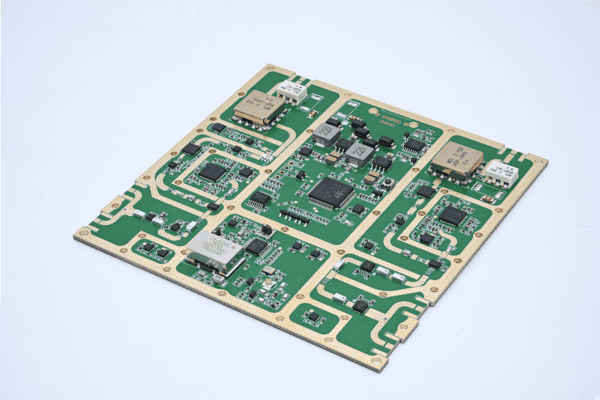
A printed circuit board assembly, or PCBA, is a fabricated PCB with electronic components mounted and soldered in place. PCB fabrication creates the laminate, copper circuitry, plated holes, solder mask, legend, and surface finish. Assembly adds solder paste printing, component placement, reflow, through-hole insertion, soldering, inspection, and testing.
Main PCBA Assembly Technologies and Processes
PCBA production uses surface-mount technology, through-hole technology, or a mixed process, and each route creates a different assembly pricing structure. The correct method follows the package types, mechanical loads, thermal limits, and production volume defined by the design.
| Method | Typical process | Best fit | Cost effect |
|---|---|---|---|
| SMT | Stencil printing, 3D SPI, pick and place, reflow, AOI | Dense boards and automated production | Higher setup cost but low repeat placement labor |
| THT | Lead insertion, wave or selective soldering, hand touch-up | Connectors, transformers, high mechanical load | More drilling and manual handling; often higher per joint |
| Mixed | SMT first, followed by THT insertion and soldering | Most industrial and power assemblies | Combines setup, automated placement, and manual operations |
Double-sided SMT also affects the unit assembly price because the board needs a second print, placement, and reflow cycle. BGAs, QFNs, and other bottom-terminated packages may add X-ray inspection because AOI cannot see hidden joints. A process-based quote should therefore describe each production pass and each required inspection gate.
How PCB Assembly Pricing Changes by Board Technology and Volume
PCB assembly pricing should be calculated from the order configuration rather than a universal price range. Three views are useful: the cost of one completed board, the selected assembly technology, and the number of boards over which fixed charges are spread.
1. Cost Per Completed Board
For one board, calculate all order-level charges plus all unit-level charges, then divide by the expected accepted quantity. A simple board can still have a high PCB assembly cost per board when stencil, programming, and first-article work are spread across only one or five pieces. The physical board area matters, but component count, unique BOM lines, package mix, and test time usually provide a better assembly workload estimate.
2. Assembly Technology
SMT generally offers the lowest repeat labor for packages that can be placed automatically. THT cost rises with insertion, lead preparation, selective or hand soldering, and visual verification. Mixed assembly often gives the best product design, but its total cost includes both automated and manual process steps. Treat BGA X-ray, press-fit insertion, odd-form placement, wire attachment, and conformal coating as separate operations rather than hiding them in a single rate.
3. Production Volume
| Build stage | What dominates | How to budget |
|---|---|---|
| 1 to 10 prototypes | Setup, engineering review, first article, component pack quantities | Expect a high unit cost and focus on design learning |
| 10 to 100 boards | BOM spend plus setup divided across the batch | Compare alternate parts and panel efficiency |
| 100 to 1,000 boards | Components, line time, yield, test throughput | Validate fixtures and lock approved substitutions |
| 1,000 plus boards | Material pricing, cycle time, process capability, supply continuity | Use a controlled pilot before the production release |
The table shows the direction of change, not a universal price schedule. Unit cost may stop falling when a larger lot requires extra fixtures, longer component lead times, more test stations, or a second production shift. Request price breaks only after the process scope is stable.
What Factors Affect PCB Assembly Cost?
The main PCB assembly cost drivers are material choice, board geometry, component and process complexity, production conditions, and test coverage. Each factor should be connected to a manufacturing operation so the buyer can decide whether it adds necessary value.
1. Materials Including Substrate Copper and Solder Paste
Substrate selection affects the bare PCB portion of the total PCBA budget. The following ranges are indicative raw-material prices, not finished PCB or PCBA prices. Actual costs vary with thickness, copper cladding, grade, supplier, and order volume.
FR-4: Approximately $6–$15 per m2 for standard raw laminate. FR-4 is the most economical choice for consumer electronics, industrial controls, and other general-purpose products. High-Tg FR-4 and low-loss FR-4 grades typically cost more.
Ceramic: Basic alumina substrate material may start at approximately $60–$120 per m2, while aluminum nitride and finished metallized ceramic boards can cost considerably more. Ceramic is mainly used for high-power, high-temperature, and high-reliability applications.
Polyimide: Approximately $18–$35 per m2 for basic polyimide film or laminate. It is commonly used in flexible and rigid-flex circuits because it tolerates bending and higher operating temperatures. Finished flex PCBs cost more because they require coverlay, controlled lamination, and specialized handling.
PTFE: Basic PTFE laminate may cost approximately $25–$45 per m2, while specialized RF-grade or ceramic-filled PTFE materials can reach $180–$280 per m2. PTFE is generally selected for microwave, radar, satellite, and other low-loss high-frequency applications.
Copper thickness: Standard copper weights are usually the most economical. Heavy copper requires more material and tighter etching and plating control, increasing bare-board manufacturing costs and affecting heat distribution during soldering.
Solder paste: Standard lead-free paste is normally included in conventional SMT processing. Special alloys, low-temperature paste, water-soluble flux, or project-specific cleaning requirements may add material, storage, line-changeover, and cleaning costs.
2. Size Thickness and Complexity
Board size affects panel utilization and the number of assemblies that pass through a line per panel. Thickness, warpage, edge clearance, and component overhang affect conveyance and fixturing. Fine pitch, bottom-terminated packages, densely packed components, double-sided placement, heavy thermal masses, and mixed component heights increase process engineering and inspection effort even when the board outline stays small.
3. Component Types and Assembly Technology
The BOM often contributes the largest share of total PCBA spend, but purchase price is only part of the picture. Unique part numbers create feeder setup and material control work. Moisture-sensitive devices may require dry storage or baking. BGAs and QFNs need controlled paste deposition and hidden-joint inspection, while press-fit connectors, large transformers, and nonstandard parts may require dedicated tooling or manual operations.
4. Production Quantity and Lead Time
Volume spreads fixed charges, but only when the design and BOM remain stable. An urgent schedule can increase the assembly price through expedited component purchasing, priority line scheduling, overtime, partial shipments, and reduced opportunity to combine material orders. Provide an annual forecast separately from the immediate release quantity so the manufacturer can price the current build without assuming uncommitted demand.
5. Testing and Quality Control
Testing increases PCB assembly cost through equipment time, programming, labor, and test fixtures, but the cost varies by method and production volume. 3D SPI and AOI are usually integrated into SMT production, while X-ray inspection adds cost when hidden joints under packages such as BGA and QFN must be examined. Flying probe testing avoids fixture costs and is economical for prototypes, whereas in-circuit testing requires a higher upfront fixture cost but lowers testing time per board in volume production. Functional testing adds further setup and operating time. Selecting inspection methods according to actual defect risk helps control PCB assembly cost without creating avoidable rework or field failures.
Detailed Cost Calculation With a Practical Example
A clear cost breakdown makes PCB assembly quotes easier to evaluate and compare. Consider a 100-unit mixed-technology controller board with a finalized BOM, 95 SMT placements per board, six manually inserted through-hole components, standard AOI, targeted X-ray inspection for hidden joints, and basic functional testing. The example below shows how these costs combine into an estimated price per board.
| Cost element | Example amount | Calculation basis |
|---|---|---|
| Components | $720 | BOM extended cost including normal purchasing allowance |
| Bare PCBs and panelization | $160 | 100 usable boards from the planned panel |
| Stencil setup and programming | $120 | Order-level non-recurring work |
| SMT placement and reflow | $180 | 9,500 placements plus line processing |
| THT insertion and soldering | $90 | 600 through-hole components |
| Inspection and functional test | $80 | SPI, AOI, targeted X-ray, and test time |
| Quality records packaging and overhead | $50 | Lot control, final handling, and indirect cost |
| Estimated total | $1,400 | Sum of all listed elements |
| Estimated cost per board | $14.00 | $1,400 divided by 100 accepted boards |
The same project built as five boards would not cost one-twentieth of $1,400 because the $120 setup charge remains and components may have minimum pack quantities. At 500 boards, setup falls to $0.24 per board, but the component, bare-board, placement, and testing totals rise with quantity. For a realistic quote comparison, ask every supplier to identify assumptions for yield, excess components, accepted quantity, tooling ownership, test fixtures, and shipping.
How to Reduce PCB Assembly Cost Without Increasing Risk
The safest PCB assembly cost reductions remove avoidable work before production rather than deleting inspection after the board is built. The following actions change the cost driver itself.
Release clean manufacturing data. Keep Gerber or ODB++ data, BOM, centroid coordinates, assembly drawings, polarity marks, and revision identifiers consistent. A complete package reduces engineering clarification and prevents program rework.
Reduce unnecessary unique parts. Reuse resistor and capacitor values where the circuit allows, and specify manufacturer part numbers with approved alternates. Fewer unique BOM lines reduce purchasing and feeder setup effort.
Design for automated placement. Use SMT packages when the electrical and mechanical requirements permit. Reserve THT for connectors, high-load parts, or components that genuinely need lead-through-board retention.
Improve panel and edge design. Provide suitable rails, fiducials, tooling holes, breakaway features, and component-to-edge clearance. Efficient panels increase line throughput and reduce handling.
Plan test access early. Add accessible test points and define the pass criteria before quoting. A clear test plan prevents late fixture redesign and ambiguous troubleshooting.
Avoid artificial rush orders. Freeze the BOM, approve substitutes, and order long-lead components before the assembly slot. Schedule pressure often costs more than the line labor it is meant to accelerate.
Do not reduce PCB assembly cost by removing X-ray from a BGA assembly or by skipping first-article verification on a new revision. A better approach is risk-based coverage: inspect the feature with the method that can actually observe its failure mode, and avoid redundant checks that do not add evidence.
PCBgogo Factory Direct Pricing and In-Process Inspection
A reliable manufacturing partner controls both the price model and the process that produces the board. PCBgogo provides factory-direct PCB fabrication and assembly, removing a broker layer from quotation and production communication. Customers can submit the fabrication files, BOM, centroid file, drawings, and test requirements as one package, which makes PCB assembly cost easier to trace to actual materials and operations.
PCBgogo integrates inspection into production instead of relying on a single final check. Incoming quality control screens boards and components before line release. X-ray component counting can verify reel quantities where required, first-article checks confirm the setup, and 3D SPI measures solder paste before placement. AOI examines visible placement and solder features after assembly, while X-ray is used for hidden joints under BGA, QFN, and similar packages.
| Control point | What it checks | How it protects total cost |
|---|---|---|
| Incoming inspection | Material identity, condition, and component readiness | Stops unsuitable input before value is added |
| X-ray component counting | Reel quantity where the project requires verification | Reduces shortage and line-interruption risk |
| First-article inspection | BOM value, orientation, placement, and setup | Contains programming errors before batch production |
| 3D SPI | Paste height, area, volume, and offset | Finds printing defects before placement and reflow |
| AOI | Visible presence, polarity, placement, and solder conditions | Detects repeatable defects within the process |
| X-ray inspection | Hidden solder joints and void patterns | Provides evidence where optical inspection has no line of sight |
Early detection does not make inspection free, but it lowers the chance that a basic printing or placement issue reaches functional test, rework, or field use. That is the practical connection between quality control and PCB assembly cost: defects are less expensive to correct near the process step that created them.
PCBgogo - Reliable, High-Quality PCB Manufacturing
PCBgogo is a one-stop PCB and PCBA manufacturing factory, helping you save time and costs while ensuring consistent, reliable quality.
Get a Free Quote >
Conclusion
PCB assembly cost becomes manageable when fixed charges, unit charges, component risk, process complexity, and test coverage are shown separately. The best quote is the one that explains what will be built, inspected, tested, and accepted, not simply the smallest number in the total column.
PCBgogo provides cost-effective PCB fabrication and assembly with factory-direct pricing and inspection integrated throughout manufacturing. Send your Gerber or ODB++ files, BOM, centroid data, assembly notes, quantity, and test requirements to receive a project-specific PCBA review and quotation.
Frequently Asked Questions
How Much Does PCB Assembly Cost Per Board
PCB assembly cost per board equals the total order cost divided by the accepted quantity. The result depends on the BOM, bare PCB, setup, placements, manual operations, inspection, testing, and overhead, so a responsible supplier cannot quote accurately from board dimensions alone.
Why Is Prototype PCB Assembly More Expensive Per Board
Prototype PCB assembly cost is higher because stencil, programming, feeder setup, engineering review, and first-article work are divided across very few boards. Small orders may also require full component pack purchases even when only a few pieces are consumed.
Does SMT Always Cost Less Than Through Hole Assembly
SMT normally has lower repeat labor when machines can place standard packages, but total PCB assembly cost still depends on setup, package complexity, board sides, and inspection. THT remains appropriate where connectors or heavy components need stronger mechanical retention.
Which Files Are Needed for an Accurate PCBA Quote
Provide fabrication data, a BOM with manufacturer part numbers, centroid or pick-and-place data, assembly drawings, quantity, acceptable substitutes, and test requirements. Add schematics and functional test instructions when they help the manufacturer validate polarity, net behavior, or acceptance criteria.
Can Inspection Lower the Total PCB Assembly Cost
Yes, when inspection is placed where it can prevent or contain a specific defect. SPI can stop a paste-printing problem before placement, first-article inspection can stop a setup error before the batch, and X-ray can find hidden-joint defects that AOI cannot see. The goal is effective coverage, not the maximum number of tests.