日本語
日本語
 한국어
한국어

12 Types of CNC Machines and How to Choose the Right One
QUICK ANSWER The main types of CNC machines are CNC mills, lathes, mill-turn centers, drilling machines, routers, Swiss-type lathes, grinders, waterjet cutters, EDM machines, laser cutters, plasma cutters, and 3D printers. For most precision parts, geometry points to the first choice: use turning for round parts, milling for prismatic parts, and mill-turn machining when one component combines both. Material, tolerance, part size, surface requirements, and production volume then determine the exact machine and setup. If you need a finished part rather than equipment for your own shop, a qualified CNC machining service can select the process from your CAD model and drawing.
What Is CNC Machining
CNC machining is a manufacturing method in which computer numerical control directs a machine movement. A program defines where the tool or workpiece moves, along with spindle speed, feed rate, tool changes, coolant, and other machine functions. Most CNC machining is subtractive: a mill, lathe, drill, grinder, or cutting system removes material until the part reaches its specified shape.
CNC describes the control method, not one specific machine. The category therefore includes equipment as different as a five-axis machining center and a waterjet table. Its practical benefit is repeatability once the process, workholding, tools, and inspection plan are proven. CNC still depends on skilled decisions; automation cannot correct poor fixturing, the wrong toolpath, or an unrealistic tolerance.
Main Components of a CNC Machine
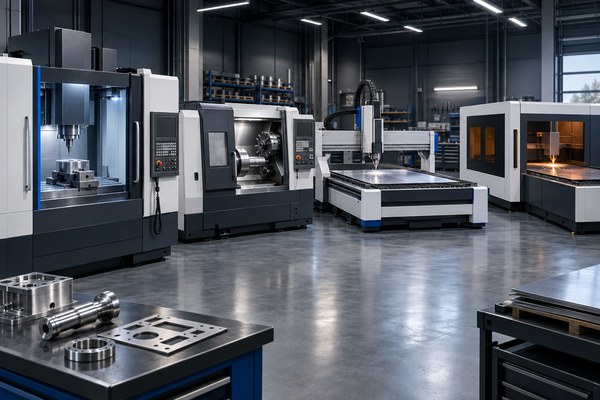
Although the layout varies by machine type, most CNC systems contain the following core components:
Controller: reads the program and coordinates axis movement, spindle functions, tool changes, and auxiliary commands.
Machine structure: includes the bed, column, enclosure, and guideways that provide stiffness and control vibration.
Drive system: uses servo motors, ball screws, linear drives, or rotary drives to position each axis.
Spindle or process head: holds a cutting tool, rotates the workpiece, or delivers the laser, plasma, waterjet, or EDM energy.
Workholding: keeps the stock located and stable through vises, chucks, fixtures, collets, pallets, or vacuum tables.
Feedback and support systems: use encoders, probes, coolant, chip removal, tool changers, and safety interlocks to keep the process controlled.
How a CNC Machine Works
The workflow begins with a 3D CAD model and a 2D drawing for critical features. CAM software converts the geometry into toolpaths, and a post-processor translates them into code matched to the machine. Before cutting, the machinist chooses tools, builds the fixture, sets coordinates and offsets, and verifies clearances.
During the cycle, the controller commands each axis while feedback devices confirm position. Inspection follows at planned stages and at final release. Machine selection matters because it controls tool access, setup count, stiffness, and which features can be completed without re-clamping the part.
Common Types of CNC Machines Compared
| Machine type | Best for | Main strength | Watch for |
|---|---|---|---|
| CNC milling machine | Prismatic parts, pockets, surfaces | Broad capability and multi-axis options | Extra setups for inaccessible faces |
| CNC lathe | Shafts, rings, bushings, threads | Fast, concentric round features | Limited for strongly prismatic shapes |
| Mill-turn center | Parts with round and milled features | Completes more work in one setup | Higher programming and machine cost |
| CNC drilling machine | Repeated holes and hole patterns | Fast, consistent hole production | Narrower process range |
| CNC router | Large sheets, wood, plastics, composites | Large work area and high feed rates | Lower rigidity than a metalworking mill |
| 3D printer | Internal channels and low-volume complex forms | Builds geometry that cutting cannot reach | Different accuracy, material, and finish limits |
| Swiss-type CNC lathe | Long, small-diameter parts | Supports stock close to the cut | Best within a specialized size range |
| CNC grinder | Hardened parts and fine finishes | Excellent size and surface control | Usually a slower finishing process |
| CNC waterjet | Heat-sensitive or thick materials | No heat-affected zone | Kerf taper and slower fine cuts |
| CNC EDM | Hard conductive materials and fine features | Cuts without mechanical force | Conductive materials only and slower removal |
| CNC laser cutter | Thin sheet and detailed profiles | Fast, narrow, clean cuts | Heat input and thickness limits |
| CNC plasma cutter | Conductive metal plate | High cutting speed at economical cost | Wider kerf and rougher edge than laser |
CNC Milling Machines
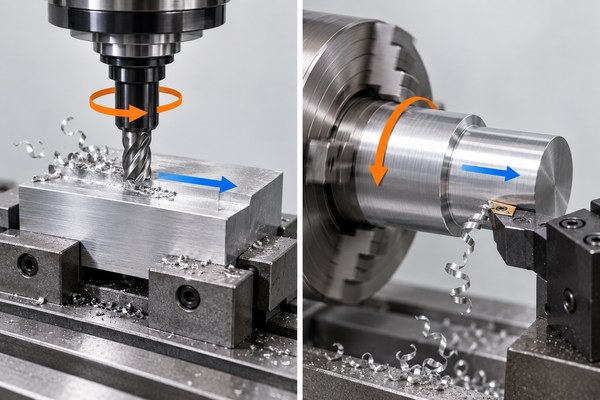
A CNC mill uses a rotating cutter against a stationary or indexed workpiece. Three-axis machines suit plates, brackets, housings, and pockets. Four-axis machines add one rotary axis; five-axis machines add two for angled faces and complex contours. Extra axes can reduce setups, but they demand more capable programming and verification. Compare 3-axis, 4-axis, and 5-axis CNC milling before specifying a high-axis process for a simple part.
CNC Lathes and Turning Centers
A CNC lathe rotates the workpiece while a tool cuts along its length or diameter. It is efficient for shafts, pins, sleeves, bushings, grooves, and threads that share a central axis. Modern CNC turning services may use live tooling and a Y-axis to add flats, cross-holes, and milled features without moving the part to a separate mill.
CNC Mill Turn Machines
Mill-turn centers combine turning and milling, often with live tools and a subspindle. They suit parts with concentric diameters plus off-axis holes, slots, or flats. One clamping can improve alignment and reduce handling, although a simple shaft may cost less on a conventional lathe.
CNC Drilling Machines
Dedicated CNC drilling machines produce repeated holes, tapped features, and countersinks with short cycle times. Many machining centers perform the same operations, so a dedicated drill is most attractive when hole-making throughput outweighs broad milling capability.
CNC Routers and Engraving Machines
CNC routers use high-speed tools over a large bed for wood, foam, plastics, composites, and selected aluminum work. Engraving machines emphasize small tools and fine lettering or shallow reliefs. Routers offer a large work area but generally less stiffness than metalworking mills.
3D Printers
A 3D printer is not a conventional subtractive CNC machine, but it is digitally controlled manufacturing equipment. It builds parts layer by layer and suits internal channels, lattice structures, and early prototypes that are difficult to cut. Machining often provides better fits and surfaces; some printed parts receive CNC finishing.
Swiss Type CNC Lathes
A Swiss-type lathe supports bar stock near the cutting point with a guide bushing, limiting deflection in long, slender parts. It suits small pins, fasteners, and instrument components produced in volume, but offers less value for short, large-diameter workpieces.
CNC Grinding Machines
CNC grinders remove small amounts of material with abrasive wheels. Surface grinders create flat faces, while cylindrical, centerless, and internal grinders control round features or bores. Grinding is often used after heat treatment for fine size and surface control.
CNC Waterjet Cutting Machines
A waterjet uses a high-pressure stream, usually mixed with abrasive for hard materials. It avoids a heat-affected zone and cuts metals, stone, glass, composites, and heat-sensitive stock. Fine cuts are slower, and the process must account for kerf taper.
CNC Electrical Discharge Machines
Electrical discharge machining removes conductive material with controlled sparks. Wire EDM cuts profiles; sinker EDM reproduces an electrode shape in the workpiece. EDM suits hardened alloys, sharp internal details, narrow slots, and delicate features, but it is slower than conventional cutting and requires conductive material.
CNC Laser Cutting Machines
A CNC laser focuses energy to melt or vaporize material along a programmed path. It produces detailed profiles and narrow kerfs at high speed, especially in thin sheet. Material, thickness, assist gas, heat input, and the required edge condition determine suitability.
CNC Plasma Cutting Machines
A plasma cutter sends an ionized gas arc through conductive material. It cuts steel, stainless steel, and aluminum plate quickly and economically. Plasma suits structural fabrication and thicker plate where speed matters more than a narrow kerf or near-finished edge.
How to Choose the Right Type of CNC Machine
Choose the process from the part requirements, then compare machines within that process. The following order prevents expensive capability from becoming a substitute for sound planning:
Start with geometry: Round parts favor turning. Blocks, plates, pockets, and freeform surfaces favor milling. Mixed geometry may justify mill-turn machining. Sheet profiles may fit laser, plasma, waterjet, or routing.
Match the material: Hardness, conductivity, heat sensitivity, abrasiveness, and stock form can rule processes in or out. EDM needs conductive material; plasma needs conductive sheet or plate; waterjet avoids thermal damage.
Define tolerance and finish by feature: Apply tight tolerances only where function requires them. The machine, tool access, setup strategy, and finishing process must all support the requirement. A practical guide to CNC surface finish can help separate measured roughness from later treatments such as anodizing, plating, blasting, or polishing.
Check part size and tool access: Confirm travel, spindle clearance, chuck capacity, bar diameter, table load, tool reach, and the number of faces that need machining.
Estimate setup count and volume: One setup on a more capable machine may reduce alignment risk, while a simpler machine with dedicated fixtures may win at high volume. Compare total process cost, not the hourly rate alone.
Plan inspection before production: Identify datums, critical dimensions, sampling needs, material records, and any first-article report. A tolerance is useful only when the measurement method is clear.
A Trusted Precision CNC Machining Partner
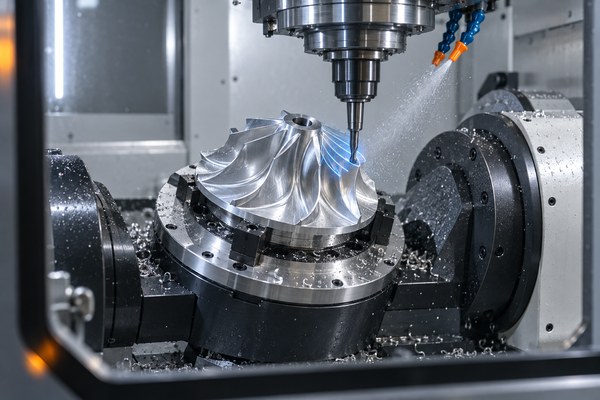
PCBgogo has operated since 2015, bringing more than 10 years of manufacturing experience to projects that need reliable process control and responsive engineering support. Its CNC capabilities include 3-axis, 4-axis, and 5-axis milling, CNC turning, and mill-turn machining for prototypes through production. Available materials include common aluminum, stainless steel, steel, copper, brass, titanium, and engineering plastics, with finishing options selected around the part functional and cosmetic requirements.
The most useful supplier conversation starts with the design rather than a machine name. Send a STEP or IGES model, a drawing for critical tolerances, material and quantity requirements, and notes for finish or inspection. The engineering team can then review tool access, wall thickness, internal radii, fixturing, and the most economical process route. When the requirements are ready, request a CNC machining quote based on the complete manufacturing package.
PCBgogo - Precision Custom CNC Machining
Save time and money with reliable CNC milling & turning. Get tight?tolerance custom parts, streamlined sourcing, and consistent production quality for your projects.
Get a Free Quote >
Conclusion
The right CNC machine is the one that produces the required geometry, tolerance, and finish with the fewest avoidable setups and the most stable process. CNC lathes lead on round parts, mills on prismatic parts, and mill-turn centers on components that combine both. Routers, grinders, EDM, waterjet, laser, plasma, drilling machines, and 3D printers solve more specialized problems. Define the part first, then select the equipment. That approach produces a more accurate quote and a more predictable manufacturing result.
Frequently Asked Questions
What are the most common types of CNC machines
CNC milling machines and CNC lathes are the most common for precision metal and plastic parts. Routers, drilling machines, grinders, EDM, laser, plasma, and waterjet systems serve more specialized materials or geometries.
What is the difference between a CNC mill and a CNC lathe
A CNC mill usually rotates the cutting tool while the workpiece remains fixed or indexed. A CNC lathe rotates the workpiece while a tool cuts it. Mills suit prismatic shapes; lathes suit cylindrical shapes.
Are 3D printers considered CNC machines
They use computer-controlled motion and digital toolpaths, so they are often grouped with CNC equipment. However, a 3D printer adds material layer by layer, while conventional CNC machining removes material.
Is a five-axis CNC machine always more accurate
No. Five-axis motion can reduce setups and improve access, which may protect relationships between features. Final accuracy still depends on machine condition, calibration, tooling, fixturing, temperature, programming, and inspection.
Which CNC machine is best for metal parts
For blocks, plates, housings, and complex surfaces, start with CNC milling. For shafts, pins, rings, and bushings, start with CNC turning. Sheet metal profiles may fit laser, plasma, or waterjet cutting, while hardened conductive parts with fine details may need EDM.
What information is needed for a CNC machining quote
Provide a 3D CAD model, a 2D drawing for critical tolerances and threads, material, quantity, surface finish, and inspection requirements. Naming the function of critical features also helps the manufacturer choose a stable process.