日本語
 한국어

PCB Price Compare for FR-4, Aluminum, RF and Flex Boards
QUICK ANSWER A PCB price compare starts with a simple question: what must the board actually do? Standard FR-4 is usually the lowest-cost rigid option. Aluminum earns its premium when heat must move into a metal base; RF laminates address signal loss; polyimide flex solves a packaging or movement problem. Paying for any of these without a matching requirement rarely improves the product.
PCB material cost comparison at a glance
I checked PCBgogo's public calculator on November 17, 2026 using a 100 × 100 mm board, 100 pieces, two layers, 1.6 mm thickness, 6/6 mil track and spacing, 1 oz finished copper, green solder mask, white silkscreen and leaded HASL. The aluminum options use the calculator's 1.0 mm minimum-hole setting; the other rigid options use its 0.3 mm-and-up setting. The comparison therefore assumes a design with no holes smaller than 1.0 mm.
| Material option | 100 boards | Per board | Change vs FR-4 |
|---|---|---|---|
| Standard FR-4, Tg 150 | $192.84 | $1.93 | Baseline |
| High-Tg FR-4, Tg 170 | $235.16 | $2.35 | +$42.32 (+22%) |
| Aluminum core, 1.0 W/mK | $158.78 | $1.59 | ?$34.06 (?18%) |
| Aluminum core, 2.0 W/mK | $190.48 | $1.90 | ?$2.36 (?1%) |
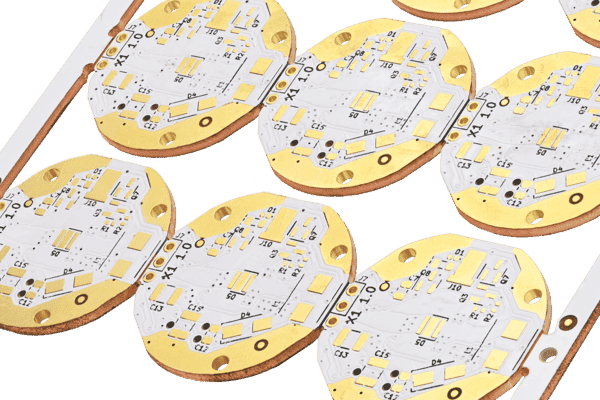
| Copper base, 2.0 W/mK | $912.99 | $9.13 | +$720.15 (+373%) |
These are rough bare-board estimates, before Gerber review, assembly and tax. Rogers and polyimide flex showed "price confirmed after review" in the same online workflow, so a per-board figure for either would be invented. Ask for the exact RF laminate grade or flex construction before comparing them.
Why the finished price does not follow the material ratio
A premium substrate changes more than the sheet cost. It may require different bonding, drilling, panel layout or inspection. Sandborn and Murphy's material-centric study of printed wiring board fabrication found that useful cost models track material added, removed, wasted and scrapped through the process. The practical lesson is to compare acceptable finished boards, not multiply an FR-4 quote by a laminate price ratio.
RF material shows why the exact grade matters. Rogers describes RO4000 as a hydrocarbon-ceramic family and RO3000 as ceramic-filled PTFE; these are different constructions with different processing needs. Specify the grade, thickness and copper profile before treating "RF laminate" as one price.
Three buying decisions that make the comparison useful
1. LED lighting: Compare a two-layer FR-4 board with thermal vias and a separate heat sink against aluminum IMS. If both keep the LED junction below its limit in the real enclosure, compare the full board-plus-heat-sink cost. The cheaper bare board may need a more expensive thermal assembly.
2. RF sensor: A short, tolerant radio trace may work on characterized FR-4. If testing shows excess loss, request an approved hybrid stackup that puts RF laminate only under the sensitive paths, then compare it with an all-RF build.
3. Hinged device: Polyimide flex costs more than rigid FR-4, but it may remove a connector, cable and assembly step. Compare cost per assembled, tested device and state whether the bend is one-time or repeated.
Conclusion
A useful PCB price compare starts with the job the board must do. Standard FR-4 is usually the lowest-cost choice for a rigid board, while aluminum-core, RF and polyimide flex materials earn their higher price only when heat transfer, signal performance or bending requires them. Compare finished-board quotes against the same specifications, then include any heat sinks, connectors and testing needed for the complete product.
FAQ
Is the cheapest PCB material always the lowest-cost choice?
No. An FR-4 board may need a separate heat sink or connector that another construction could eliminate. Compare the cost of the complete, tested assembly.
How much more does aluminum-core PCB cost than FR-4?
PCBgogo's published planning guide places its cost impact at roughly 2–4× the standard FR-4 baseline. The finished-board quote depends on size, layer count, thermal dielectric, quantity and processing.
When is an RF laminate worth the extra cost?
Use it when a characterized FR-4 design cannot meet the required signal loss or impedance limits. If only a few paths need the material, ask whether an approved hybrid stackup would cost less.
How can I make a fair PCB material cost comparison?
Request quotes with the same outline, layer count, copper weight, finish, quantity, tests and delivery date. Specify the exact material grade and compare only designs that meet your performance requirements.
Related Reading