日本語
日本語
 한국어
한국어

Acetal vs Delrin for CNC Machining: Properties and Selection Guide
QUICK ANSWER Delrin is not a separate plastic family. It is a branded acetal homopolymer, usually identified as POM-H. In purchasing conversations, “acetal” often means acetal copolymer, or POM-C. Delrin generally offers higher strength, stiffness, fatigue resistance, and a slightly harder surface. Acetal copolymer usually provides better resistance to hot water, strong alkalis, and chlorine-bearing solutions, with less risk of centerline porosity in thick stock.
For most CNC machining projects, either material can produce low-friction, dimensionally stable parts with a clean machined finish. The right choice depends on load, chemical exposure, stock size, tolerances, and the exact grade available. This guide focuses on those decisions and on the machining details that can change the final dimensions.
What Is Acetal
Acetal is the common name for polyoxymethylene, abbreviated POM. It is a semi-crystalline engineering thermoplastic used where ordinary plastics are too soft, flexible, or unstable. Its tightly packed molecular structure gives it a useful balance of stiffness, wear resistance, low friction, and low moisture absorption. That combination makes POM a practical material for moving components and close-fitting mechanical parts.
Acetal Types and Properties
The acetal family has two main types. POM-C is a copolymer whose chain contains small amounts of a comonomer. POM-H is a homopolymer with a more regular molecular structure. The name “acetal” can describe either type, although suppliers often use it as shorthand for POM-C and reserve Delrin for branded POM-H.
POM-C acetal copolymer offers low moisture absorption, good dimensional stability, broad resistance to fuels and solvents, and better performance in hot water and alkaline environments than POM-H.
POM-H acetal homopolymer is typically stronger, stiffer, and more fatigue resistant. Delrin is the best-known branded example, but not every POM-H stock shape is Delrin.
Filled or modified grades may contain PTFE, glass fiber, lubricant, metal-detectable additives, or pigments. These additions can change wear, stiffness, tool life, compliance, and dimensional behavior.
Both types mill and turn easily, but their thermal expansion is much higher than that of metal. Thin features can also deflect under cutting pressure, so part geometry affects achievable tolerance.
Acetal Applications
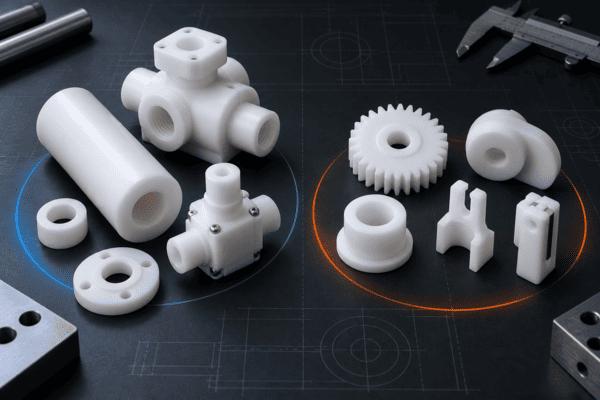
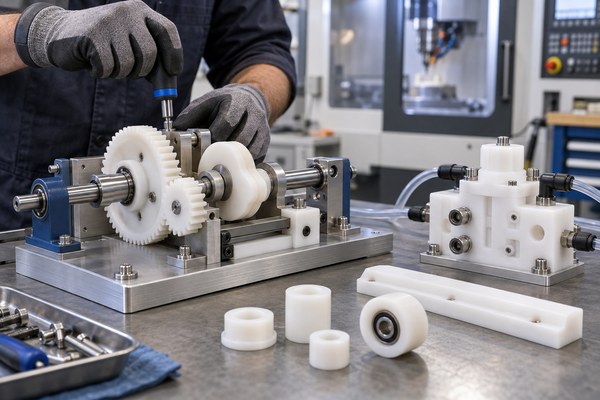
CNC-machined acetal is common in bushings, valve bodies, pump components, manifolds, rollers, guides, spacers, wear pads, electrical insulators, and food-processing equipment. POM-C is particularly useful when a part has thick sections, internal fluid passages, or prolonged contact with moisture and cleaning chemicals. Its consistent stock structure also helps when a bore passes through the center of a large rod.
Flat housings, pockets, channels, and multi-face components are often made through 3-axis to 5-axis CNC milling. Designers should allow realistic internal corner radii and avoid unnecessarily thin walls so the cutter can remove heat efficiently without pushing the workpiece out of position.
What Is Delrin
Delrin is a registered trade name for a family of acetal homopolymer resins. In a practical acetal vs Delrin comparison, the meaningful material distinction is therefore POM-C versus a specified Delrin POM-H grade. Calling any black or white acetal stock “Delrin” can create a procurement error because appearance alone cannot identify the polymer type or grade.
Delrin Properties
The regular POM-H chain generally produces higher crystallinity, tensile strength, stiffness, and fatigue endurance than general-purpose POM-C. Delrin also machines to sharp details and a smooth as-machined surface when tools are sharp and heat is controlled. Its low coefficient of friction suits sliding and rotating parts, while its resilience helps gears and snap features survive repeated loading.
The tradeoff is environmental resistance. Delrin is suitable for many oils, fuels, alcohols, and neutral chemicals, but POM-C is usually the safer starting point for prolonged hot-water, steam, strong-alkali, or chlorine exposure. Thick extruded POM-H rod can also contain a lower-density centerline. If machining opens that region, a pressure-tight bore or sealing surface may be less reliable. The risk depends on the stock form, diameter, supplier, and production process, so it should be checked rather than assumed.
Delrin Applications and Grades
Typical Delrin applications include precision gears, cams, pulleys, bearings, bushings, fasteners, latches, conveyor components, and electrical or mechanical housings. It is a strong choice for small, highly detailed parts and repeated-load mechanisms in dry or mildly exposed environments.
General-purpose Delrin grades balance machinability and mechanical strength; the full grade code identifies stabilization, color, and processing variants.
Low-friction grades, including PTFE-filled or internally lubricated formulations, reduce wear in sliding assemblies but do not share the same strength or dimensional data as unfilled Delrin.
Glass-filled grades increase stiffness and reduce creep, but they are more abrasive to cutting tools and can leave a different surface texture.
Food-contact, medical, metal-detectable, and electrically modified grades require documentation for the exact resin and stock shape. A generic POM label is not enough for regulated use.
Acetal vs Delrin CNC Machining Comparison
The table compares typical unfilled stock at room temperature. Values vary by grade, stock form, and test method. Use the actual datasheet and appropriate safety factors for final calculations.
Table 1 Typical selection ranges for unfilled POM stock
| Property | Acetal copolymer POM C | Delrin homopolymer POM H |
|---|---|---|
| Chemical resistance | Generally better with hot water, alkalis, and chlorine-bearing solutions | Good with many fuels, oils, alcohols, and neutral chemicals; verify aggressive media |
| Temperature behavior | Typical continuous-use range is grade dependent; melting region about 165 to 172 C | Similar service range for many grades; melting region about 175 to 178 C |
| Hardness | Typically around Rockwell M 80 to 90 | Typically around Rockwell M 88 to 94 |
| Tensile strength | Common unfilled grades are roughly 60 to 70 MPa | Common unfilled grades are roughly 70 to 80 MPa |
| Yield strength | Often about 60 to 65 MPa at room temperature | Often about 65 to 72 MPa at room temperature |
| Stiffness and fatigue | Good; often more forgiving where toughness and environmental stability lead | Usually higher stiffness and better cyclic-load performance |
| Centerline porosity | Lower risk in thick stock | Possible in thick extruded rod; review for pressure-tight or center-bored parts |
| Machinability | Excellent; may form slightly longer chips | Excellent; often forms short, controlled chips and sharp details |
| Relative cost | Usually the more economical generic option | Often carries a brand and performance premium |
| Best fit | Wet, chemically exposed, thick, or cost-sensitive parts | High-load, fatigue-critical, small, or precision mechanical parts |
CNC Machinability and Dimensional Control
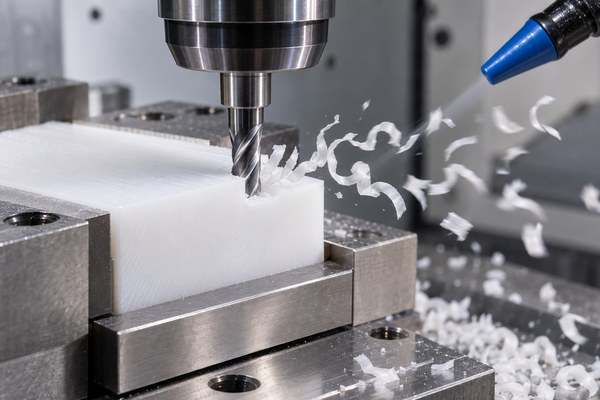
Acetal and Delrin cut cleanly with sharp, polished-edge carbide or high-speed-steel tools. Positive rake, adequate chip clearance, and light final passes help prevent rubbing. Excessive spindle speed, a dull edge, or recutting chips concentrates heat at the surface and can cause glazing, burrs, or an oversized feature while the part is warm.
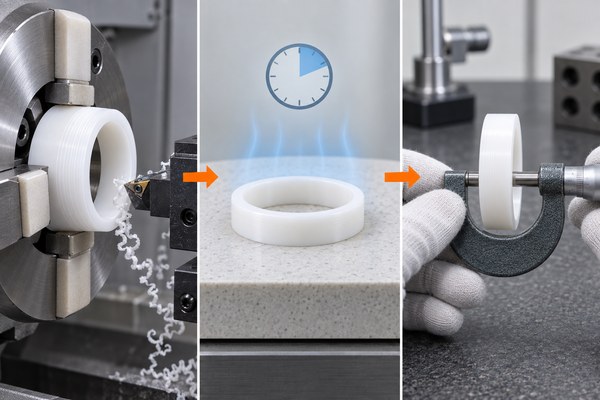
For round parts such as bushings, rollers, pins, and threaded components, precision CNC turning can produce an excellent finish in either material. Use gentle, uniform clamping because chuck pressure can distort thin rings. Rough the part, allow it to cool and relax, then finish critical diameters. Measure at a controlled temperature after the workpiece has stabilized.
Coolant choice also matters. Air blast or a compatible water-based coolant can clear chips and limit heat, but the fluid must be approved for the exact POM grade. Avoid aggressive solvents and do not treat laser cutting as a substitute for machining: overheating POM can release formaldehyde-containing fumes. Follow the material supplier's safety data and provide suitable extraction for any thermal process.
Advantages Shared by Acetal and Delrin
Low friction and good wear resistance for moving mechanical components
Low moisture absorption and better dimensional stability than nylon in humid service
High stiffness and strength relative to many general-purpose plastics
Good electrical insulation and a clean as-machined appearance
Efficient CNC milling and turning without molds or expensive dedicated tooling
Both materials can creep under sustained load, expand with temperature, and degrade under strong acids or prolonged ultraviolet exposure. Their low surface adhesion also makes bonding and painting difficult, so mechanical fastening or captured geometry is often more dependable.
When to Choose Acetal or Delrin
Choose POM-C acetal for valve parts, fluid-handling components, cleaning exposure, hot-water service, thick stock, pressure-sensitive bores, or projects where a general-purpose grade controls cost.
Choose Delrin POM-H for gears, cams, snap features, compact load-bearing parts, repeated motion, or designs where higher stiffness and fatigue resistance justify the premium.
Choose by exact grade when compliance, wear additives, electrical behavior, color, outgassing, or food and medical documentation matters. “Acetal” alone is not a complete material specification.
Prototype the actual geometry when tolerances are tight. Wall thickness, residual stress, clamping, thermal expansion, and stock orientation can outweigh the small property difference between POM-C and POM-H.
A useful drawing callout includes the polymer type, grade or approved equivalent, color, stock certification requirement, critical dimensions, operating temperature, chemical exposure, and inspection condition. If substitutions are allowed, define the performance requirements rather than accepting any material sold under a familiar trade name.
Choosing a Reliable CNC Machining Manufacturer
Ask how the shop controls heat, fixtures thin sections, handles stock traceability, and verifies dimensions after stabilization. For pressure components, discuss whether the bore intersects the stock centerline. For wear parts, identify mating material, finish, load, speed, and lubrication before selecting a grade.
DFM review for wall thickness, internal radii, deep pockets, threads, press fits, and datum strategy
Material certificates or certificates of conformance when grade identity matters
Inspection equipment appropriate to the tolerance, with first-article or dimensional reports when requested
A documented plan for deburring, cleaning, inspection, and lot-to-lot repeatability
PCBgogo supports CNC milling, turning, and mill-turn work in POM and other engineering plastics. To receive a useful CNC machining quote, upload the 3D model and include a 2D drawing that marks the critical tolerances, material grade, finish, quantity, and inspection requirements. Those details let the engineering review address the risks that affect cost and repeatability before material is cut.
PCBgogo - Precision Custom CNC Machining
Save time and money with reliable CNC milling & turning. Get tight?tolerance custom parts, streamlined sourcing, and consistent production quality for your projects.
Get a Free Quote >
Conclusion
In the acetal vs Delrin decision, start by correcting the terminology: acetal is the POM material family, while Delrin is a branded POM-H product line. Choose general-purpose POM-C when chemical and hot-water resistance, thick-stock consistency, and cost are the main constraints. Choose a specified Delrin grade when strength, stiffness, fatigue life, and crisp precision features carry more weight.
Confirm the grade, design around thermal expansion and creep, control cutting heat, and inspect after the part stabilizes. This is more reliable than selecting material from one strength number or a trade name.
Frequently Asked Questions
Is Delrin the same as acetal
Delrin is a type of acetal, not a synonym for every acetal product. Acetal is the common name for POM. Delrin refers to branded POM-H grades, while many materials sold simply as acetal are POM-C copolymers.
Is Delrin stronger than acetal copolymer
General-purpose unfilled Delrin is usually stronger and stiffer than general-purpose POM-C, often by roughly 10 to 15 percent. The exact difference depends on grade, stock form, temperature, and test method.
Which material machines better
Both machine very well. Delrin may form shorter, controlled chips and hold sharp details, while POM-C can be preferable for thick or center-bored parts because it has less risk of centerline porosity. Tool condition and heat control usually matter more than the small difference in cutting behavior.
Which is better for water and chemicals
POM-C is generally the better starting point for hot water, steam, strong alkalis, and chlorine-bearing solutions. Compatibility still depends on concentration, temperature, stress, and exposure time, so check the exact grade's chemical-resistance data.
Can acetal or Delrin hold tight CNC tolerances
Yes, especially on short, well-supported features. Tight tolerances become harder on thin walls, long spans, and large parts because POM expands with heat and can relax after machining. Roughing, cooling, finishing, and temperature-controlled inspection improve repeatability.
Can Delrin be laser cut
POM should not be casually laser cut. High heat can decompose the polymer and generate formaldehyde-containing fumes. CNC machining, sawing, or another approved mechanical process is usually the safer choice, subject to the supplier's safety guidance.