日本語
日本語
 한국어
한국어

How to Choose Aerospace PCB Manufacturing Services?
Aerospace hardware doesn't get a second chance to fail. A board destined for an avionics bay, a satellite bus, or a UAV flight controller has to keep working through vibration, thermal extremes, and years of service life with no room for a bad via or a delaminated layer. That's why choosing the right aerospace PCB manufacturing services partner is one of the highest-leverage decisions a design or procurement engineer makes on any program. This guide breaks down what actually makes aerospace-grade PCBs different, the standards worth verifying before you commit a design, and how PCBgogo supports engineering teams building high-reliability boards from prototype through production.
Why Aerospace PCBs Demand a Different Level of Manufacturing
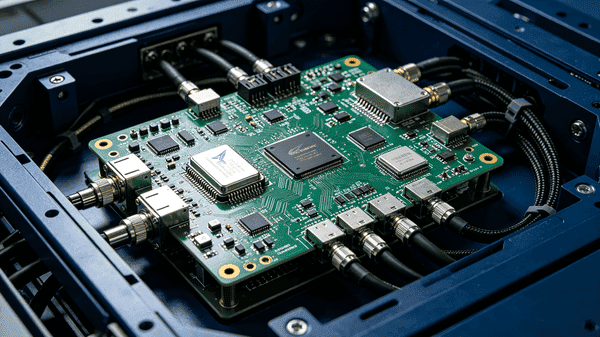
Commercial-grade PCBs are built to work; aerospace PCBs are built to keep working under conditions that would degrade a typical consumer board within months. Depending on the platform, a board may need to operate reliably across temperature swings from roughly -55°C to +125°C, withstand continuous vibration and mechanical shock, resist humidity and altitude-driven pressure changes, and maintain signal integrity over a service life measured in decades rather than product cycles.
That reliability bar changes almost every decision in the manufacturing process — from the laminate and copper weight chosen at the design stage, to how tightly plating thickness is controlled across a panel, to how thoroughly each board is electrically tested before it ships. A manufacturer that treats these as optional upgrades rather than defaults isn't set up for aerospace work, no matter how competitive the quote looks.
Standards and Requirements Worth Verifying Before You Choose a Supplier
Because aerospace programs carry real safety and mission consequences, procurement engineers typically qualify suppliers against a specific set of standards and process requirements rather than relying on a general "we do quality PCBs" claim. The table below summarizes what to check for and why each item matters.
| Requirement | Why it matters for aerospace PCBs |
|---|---|
| AS9100 / ISO 9001-based QMS | Establishes documented and auditable quality processes covering configuration control, first-article inspection, and corrective actions — the baseline aerospace customers expect from suppliers. |
| IPC Class 3 | Defines acceptance criteria for high-reliability boards where continuous performance is critical, with stricter requirements for annular rings, plating thickness, and cleanliness than commercial Class 2 boards. |
| Material traceability | Provides lot-level records linking finished PCBs to raw materials such as copper foil, laminate, and solder mask batches, allowing fast identification and containment of potential issues. |
| Environmental & thermal testing | Ensures boards can withstand extreme conditions, including thermal cycling (often -55°C to +125°C), vibration, and altitude/pressure changes without delamination or plating failures. |
| Controlled impedance & signal integrity | Maintains accurate RF and high-speed digital signal transmission for applications such as avionics, radar, and satellite communication systems throughout the product lifecycle. |
| Export & documentation control | Supports ITAR/EAR-sensitive projects by controlling technical documents, design data, and access permissions across the entire supply chain. |
When evaluating any supplier, it's fair and expected to ask for current certificates, process documentation, and sample test reports before committing a flight-hardware design. A manufacturer that can produce this documentation quickly and clearly is telling you something important about how disciplined its process actually is.
Materials and Technical Capabilities That Aerospace Boards Require
Beyond certifications, the physical build of an aerospace-grade board has to match the mission profile. Common requirements include:
High-Tg and polyimide laminates that hold their mechanical and electrical properties at elevated temperatures
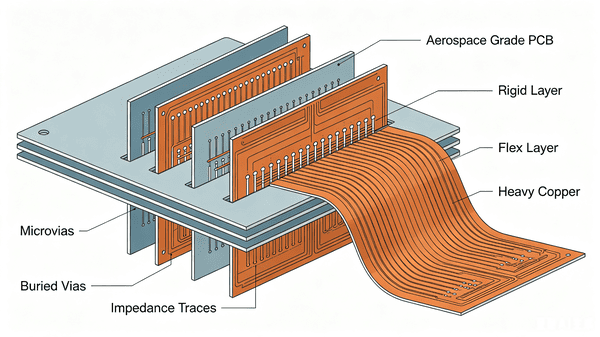
Heavy copper (2 oz and above) for power distribution and thermal management in dense enclosures
Multilayer and rigid-flex constructions to save weight and volume in tightly packed avionics and payload bays
Controlled impedance and careful stack-up design for RF, radar, and high-speed digital interfaces
Blind, buried, and microvias for the interconnect density modern avionics and satellite electronics demand
Conformal coating-compatible finishes and surface treatments suited to harsh, humid, or corrosive environments
Getting these details right at the fabrication stage is what separates a board that passes incoming inspection from one that actually survives its mission profile.
How PCBgogo Supports High-Reliability Aerospace and Defense-Adjacent Projects
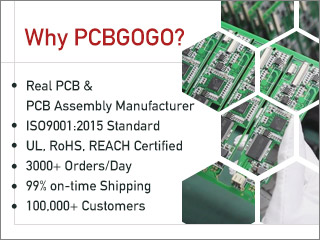
PCBgogo owns and operates its own PCB manufacturing facilities, supported by a documented ISO 9001:2015 quality management system, with additional certifications including UL, IATF 16949, ISO 14001, ISO 45001, and RoHS/REACH compliance. That combination of an audited QMS, environmental controls, and safety-management certification gives engineering teams a manufacturing foundation that's built for consistency, not one-off good luck.
For teams designing toward aerospace and other high-reliability applications, PCBgogo's capabilities include:
Quick-turn prototyping alongside small-to-medium volume production, so a design can move from a single validation board to a production run without switching suppliers
Multilayer, heavy-copper, rigid-flex, and controlled-impedance PCB fabrication
100% electrical testing on boards before they ship, reducing the risk of a defective unit reaching assembly
A range of surface finishes — including ENIG, immersion silver, and lead-free HASL — suited to different environmental and reliability requirements
Engineering support during quoting to flag design-for-manufacturability issues before they become field problems
PCBgogo is upfront that aerospace and defense programs often carry additional program-specific requirements — AS9100, ITAR, or Nadcap accreditation among them — and every buyer should independently verify current certification scope for their specific application before finalizing a supplier.

From Quote to Flight-Ready Board: What Working With PCBgogo Looks Like
Upload your design files (Gerber, ODB++, or native CAD) for an instant online quote, or send drawings directly to an engineer for a manual review on complex stack-ups
Get design-for-manufacturability feedback on impedance, layer stack, and copper weight before production starts
Move from prototype to pilot run to production volume with the same documented process controls at every stage
Every PCB undergoes 100% electrical testing before shipment, supported by reliable after-sales service to ensure long-term product quality and customer confidence.
FAQ: Aerospace PCB Manufacturing
Can PCBgogo manufacture to IPC Class 3?
Yes, on a project-by-project basis. Share your Class 3 acceptance criteria and stack-up at quoting so our engineers can confirm feasibility before production starts.
What's the minimum order quantity for aerospace prototypes?
PCBgogo accepts orders from 1 piece, so a single validation board can be built before committing to volume.
How long does an aerospace-grade PCB take to manufacture?
Quick-turn prototypes typically ship in a few days; complex multilayer, heavy-copper, or controlled-impedance boards take longer depending on layer count and finish. PCBgogo also offers 24-hour expedited service options to help engineers meet tight development schedules. The exact lead time will be confirmed during the quotation process.
Can PCBgogo handle controlled impedance and RF designs?
Yes. Share your target impedance and stack-up requirements and our engineers will confirm the build before production.
Ready to Source Your Next Aerospace PCB Project?
Whether you're validating a new avionics design or scaling up a qualified board into production, PCBgogo's engineering team can walk through your stack-up, materials, and testing requirements before you commit to a supplier.
Request an instant quote at www.pcbgogo.com or reach out to our engineering support team to discuss your project's specific reliability and certification requirements.