日本語
日本語
 한국어
한국어

Turning vs Milling: CNC Processes, Differences and Uses
QUICK ANSWER In CNC turning, the workpiece rotates while a cutting tool removes material. In CNC milling, the cutting tool rotates while the workpiece is held in a fixture. Turning is usually the efficient choice for shafts, pins, bushings, and other rotational parts. Milling is better for brackets, housings, pockets, slots, hole patterns, and freeform surfaces. When a part combines both feature groups, turn mill machining can complete more work in one setup and protect relationships between critical features.
What Is the Difference Between Turning and Milling
Both processes remove material from a solid workpiece under computer control, but their cutting motion changes what each machine does efficiently. A lathe establishes geometry around the spindle centerline. A mill approaches a fixed part from one or more directions. That distinction affects the shape of the part, how it is held, where cutting forces act, how many setups are needed, and ultimately the quoted price.
The most useful way to choose is to identify the part's dominant geometry first. A round component with diameters, shoulders, grooves, tapers, bores, and external or internal threads normally starts as a turning job. A prismatic component with faces, pockets, slots, off-axis holes, or sculpted surfaces normally starts as a milling job. Mixed geometry deserves a setup-by-setup review instead of a decision based only on the part's overall appearance.
Turning vs Milling Comparison
| Factor | CNC turning | CNC milling | Turn mill machining |
|---|---|---|---|
| Primary motion | Workpiece rotates | Multi-edge tool rotates | Workpiece and live tools operate in one machine |
| Best geometry | Rotational and concentric | Prismatic and freeform | Rotational parts with off-axis features |
| Typical features | Diameters, tapers, grooves, bores, threads | Faces, pockets, slots, hole patterns, contours | Turned profiles plus flats, cross-holes, keyways, or bolt circles |
| Workholding | Chuck, collet, or between centers | Vise, fixture plate, clamps, or custom fixture | Chuck or collet with secondary spindle and live tooling as needed |
| Economic strength | Fast production of round parts, especially from bar | Geometric flexibility and access from several axes | Fewer transfers and stronger feature-to-feature accuracy |
| Main limitation | Poor fit for broad flat or off-axis geometry | Round profiles may take longer and waste more stock | Higher machine and programming cost; access still depends on configuration |
How CNC Milling Works
A CNC mill clamps the blank while a rotating cutter moves along programmed paths. A standard three-axis machine moves in X, Y, and Z. Four-axis and five-axis equipment adds rotary motion so the tool can reach more faces or maintain a better cutting angle on complex surfaces. Common operations include face milling, pocketing, contouring, drilling, reaming, tapping, and boring.
Milling suits parts whose functional features are distributed across several faces. Examples include equipment brackets, manifolds, enclosures, tooling inserts, impellers, and mold components. The engineer must still consider tool access. Deep narrow pockets, sharp internal corners, and high walls may require long tools, small cutters, or extra setups, all of which can increase cycle time and reduce rigidity.
Advantages and Limitations of CNC Milling
Advantages include broad geometric freedom, multi-face machining, accurate hole patterns, and the ability to produce complex three-dimensional contours.
Limitations include more elaborate fixturing, unavoidable internal corner radii, and longer cycle times when a mostly round part is milled from rectangular stock.
How CNC Turning Works
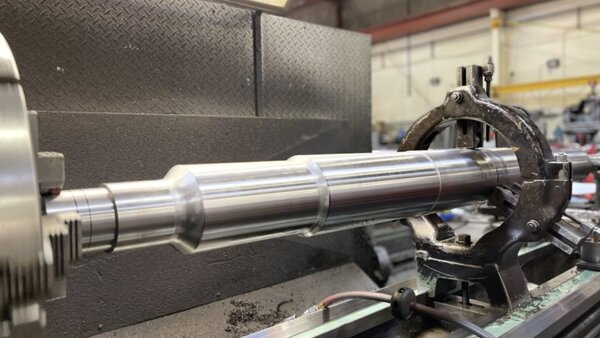
A CNC lathe grips bar stock or a blank in a chuck or collet and spins it around a fixed centerline. A single-point tool feeds along the diameter or length to create faces, cylindrical surfaces, tapers, shoulders, grooves, and threads. Drills and boring bars create centered internal features. Swiss-type machines support slender stock close to the cut, while vertical lathes can hold large, heavy diameters more naturally.
Turning is especially efficient when most surfaces share the same axis. Because the part remains referenced to the spindle, the process can hold concentric relationships between outside diameters, bores, and faces without transferring the workpiece. Bar-fed automation also makes turning attractive for repeat production of small components.
Advantages and Limitations of CNC Turning
Advantages include efficient material removal on round parts, strong concentricity, clean cylindrical finishes, simple bar feeding, and economical repeat production.
Limitations include restricted access to non-rotational features. Flats, cross-holes, keyways, and off-axis pockets require a second operation or a lathe with driven tools and suitable axes.
When Turn Mill Machining Is the Better Choice
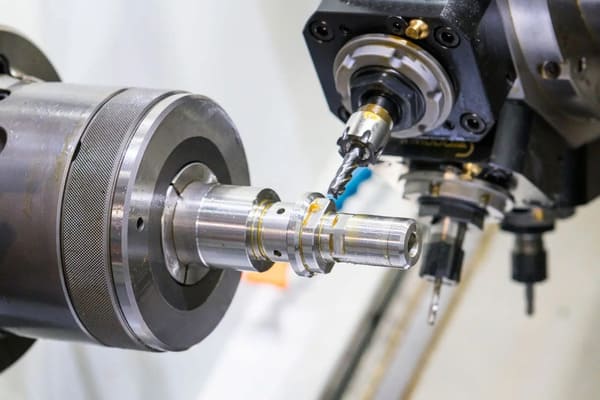
Turn mill machining combines lathe operations with driven milling tools. It is useful for a shaft that also needs a wrench flat, a cross-hole, a keyway, or an off-axis threaded feature. Completing these features before the part leaves the machine can reduce queue time, workholding changes, and accumulated alignment error.
A combined machine is not automatically the lowest-cost option. Simple parts may run more economically on a dedicated lathe or mill with a lower hourly rate. Complex programming, tool clearance, and machine availability also matter. The strongest case for turn mill machining is a part whose critical turned and milled features must maintain a close positional relationship, or whose volume makes secondary handling a meaningful cost.
Materials for Turning and Milling
Turning and milling can process many of the same metals and engineering plastics. Process selection should therefore begin with geometry, then account for the material's chip behavior, heat generation, abrasiveness, rigidity, and tendency to distort. Tool grade, cutting speed, feed, coolant strategy, and workholding must be adjusted for the specific alloy or polymer.
| Material group | Common examples | Machining considerations |
|---|---|---|
| Aluminum | 6061, 6063, 7075, 5052 | Machines quickly; thin walls and cosmetic surfaces still need stable workholding and controlled finishing passes. |
| Steels | Mild, alloy, tool, and stainless steels | Strength, hardness, and work hardening vary widely. Tooling and heat control should match the exact grade and condition. |
| Copper alloys | Brass and copper | Brass is often free cutting. Pure copper can be gummy and may need sharp tools and careful chip control. |
| Titanium | Ti 6Al 4V and related grades | Low thermal conductivity concentrates heat near the cutting edge, so rigid setups and conservative parameters are important. |
| Engineering plastics | ABS, POM, nylon, PC, PMMA, PTFE, PEEK | Heat and clamping pressure can distort parts. Sharp tools, chip evacuation, and realistic tolerances reduce risk. |
How to Choose the Right CNC Process
Start with the features that control function and inspection, not with the machine name. The following sequence gives a supplier enough context to propose a stable process rather than simply quote the visible shape.
1 Identify the primary axis. If most critical surfaces are concentric around one centerline, begin with turning. If the part is defined by planes, pockets, or features on several faces, begin with milling.
2 Mark every off-axis feature. A mostly turned component with flats, cross-holes, slots, or a bolt pattern may justify live tooling or turn mill machining. A single easy feature may be cheaper as a secondary milling operation.
3 Review tolerances by relationship. A tight diameter tolerance is different from tight positional control between a bore and an off-axis hole. Keeping related features in one setup can reduce datum transfer error, but only if the machine can reach and inspect them reliably.
4 Consider quantity and stock form. Bar-fed turning often scales well for repeat round parts. Milling may be more flexible for prototypes and changing geometries. At higher quantities, setup reduction and automation can outweigh a higher machine rate.
5 Simplify difficult features. Use standard hole and thread sizes where possible, allow practical internal radii, avoid unnecessarily deep pockets, and specify tight tolerances only on functional dimensions. These changes often lower cost more than switching suppliers or materials.
6 Send a complete quote package. Provide a 3D model, a dimensioned drawing, material and finish requirements, quantities, critical datums, inspection needs, and any mating-part context. Ask the manufacturer to recommend the process sequence when mixed features are present.
PCBgogo CNC Machining Support
PCBgogo supports CNC projects from prototypes through production with milling, turning, and combined machining capabilities. The engineering review considers geometry, material, tolerances, workholding, secondary operations, and inspection before production. This is particularly useful when a model can be made by more than one process but the setup strategy changes cost or dimensional risk.
Explore custom CNC machining services, review the available CNC milling options, or see the CNC turning capabilities for round, slender, large-diameter, and mixed-feature components. Uploading the model and drawing together helps the team evaluate manufacturability and quote the most suitable route.
Conclusion
The turning vs milling decision is mainly a geometry and setup decision. Choose turning when rotational features dominate, milling when the part depends on multiple faces or complex contours, and turn mill machining when mixed features benefit from staying in one setup. Material, tolerance, volume, and inspection requirements refine that choice. A clear drawing and early DFM review give the manufacturer the information needed to balance accuracy, lead time, and total cost.
Frequently Asked Questions
Is turning faster than milling
For a rotational part, turning is usually faster because the process follows the natural geometry of the workpiece and can remove material continuously. Milling can be faster for flat, pocketed, or multi-face parts. Cycle time depends on material, stock size, tool access, tolerance, and setup count.
Can a CNC mill make round parts
Yes. A mill can interpolate circular features and can machine a round part with a rotary axis or suitable fixture. However, a lathe normally produces concentric outside and inside diameters more directly and economically when rotational geometry dominates.
Can a CNC lathe perform milling
A turning center with live tooling can drill, tap, mill flats, and create some off-axis features. Y-axis, C-axis, secondary-spindle, and B-axis capability expand what can be completed in one setup. The exact feature access depends on the machine configuration.
Which process gives better tolerances
Neither process is universally more accurate. Turning naturally controls concentric diameters and faces, while milling naturally controls locations across planes and multiple axes. Machine condition, setup rigidity, tool selection, thermal stability, measurement method, and feature accessibility often matter more than the process label.
Which process is cheaper
The cheaper process is the one that creates the required features with the fewest stable setups and the least unnecessary cutting. Turning tends to be economical for round parts from bar stock. Milling tends to be economical for prismatic parts. Turn mill machining can lower total cost when it eliminates repeated handling, although its hourly machine rate may be higher.
What files are needed for a CNC quote
Send a neutral 3D CAD file such as STEP, plus a 2D drawing that identifies tolerances, datums, threads, surface finish, material, quantity, and post-processing. The drawing should distinguish critical requirements from reference dimensions so the supplier can plan inspection and avoid unnecessary cost.