日本語
 한국어

PTC vs NTC Thermistor Differences Applications and How to Choose
QUICK ANSWER An NTC thermistor decreases in resistance as temperature rises and is commonly used for temperature sensing and inrush current limiting. A PTC thermistor increases in resistance and is generally used for overcurrent protection, overtemperature protection, and self-regulating heating. On a PCB, the correct choice depends on whether the circuit must measure temperature or react to a fault.
What Is a Thermistor
A thermistor is a resistor made from temperature-sensitive semiconductor material. Its resistance changes far more with temperature than a standard fixed resistor, so a PCB can translate that change into a measurement, a control signal, or current-limiting action. The two main families are NTC and PTC.
What Is an NTC Thermistor
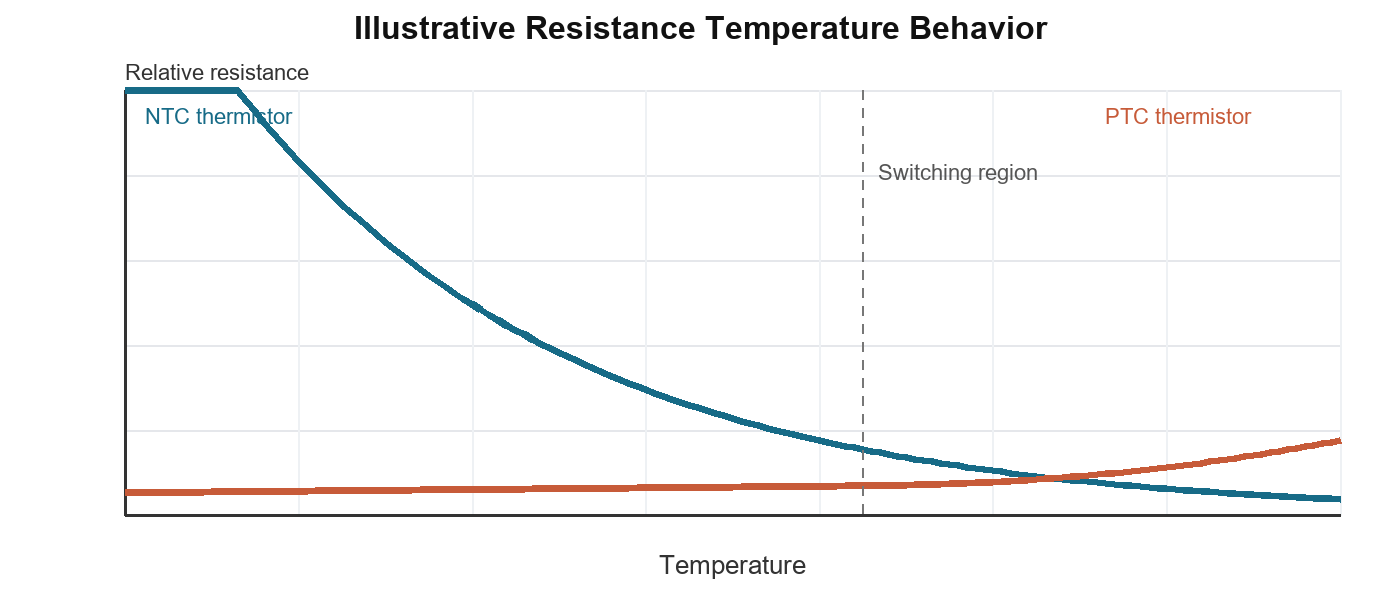
An NTC thermistor has a negative temperature coefficient: resistance falls as its body temperature rises. Sensing parts are normally specified by resistance at 25°C, called R25, and a B value that defines the resistance temperature curve. A 10 kΩ label therefore means 10 kΩ at 25°C, not at every temperature.
For PCB temperature sensing, place the NTC close to the component or thermal zone being monitored and connect it in a voltage divider to an ADC. Keep copper pours, airflow, and nearby heat sources consistent between prototypes and production boards. Use a low measurement current because self-heating can make the reported temperature higher than the actual local temperature.
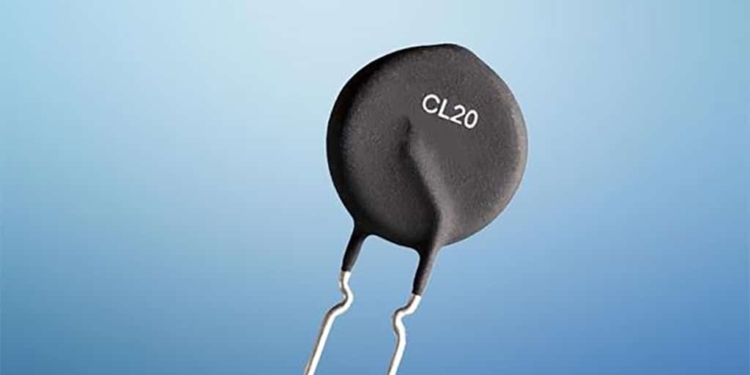
A power NTC thermistor works differently in the circuit. Installed in series with the input, it starts cold with relatively high resistance and then warms until its resistance drops. This limits startup current, but designers must verify steady-state current, energy rating, cooling time, and hot restart behavior. A small sensing NTC thermistor must never replace a power-rated inrush limiter.
What Is a PTC Thermistor
A PTC thermistor has a positive temperature coefficient: resistance rises with temperature. Ceramic PTC devices can show a steep increase near their switching or Curie temperature, which suits motor winding protection and self-regulating heaters. Polymer PTC devices, often called PPTCs, heat under excess current and enter a high-resistance state until power is removed and the device cools.
A PTC device is useful when the PCB needs a threshold response rather than an accurate temperature value. A PPTC can protect a USB rail, battery output, or peripheral connector, but it is not identical to a fuse. It remains slightly resistive in normal operation, trips according to current and ambient temperature, and may not return to its original resistance immediately after a fault.
PTC vs NTC Thermistor Key Differences
The table shows how the electrical behavior of each thermistor type leads to different PCB functions.
| Comparison | NTC Thermistor | PTC Thermistor |
|---|---|---|
| Resistance change | Decreases as temperature rises | Increases as temperature rises |
| Typical PCB role | Measurement, compensation, startup limiting | Protection, current limiting, heating |
| Response | Continuous nonlinear curve | Often rises sharply near a threshold |
| Key parameters | R25, B value, tolerance, dissipation | Trip temperature, hold current, trip current |
| Common products | BMS, HVAC, 3D printers, power supplies | Motors, USB protection, PTC heaters |
Where PTC and NTC Thermistors Are Used
Product requirements determine whether the PCB needs an NTC thermistor for measurement or a PTC thermistor for protection and heating.
Microwave ovens and coffee machines: an NTC can monitor operating temperature, while a PTC may support protection or heating functions.
Air conditioners and refrigerators: NTC sensors measure coil, air, and refrigerant-related temperatures for closed-loop control.
3D printers: An NTC thermistor measures the hotend or heated bed. The PCB must include open-circuit and short-circuit fault detection because a detached sensor can create a heating hazard.
Battery packs and BMS boards: NTC sensors monitor cell temperature. Place them against representative cells and keep sense traces away from switching nodes.
Power supplies: a power NTC limits cold startup current. Confirm fuse coordination and hot restart performance.
Motors and transformers: embedded PTC sensors can trigger shutdown near a defined winding temperature, while an NTC thermistor supports continuous monitoring.
USB and battery outputs: a PPTC limits sustained fault current and resets after the fault is removed and the device cools.
How to Choose Between PTC and NTC Thermistors
Choose the thermistor from the function first, then validate its electrical, thermal, and assembly limits.
Continuous temperature measurement: select an NTC thermistor with the required R25, B value, curve tolerance, response time, and operating range.
Startup surge control: select a power NTC thermistor using cold resistance, maximum steady current, energy rating, and expected time between power cycles.
Resettable overcurrent protection: select a PPTC with hold current above the maximum normal current and check trip current, voltage rating, fault current, resistance, and ambient derating.
Temperature threshold or heating: select a ceramic PTC thermistor by switching temperature, voltage, power, and thermal contact conditions.
For PCB layout, avoid locating a sensing NTC beside MOSFETs, regulators, or high-current copper unless that heat source is the target. Define its footprint and assembly side in the BOM. Review land patterns and thermal placement during DFM. PCBgogo can manufacture and assemble the PCB from released Gerber files, BOM, and placement data so builds remain consistent.
Common Thermistor Selection Mistakes
Most thermistor failures in PCB projects come from choosing the right family for the wrong operating condition.
Wrong NTC thermistor class: a sensing device does not have the current or energy capability of a power inrush limiter.
Self-heating ignored: excess divider current creates a temperature error, especially in still air or small enclosures.
R25 used alone: two NTC parts with the same R25 can have different B values and produce different readings away from 25°C.
PPTC treated as a fuse: its trip behavior depends on ambient temperature, PCB copper, fault current, and cooling conditions.
Thermal location left to assembly: a few millimeters of placement change can alter response time and measured temperature when heat gradients are steep.
Frequently Asked Questions
What is the main difference between PTC and NTC thermistors?
An NTC thermistor loses resistance as temperature rises, while a PTC thermistor gains resistance. This makes NTC devices well suited to measurement and PTC devices well suited to threshold protection or heating.
Which thermistor is better for temperature sensing?
An NTC is usually the practical choice for continuous PCB temperature measurement because it provides a predictable resistance change across a range. Accuracy still depends on its curve tolerance, circuit, calibration, and placement.
Can both types limit inrush current?
Yes, but they behave differently. A power NTC thermistor is common for cold startup limiting, while specialized PTC solutions suit applications requiring different reset or fault behavior.
What does 10K NTC mean?
It normally means the NTC thermistor has a nominal resistance of 10 kΩ at 25°C. The B value or full resistance-temperature table is still required to calculate other temperatures.
Is a PTC thermistor the same as a resettable fuse?
Not always. PPTCs are widely sold as resettable protection devices, while ceramic PTC thermistors can be designed for temperature sensing, motor protection, switching, or self-regulating heating.
How can I test a thermistor with a multimeter?
Measure resistance at room temperature, warm the device gently, and watch the direction of change. An NTC thermistor should decrease, and a PTC thermistor should increase, but a datasheet is needed to judge whether the values are within tolerance.
Conclusion
Use an NTC thermistor when a PCB must measure temperature or limit cold startup current, and use a PTC thermistor when the design needs overcurrent protection, an overtemperature threshold, or self-regulating heat. Select from the complete datasheet and verify the behavior on the assembled board under minimum and maximum ambient conditions. For a build review or quotation, send PCBgogo the Gerber files, BOM, placement file, and thermistor datasheet.
PCBgogo - Reliable, High-Quality PCB Manufacturing
PCBgogo is a one-stop PCB and PCBA manufacturing factory, helping you save time and costs while ensuring consistent, reliable quality.
Get a Free Quote >