日本語
日本語
 한국어
한국어

PCB Price Increase 2026: Why Are PCB Prices Rising & What to Do
KEY DEFINITION PCB prices are rising due to simultaneous cost pressures across the supply chain, including higher CCL, copper foil, glass cloth, and resin costs, capacity redirected toward AI and high-performance computing, longer lead times, and geopolitical or logistics disruptions. The increase is not uniform: standard 2-layer FR-4 boards may see limited impact, while high-layer-count, HDI, low-loss, and heavy-copper boards face the greatest exposure.
PCB prices are rising across the industry in 2026, and the increase is structural rather than a short-term spike. Standard base materials have climbed roughly 20 to 30 percent in some segments compared with 2025, advanced laminates are up 10 to 15 percent with allocation quotas attached, and Goldman Sachs analysts reported that PCB prices jumped by as much as 40 percent in a single month during the spring supply shock. The root causes are a surge in AI server demand that is absorbing laminate capacity, copper trading near record levels, a persistent glass fiber cloth shortage, and geopolitical disruption hitting resin and logistics.
For engineers and procurement teams, the practical consequences are already visible: quotes expiring faster, FR-4 lead times stretching from days to weeks, and advanced material lead times reaching four to five months. This article breaks down how much PCB prices have actually risen, the six forces behind the increase, which board types are affected most, where the price trend is likely heading through 2027, and the specific procurement and design moves that protect your budget while the market stays tight.

PCB Price Increase at a Glance
| Question | Short Answer |
|---|---|
| Are PCB prices increasing? | Yes, but the increase varies substantially by technology and specification. |
| What is driving the increase? | Materials, AI-related demand, constrained capacity, energy, logistics and geopolitical risk. |
| Which PCBs are most affected? | HDI, high-layer-count, high-speed, RF, heavy-copper and large-format boards. |
| Are standard FR-4 boards affected? | Yes, but usually less than material-intensive or specialized boards. |
| Will prices fall soon? | Depends on capacity, material availability and demand; use scenarios rather than one fixed forecast. |
| What should buyers do? | Validate the surcharge, secure critical material, optimize specifications and qualify alternatives. |
Note: This article discusses bare PCB fabrication prices. PCBA pricing also includes electronic components, assembly, stencil, testing and procurement costs.
How Much Have PCB Prices Risen?
PCB quotation change = material exposure + process cost + expected yield loss + capacity premium + testing/tooling + logistics/tariffs + supplier margin adjustment.
There is no defensible single percentage for the global PCB price increase. The change depends on board type, material system, layer count, copper weight, quantity, supplier region and delivery requirements. The headline numbers, drawn from industry reporting through mid-2026:
Base materials: European fabricators expect advanced laminate prices 10 to 15 percent above 2025 levels, with some standard base material segments up 20 to 30 percent and subject to supplier allocation quotas.
Copper-clad laminate (CCL): South Korean customs data showed CCL import prices crossing $20,000 per ton in March 2026, roughly a 75 percent year-over-year increase and the highest level since records began.
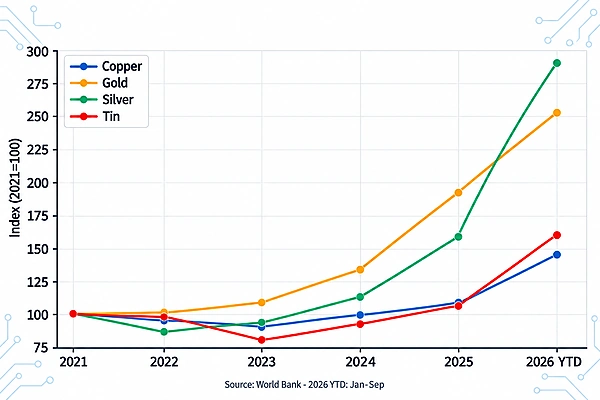
Copper: LME copper has traded above the $10,000 per tonne mark, at times exceeding $11,000, keeping copper foil prices elevated since early in the year.
Glass fiber cloth: Electronic-grade glass fabric rose about 12 percent year over year, with some suppliers announcing across-the-board increases near 20 percent.
High-end boards: Prices for high-end PCBs used in AI servers, HDI, and high-speed applications rose close to 38 percent year over year in 2025, before the 2026 increases layered on top.
The spring shock: Following supply disruption tied to the Middle East conflict, Reuters reported Goldman Sachs estimates that PCB prices rose by as much as 40 percent from March to April 2026.
Lead times provide a second indication that the increase is being driven by genuine supply constraints rather than raw-material prices alone. Advanced high-Tg PCB materials and low-Dk laminates have recorded lead times of up to 140 days, while standard FR-4 laminate that was previously available from stock may now require around four weeks. Some PCB fabricators in Asia and Europe have also reported production backlogs of three to four months.
These lead-time figures vary by material grade, supplier and region, so they should not be treated as universal benchmarks. However, downstream producer-price data confirms that the pressure has moved beyond isolated material quotations. The U.S. Producer Price Index for bare printed circuit board manufacturing rose from 133.793 in July 2025 to 194.470 in July 2026—an increase of approximately 45.4% year over year.
The index represents U.S. producer prices rather than the entire global PCB market, and it typically responds more slowly than spot-material quotations. Nevertheless, when raw-material prices, lead times, factory backlogs and producer prices all rise together, the evidence points to a broader cost-and-capacity imbalance. The next section examines the six forces driving that imbalance.
Why Are PCB Prices Increasing? The 6 Drivers
1. AI Server Demand Is Absorbing Laminate Capacity
This is the dominant force, and it explains why the current increase behaves differently from past cycles. An AI server board is not just another PCB order. Average AI server PCB layer counts have climbed from roughly 18 layers in 2023 to around 32 layers in 2025, and each board consumes several times more copper-clad laminate by volume than a conventional server board. Multiply that per-unit consumption by AI server shipment growth running far above the broader market, and demand for CCL, low-loss resin systems, and fine glass fabrics has stepped up faster than any capacity plan anticipated.
The squeeze started in exotic low-Dk materials for AI and networking hardware. By late 2025 it had spread downstream: laminate suppliers running with days of inventory or none, allocation programs that cap purchases at historical consumption levels, and, critically for everyone else, shortages reaching ordinary FR-4. When the same glass fabric looms and resin reactors feed both premium and commodity laminates, suppliers prioritize the higher-margin product, and standard material availability suffers.
2. Copper at Record Levels
Copper is the single most visible commodity input: it becomes the foil laminated onto every board and the plating in every via. With LME copper holding above $10,000 per tonne and briefly pushing past $11,000, copper foil producers have passed the increase straight into CCL, and CCL is the largest single line in a PCB’s cost structure, typically 27 to 40 percent of board cost depending on layer count. When copper moves, board prices follow with only a short delay.
3. Glass Fiber Cloth Shortage
Electronic-grade glass fabric is the reinforcement inside nearly every rigid laminate, and it has become the industry’s quiet bottleneck. Fine and low-CTE fabrics needed for high-layer-count and high-speed boards compete for the same production capacity as standard weaves, and expanding that capacity means building new furnaces and looms on multi-year timelines. Price increases of 12 to 20 percent have already landed, and fabric availability, not fabricator capacity, now sets the schedule for some builds.
4. Resin Supply Disruption
Specialty resins concentrated in a few production sites add fragility. A disruption at a Saudi petrochemical complex producing high-purity polyphenylene ether (PPE) resin, a key ingredient in low-loss laminates and a facility reported to represent the large majority of global supply, contributed to severe shortages, weeks-long component lead times, and sharp board price spikes. Epoxy systems and basic process chemicals (sulfuric acid, caustic soda) have also drifted upward, raising the cost of the wet processes inside every fab.
5. Geopolitics, Tariffs, and Logistics
The Middle East conflict has disrupted materials supply and shipping routes, which analysts link directly to the spring 2026 price spike. Separately, US tariff policy has added a layer of cost for American buyers: imported boards, components, and even the raw materials used by domestic fabricators carry tariff exposure, and those costs are being passed through the chain. The practical effect for buyers is that landed cost now varies significantly by sourcing route and can change with policy announcements rather than manufacturing economics.
6. Restocking Behavior Amplifying the Shortage
A second-order effect worth understanding: OEMs remember the 2021-2022 component crisis, and many have shifted from just-in-time purchasing to building safety stock. When hundreds of buyers simultaneously raise inventory targets, apparent demand jumps even where real consumption has not, tightening the market further and validating everyone’s decision to stockpile. This feedback loop tends to extend shortages beyond what end demand alone would justify, and it also means the eventual unwind (destocking) can soften prices faster than fundamentals suggest.
Which Boards and Materials Are Hit Hardest?
The increase is not uniform. The market has split into a severely constrained high end and a moderately affected mainstream:
| Category | Price Pressure | Lead Time Situation | Notes for Buyers |
|---|---|---|---|
| Low-Dk / high-speed laminates (AI, networking, telecom) | Severe, with the largest price increases | Up to 140 days, with allocation common | Directly competing with strong AI server demand for advanced materials |
| High-Tg FR-4, halogen-free | High | Extended lead times, with some allocation risks | Shares raw material supply with premium laminate categories |
| Standard FR-4 (consumer, industrial) | Moderate, typically 10–30% depending on segment | Ranges from several days to roughly 4 weeks | Still available but with less predictable pricing and delivery schedules |
| Heavy copper, MCPCB | Elevated due to copper price increases | Moderately extended | Pricing is influenced more by copper market trends than laminate supply |
| Flex/polyimide | Moderate | Variable depending on material availability | Uses a different supply chain and is partially insulated from standard PCB material pressures |
Two takeaways from the divergence. First, if your product uses standard FR-4, you are inconvenienced, not blocked: prices are up and planning windows are longer, but material flows. Second, if your stackup specifies a named low-loss laminate, material availability is now a program risk on par with component shortages, and it deserves the same mitigation effort.
How Raw-Material Increases Affect Your PCB Quote?
Raw materials make up roughly 60 percent of a typical PCB’s cost structure, with CCL alone accounting for over a quarter. That arithmetic means fabricators cannot absorb increases of this size in margin; they reprice. Buyers are seeing the pass-through in four forms:
Shorter quote validity. Quotes that once held for 30 to 60 days increasingly carry 7 to 14-day validity, or explicit material surcharge clauses. Treat an old quote as an estimate, not a commitment.
Repricing at reorder. The same Gerber files that cost X last year come back 10 to 30 percent higher, with the largest jumps on multilayer and high-Tg builds.
Lead time as a hidden price. When standard lead times stretch, buyers pay expedite fees to hold schedules. A 25 to 100 percent rush premium on top of a higher base price compounds quickly.
Allocation effects. Fabricators on material allocation prioritize customers with forecasts and order history. Spot buyers pay more and wait longer, which is a price increase in everything but name.
PCB Price Forecast: Trends, Drivers & Outlook
The honest answer is that relief is unlikely to be fast, for reasons built into the supply side:
Capacity takes years, not quarters. New CCL plants, glass fabric furnaces, and resin capacity require roughly 18 to 24 months from investment to full output. Expansion announced in 2025 begins to matter in 2027.
AI demand shows no sign of pausing. Analysts across TrendForce, Goldman Sachs, and equipment makers like ASML converge on the same view: AI infrastructure spending continues to outrun the supply chain’s ability to respond, and every generation of AI hardware consumes more board area, more layers, and better materials than the last.
Consolidation reduces price competition. The top ten PCB manufacturers’ combined global share climbed to over half the market in 2025, and cost pressure is pushing smaller fabricators out of the low-to-mid segment. Fewer suppliers chasing commodity work means less downward price pressure even after materials normalize.
| Scenario | Possible Direction | Conditions | Buyer Response |
|---|---|---|---|
| Easing case | Standard FR-4 stabilizes first | Capacity release, destocking, lower copper | Avoid excessive inventory |
| Base case | Elevated but slower increases | AI demand remains strong, materials tight | Lock critical materials selectively |
| Risk case | Further price and lead-time increases | New resin/copper/logistics disruption | Secure capacity and qualified substitutes |
The realistic base case: elevated prices and long lead times persist through 2026, with advanced materials staying tight into 2027, and standard FR-4 pricing stabilizing first as new mainstream capacity lands and restocking demand unwinds. A downside scenario (faster relief) requires AI capex to cool; an upside scenario (further increases) requires another supply shock in copper, resin, or shipping, none of which can be ruled out given the geopolitical backdrop.
Plan on higher prices being the operating environment, not an anomaly to wait out.
10 Procurement Strategies to Control PCB Costs in a Rising Market
1. Order earlier, and against a forecast. Suppliers on allocation reward demand visibility. Even a rough rolling quarterly forecast puts you ahead of spot buyers in both price and queue position.
2. Lock volumes with framework agreements. Where demand is reasonably firm, longer-horizon commitments trade flexibility for price protection and reserved capacity. In an allocating market, that trade favors the buyer more than usual.
3. Re-quote actively, not annually. Prices are moving in both directions at the segment level. Keep your standard designs saved in an instant-quote system and reprice monthly; five minutes of checking catches both surcharges and windows of softness. Platforms with real-time self-service quoting, offered by some PCB manufacturers, make this a near-zero-effort habit and let you compare quantity tiers in the same pass.
4. Pre-qualify an alternative laminate now. If your stackup names a constrained material, ask your fabricator for a second stackup on an available equivalent, re-run impedance calculations against the alternative’s Dk and Df, and get sign-off before the shortage forces the decision under schedule pressure.
5. Design to standard FR-4 wherever the electronics allow. The premium and the lead-time risk both concentrate in advanced materials. Every net that does not genuinely need low-loss laminate is a candidate for the mainstream supply chain.
6. Hold strategic buffer stock on critical boards. Industry analysis suggests maintaining several weeks of strategic inventory on genuinely critical items outperforms lean models during shortages. Apply it selectively: bare boards store better than assembled ones, and OSP-finished boards have limited shelf life.
7. Consolidate spend with fewer, stronger suppliers. Order history is the currency of allocation. Spreading small orders across many vendors leaves you at the back of every queue; concentrating volume builds the purchase history that secures material.
8. But keep a qualified second source. Concentration and single-sourcing are different things. Maintain at least one qualified alternate fabricator per board family, ideally in a different region, so a regional disruption or tariff change does not stop shipments.
9. Compare on landed cost. With PCB tariffs and freight in flux, unit price comparisons mislead. Request DDP terms or model duties explicitly when comparing quotes across regions.
10. Kill expedites at the source. Rush fees are the most avoidable cost in the current market. Pulling order placement forward by two weeks is free; a 48-hour expedite is not.
Design Levers That Offset the Price Increase
Procurement tactics manage the market; design changes beat it. The measures that cut cost fastest in a materials-driven market are precisely the ones that reduce material consumption:
Reduce layer count where routing allows. Layers are laminate, and laminate is the thing that got expensive. A 6-to-4 layer reduction saves more in 2026 than it did in 2023.
Shrink board area and improve panel utilization. You pay for panel area consumed, and every square centimeter of panel now costs more. Rectangular outlines and panel-friendly dimensions are worth revisiting on legacy designs.
Right-size copper weight. With copper near record prices, 2 oz copper specified out of habit rather than current-carrying need is a direct overpayment.
Question every advanced-material callout. High-Tg, halogen-free, and low-loss specifications copied from old fab drawings put your order in the most constrained queue for no functional benefit.
Run a DFM and material-risk review before release. Catching a stackup built on an allocated laminate before production release costs nothing; discovering it after release costs a redesign cycle at 2026 prices. Established fabricators generally review incoming files without charge; PCBgogo's engineering review, for instance, covers manufacturability and flags specification choices that carry avoidable cost or lead-time risk, which is exactly the feedback loop buyers need while materials stay tight.
Conclusion
The 2026 PCB price increase is demand-led, materials-driven, and slow to unwind, which makes it different from the freight-and-logistics spikes of past years. The PCB price increase is not a single global percentage. It is a segmented cost-and-capacity problem. Buyers should evaluate the material content, manufacturing complexity, supply risk and total cost of delay for each part number before accepting—or rejecting—a supplier increase.
If you want a current read on what the market is charging for your boards, upload your Gerber files to PCBgogo for an instant quote, compare multiple quantity options in seconds, and get a free engineering review to identify hidden cost drivers before they impact your budget. In a market where material choices, layer counts, and specifications can quickly increase your bill, working with an experienced PCB manufacturing partner like PCBgogo can help you build smarter and spend less.
FAQ: PCB Price Increase Questions
Why are PCB prices increasing in 2026?
Four converging forces: AI server demand absorbing copper-clad laminate and glass fabric capacity, copper trading near record highs, resin and material supply disruptions amplified by Middle East conflict and tariffs, and industry-wide restocking that tightens the market further. Raw materials are roughly 60 percent of PCB cost, so these inputs pass through to board prices quickly.
How much have PCB prices gone up?
Depending on segment: some standard base materials are up 20 to 30 percent versus 2025, advanced laminates roughly 10 to 15 percent with allocation, high-end AI-related boards rose close to 38 percent during 2025 alone, and the spring 2026 supply shock produced month-over-month spikes that Goldman Sachs put as high as 40 percent.
Is there a PCB material shortage?
Yes. It began in low-loss laminates for AI and networking hardware and has spread to standard FR-4. Advanced laminate lead times have reached up to 140 days; FR-4 that used to ship in days now commonly takes about four weeks, and several suppliers are running allocation programs.
Will PCB prices go down in 2027?
Partial relief is plausible for standard FR-4 as new capacity comes online and restocking unwinds, since laminate and glass fabric plants started in 2025 reach output around 2027. Advanced materials are likely to stay tight while AI infrastructure spending continues. Treat elevated pricing as the planning baseline rather than a temporary spike.
How can I estimate current PCB prices accurately?
Use a live quote, not a static calculator or last year’s pricing. Material costs are moving too fast for reference tables. Saving your standard designs in a fabricator’s instant-quote system and re-pricing them monthly gives you a real-time index for your own products.
Which PCB types are most affected by the price increase?
High-layer-count boards, HDI, and anything specifying low-Dk or high-Tg laminates face the largest increases and longest lead times, because they compete directly with AI server production for constrained materials. Standard 2-4 layer FR-4 boards see moderate increases and remain broadly available.
Should I stockpile PCBs?
Selectively. A few weeks of buffer on genuinely production-critical boards is reasonable insurance. Blanket stockpiling ties up cash, risks shelf-life issues (especially with OSP finishes), and collectively worsens the shortage. Forecasts and framework agreements with your fabricator achieve most of the protection with less capital.