日本語
日本語
 한국어
한국어

Isopropyl Alcohol for PCB Cleaning: The Complete Guide
Whether you're a hobbyist reworking a development board or an engineer overseeing production-level assembly, cleaning your printed circuit boards is one of the most critical steps you can take to ensure long-term reliability. Isopropyl alcohol (IPA) is by far the most popular cleaning agent in the electronics industry — but using it incorrectly can do more harm than good. This guide covers everything you need to know about using isopropyl alcohol for PCB cleaning, including the right concentration, technique, safety precautions, and when IPA alone isn't enough.
Why PCB Cleaning Matters
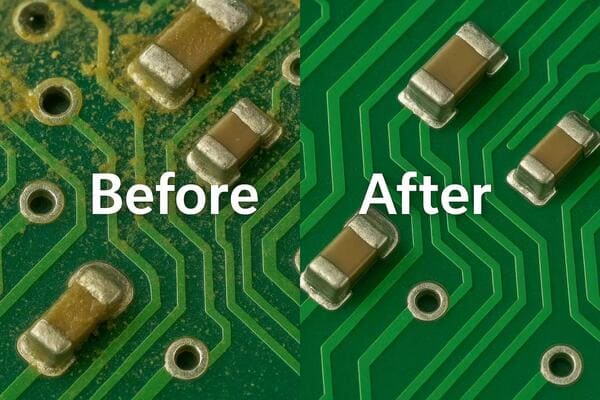
After soldering, boards are rarely as clean as they look. Flux residues, solder paste remnants, fingerprints, and airborne contaminants settle onto the surface and, more critically, under components. Left unchecked, these residues can:
Absorb moisture and create conductive pathways between pads
Accelerate corrosion on copper traces and component leads
Cause intermittent failures or signal interference
Reduce the long-term lifespan of the assembly
A clean board isn't just cosmetic. It's a reliability requirement, especially in demanding environments like automotive, medical, or industrial electronics.
Why Isopropyl Alcohol Is the Go-To Choice for PCB Cleaning
IPA has earned its dominant position in PCB cleaning for good reason. It offers a combination of properties that few other solvents can match:
Effective flux dissolution. IPA dissolves rosin-based and no-clean flux residues efficiently, lifting them from the board surface and from around component leads.
Fast evaporation. IPA evaporates quickly at room temperature, leaving behind minimal moisture — a critical property when working with sensitive electronic components.
Non-conductive. Unlike water, IPA doesn't leave conductive residues that could cause shorts after drying.
Component-safe. When used correctly, IPA is compatible with the plastics, metals, coatings, and laminates found on most PCBs.
Low cost and wide availability. IPA is inexpensive and readily available, making it practical for both lab-scale and production-scale cleaning.
Choosing the Right IPA Concentration
Not all isopropyl alcohol products are the same. The concentration you choose matters significantly.
70% IPA — The kind found at most drugstores — contains 30% water. That water content slows evaporation and introduces moisture to your board, which can be problematic for electronics. It's acceptable for general surface wiping but is not ideal for precision PCB work.
90% IPA — A noticeable step up. The reduced water content means faster drying and less risk of moisture-related issues. Suitable for most hobbyist and light professional cleaning tasks.
99% IPA (recommended) — This is the industry standard for PCB cleaning. With almost no water content, it evaporates quickly, leaves virtually no residue, and poses the least risk to sensitive components. If you're serious about PCB quality, 99% isopropyl alcohol is the right choice.
How to Clean a PCB with Isopropyl Alcohol: Step-by-Step
Cleaning a PCB with IPA is straightforward, but technique matters. Here's the correct process:
What you'll need:
99% isopropyl alcohol
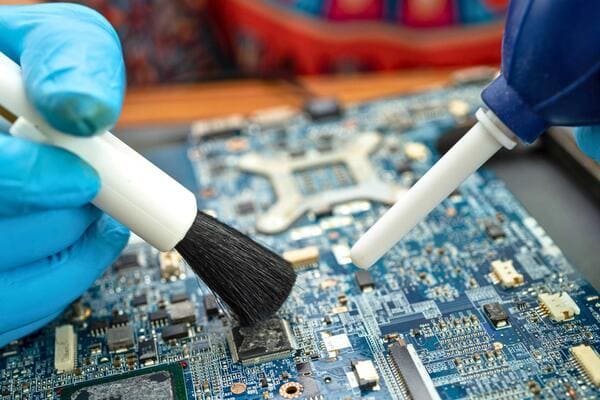
ESD-safe brush (anti-static bristle brush or dedicated PCB cleaning brush)
Lint-free wipes or swabs
Compressed air or air blower (optional but helpful)
PPE: nitrile gloves and eye protection
Step 1: Power down completely. Never clean a board while it is powered. Disconnect all power sources and allow capacitors to discharge.
Step 2: Apply IPA to the brush. Dampen your brush with IPA — don't saturate it to the point of dripping. You want enough solvent to work the residue loose, not flood the board.
Step 3: Scrub gently but thoroughly. Work in small sections, using short, circular strokes around solder joints, component leads, and connectors. Pay special attention to areas with visible flux residue (often amber or yellowish in color).
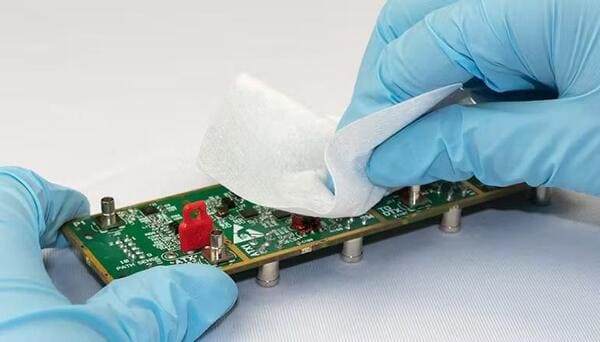
Step 4: Blot and wipe. Use a lint-free wipe to absorb the loosened residue and IPA. Swabs are useful for reaching tight spots between components.
Step 5: Allow to dry completely. IPA evaporates quickly, but allow the board to air dry for at least 5–10 minutes before powering it on. In production environments, a short baking cycle at low temperature is sometimes used to ensure complete dryness.
Step 6: Inspect under magnification. A loupe or digital microscope helps verify that no residue or debris remains, especially around fine-pitch components.
When Isopropyl Alcohol Isn't Enough
IPA is excellent, but it has limitations that users often overlook.
Flux classification matters. IPA works well on rosin-based (R, RO, RM, RH) and most no-clean fluxes. However, water-soluble fluxes — classified as ORL, ORM, or ORH — are specifically formulated to be cleaned with deionized or distilled water, not alcohol. Using IPA on water-soluble flux can redistribute ionic activators across the board, creating conductive residues that lead to corrosion and current leakage over time.
Under-component contamination. Manual IPA cleaning never fully reaches flux trapped under SMD components, BGAs, or connectors with tight stand-off heights. In high-reliability applications, ultrasonic cleaning or defluxing with specialized aqueous cleaning systems is required to address these areas.
Heavy contamination. For boards exposed to oils, heavy oxidation, or industrial contaminants, stronger solvents or multi-stage cleaning processes may be necessary before or alongside IPA.
Safety Precautions When Using IPA for PCB Cleaning
Isopropyl alcohol is generally safe, but basic precautions apply:
Ventilation: IPA produces vapors that can be irritating in enclosed spaces. Work in a well-ventilated area or use a fume extractor.
Flammability: IPA is flammable, with a flash point around 12°C (53°F). Keep it away from open flames, sparks, and hot soldering irons.
Skin and eye protection: Nitrile gloves prevent skin absorption; safety glasses protect against splashes.
Storage: Store IPA in a sealed container away from heat sources and direct sunlight.
Disposal: Check local regulations — IPA-soaked wipes and used solvent may need to be handled as hazardous waste in some jurisdictions.
The Role of PCB Quality in Cleanability
One factor that's easy to overlook: the quality of the bare PCB itself affects how well it can be cleaned. Boards with well-controlled surface finishes — HASL, ENIG, OSP — and properly cured solder mask are significantly easier to clean than lower-quality alternatives with rough surfaces or pinholes where residues can become trapped.
Because of this, proper cleaning processes are important for PCB reliability; the long-term stability of a product always starts with the board itself. High-quality PCB manufacturing helps reduce production defects, improve solderability, and make later assembly and cleaning much smoother and more efficient.
As a professional PCB factory with many years of experience in the industry, PCBgogo follows strict quality control standards and a well-established production system. We are committed to providing engineers, makers, and electronics manufacturers with high-precision and highly reliable PCB products, helping customers achieve stable performance from assembly through the entire product lifecycle.
If you are looking for PCBs that meet strict manufacturing standards with stable and reliable performance, feel free to contact PCB manufacturer PCBgogo. With mature manufacturing processes, strict quality control, and rich project experience, we can provide dependable PCB manufacturing solutions for your products.
Quick Reference: IPA for PCB Cleaning
| Factor | Recommendation |
|---|---|
| IPA Concentration | 99% preferred; 90% acceptable |
| Brush Type | ESD-safe, soft-bristle |
| Flux Compatibility | Rosin and no-clean fluxes only |
| Drying Time | 5–10 minutes minimum |
| Avoid | Water-soluble flux residues; powered boards |
Conclusion
Isopropyl alcohol remains the most practical, effective, and affordable option for cleaning PCBs in most scenarios. The key is using the right concentration (99% IPA), following proper technique, and understanding the limitations — particularly around flux type compatibility and under-component residues. For critical applications, supplement IPA cleaning with magnified inspection and consider specialized cleaning methods where the stakes demand it.
And remember: the cleanest result always starts with a quality PCB. If you're looking for boards that meet strict manufacturing standards, PCBgogo is worth requesting a quote from — reliable fabrication makes every downstream step, including cleaning, easier and more predictable.