日本語
 한국어

IPC Class 2 vs Class 3: A Complete Comparison Guide
QUICK ANSWER IPC Class 2 and IPC Class 3 are performance classifications used in PCB standards for manufacturing and assembly to define different reliability and acceptance requirements. IPC Class 2 suits products that need reliable, extended service but can tolerate planned repair or limited downtime. IPC Class 3 applies when performance on demand is critical, downtime is unacceptable, or the operating environment is unusually harsh.
A board can pass electrical test yet carry the wrong reliability class. The mistake usually happens before fabrication, when the buyer chooses by market label instead of failure consequence, environment, design rules, and acceptance evidence.
This guide turns the class decision into a practical sourcing process for rigid PCBs, from application fit to fabrication notes and final inspection.
What Are IPC Class 2 and Class 3
IPC performance classes define the required assurance level for the finished board; they do not describe layer count, material grade, or PCB assembly workmanship.
IPC Class 1: General electronic products where basic function is the main requirement; short life or cosmetic imperfections may be acceptable.
IPC Class 2: Dedicated-service products requiring continued performance and extended life. Uninterrupted operation is preferred, but a service interruption is not normally critical.
IPC Class 3: High-performance or harsh-environment products that must work when required. Failure, delayed response, or downtime can create serious operational or safety consequences.
The product owner specifies the class in the procurement documentation. A fabricator should not infer it from the market sector alone.
IPC Class 2 and Class 3 PCB Applications
Application choice depends on what happens when the PCB fails, not on whether the product is called consumer, industrial, medical, or automotive.
| Class | Typical applications | Why it fits |
|---|---|---|
| IPC Class 2 | Industrial controls, test instruments, communications hardware, appliances, and commercial systems | Long service life matters, but maintenance or replacement is available and failure is contained. |
| IPC Class 3 | Life-support functions, flight controls, critical monitoring, defense systems, and remote equipment | Performance is mission-critical, access may be limited, or shock, vibration, temperature, and humidity raise risk. |
A complex product may use different classes. Document each requirement instead of applying IPC Class 3 to every PCB by default.
PCB Manufacturing Compliance and Acceptance Criteria
Compliance starts with an exact purchase requirement and ends with objective acceptance records. For rigid boards, specify the applicable IPC-6012 revision, performance class, board type, material, surface finish, controlled-impedance needs, and any customer-specific deviations.
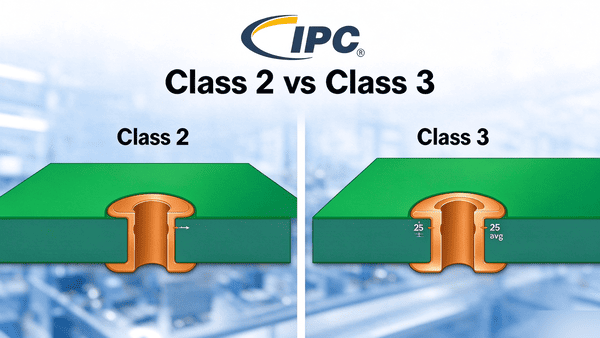
The IPC Class 2 vs Class 3 difference becomes visible in allowable defects and inspection severity. IPC Class 3 uses tighter criteria for features such as annular rings, hole-wall copper, plating voids, conductor imperfections, laminate integrity, and microsection results. IPC Class 2 may accept limited conditions that IPC Class 3 rejects, provided function and the standard's limits are maintained.
Acceptance records may include electrical continuity and isolation, visual and dimensional inspection, and coupon microsections. Do not write only "build to IPC." State the revision, class, exceptions, and required certificates, cross-sections, impedance data, or material traceability.
Durability and Reliability of Class 2 and Class 3 Products
IPC Class 3 provides a higher manufacturing assurance level, but the label alone does not guarantee a longer field life. Reliability still depends on laminate selection, stack-up, via aspect ratio, copper distribution, thermal expansion, component heat, coating, assembly process, and the real duty cycle.
The practical advantage of Class 3 is less tolerance for conditions that can become fatigue initiators during vibration or thermal cycling. Class 2 remains appropriate when the environment is controlled and maintenance is realistic. Over-specifying can increase pad sizes, inspection effort, lead time, and cost without reducing the product's actual risk.
How to Choose the Right Class for Your Product
Choose the right class by assessing failure risk first, then confirm that the design and supply chain can support its acceptance criteria.
Define the consequence of failure. If failure can threaten safety, stop a mission, corrupt critical data, or cause an inaccessible system to go offline, start with IPC Class 3.
Map the operating environment. Review temperature cycles, vibration, shock, moisture, contamination, voltage stress, and service life. A harsh or poorly controlled environment strengthens the case for Class 3.
Check maintenance and redundancy. A replaceable board in a redundant system may suit IPC Class 2. A single-point failure with no practical repair path may require Class 3.
Review design producibility. Confirm that annular rings, hole sizes, registration allowances, via structures, and materials can meet the class at acceptable yield. Class 3 should be designed in before layout release.
Write the acceptance plan. Align the drawing, purchase order, supplier quotation, inspection plan, and shipment records. Resolve exceptions with the manufacturer before production.
PCBgogo Builds to Demanding Standards
A class requirement is useful only when the factory can translate it into controlled production and verifiable acceptance. PCBgogo operates under an ISO 9001:2015 quality management system and manufactures rigid PCBs to documented IPC Class 2 and IPC Class 3 requirements specified by the customer.
Our engineering review connects fabrication notes with the stack-up, hole structure, material, finish, and inspection plan. Production controls then focus on the characteristics that matter for the selected class, with testing and records available according to the order. ISO 9001:2015 supports consistent execution, while the IPC callout defines board acceptance. Together, they connect design intent to repeatable production.
PCBgogo - Reliable, High-Quality PCB Manufacturing
PCBgogo is a one-stop PCB and PCBA manufacturing factory, helping you save time and costs while ensuring consistent, reliable quality.
Get a Free Quote >
IPC 6012 Revision F Updates
IPC-6012F, published in September 2023, is the current qualification and performance specification for rigid printed boards. It covers board Types 1 through 6, including single-sided, double-sided, multilayer, blind and buried via, microvia, embedded-circuit, and metal-core constructions.
For new orders, call out IPC-6012F rather than an unspecified IPC-6012 reference. Match any space, medical, or automotive addendum to the base revision because a later base-standard amendment does not automatically update an earlier addendum. Name the exact revision, addendum, class, and agreed deviation.
Choose the Class and Material Together
The right decision balances failure consequence, environment, producibility, and acceptance evidence. IPC Class 2 vs Class 3 should be settled before the layout and fabrication drawing are frozen.
PCBgogo supplies conventional halogenated and halogen-free FR-4 materials for prototypes and production. Send your Gerber data, stack-up, fabrication notes, target IPC class, and material preference. Our team will review the build and help turn the requirement into a PCB you can order with confidence.
FAQ
Can IPC Class 2 be used for industrial equipment
Yes. IPC Class 2 suits many industrial controls and instruments when continued service matters, the environment is understood, and repair or replacement is available. Confirm the choice through risk assessment, not the industry label.
Does IPC Class 3 always last longer than IPC Class 2
No. IPC Class 3 applies stricter acceptance criteria and provides greater assurance against manufacturing defects, but field life also depends on design, materials, assembly, temperature, vibration, and electrical loading.
Can a finished Class 2 board be upgraded to Class 3 by inspection
Usually not. Some IPC Class 3 requirements affect design allowances and process controls planned before fabrication. Inspection cannot recreate missing annular ring, change the via structure, or prove unrecorded controls.
What should a Class 3 PCB order specify
State IPC-6012F, IPC Class 3, the board type, material and finish, stack-up, impedance requirements, applicable addendum, acceptance tests, required reports, and agreed deviations. The drawing and purchase order should use the same requirements.