日本語
日本語
 한국어
한국어

PCB Adhesive: A Complete Guide to Choosing the Right Adhesive for PCBs
Whether you are assembling a prototype or scaling up to full production, selecting the right PCB adhesive can make or break the reliability of your electronics. Adhesives for PCB applications serve multiple roles — they secure components in place, protect sensitive circuitry from environmental exposure, and in some cases even help manage heat dissipation. Yet with so many formulations on the market, choosing the correct one often feels overwhelming.
This guide breaks down everything you need to know about adhesive for PCB use: what the main types are, where each one fits, and how to match the right adhesive to your specific application requirements.
Why Adhesive Selection Matters in PCB Manufacturing
An adhesive for PCB assembly does far more than simply hold parts together. In surface-mount technology (SMT) lines, adhesives keep components in position during reflow soldering so they do not shift or fall off when the board passes through an oven. In through-hole and mixed-technology designs, adhesives provide structural reinforcement that solder joints alone cannot always guarantee.
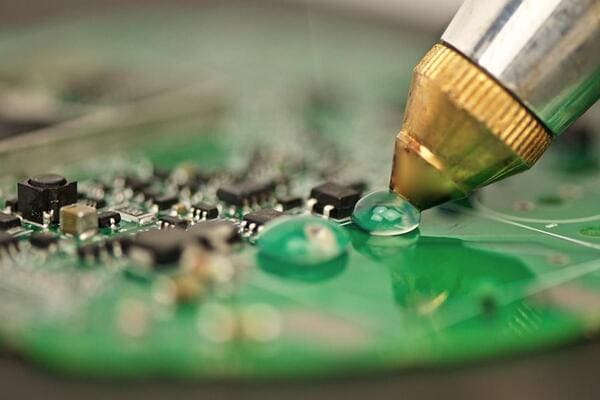
Poor adhesive selection leads to delamination, component tombstoning, thermal fatigue, or outright electrical failures. Getting the chemistry right from the start reduces rework costs and ensures the final product meets reliability standards — whether that is a consumer gadget or a safety-critical industrial controller.
Main Types of PCB Adhesive and Their Applications
Choosing a PCB adhesive is usually about matching the material to the job. Each type behaves differently, so it helps to look at them one by one.
Epoxy Adhesives
Epoxy is one of the most common options. It gives strong bonding and holds up well against chemicals and heat.
One-part epoxy is often used in SMT production. It cures during reflow, so there’s no extra step.
Two-part epoxy is more common in rework or small batches where oven curing isn’t convenient.
The trade-off is flexibility. Epoxy is rigid, so it’s not ideal for boards that bend or face heavy shock.
Silicone Adhesives
Silicone stays flexible after curing, which makes it good for harsh environments.
It works well in setups with vibration or temperature changes, such as automotive electronics or outdoor lighting. It also sticks to common PCB materials like FR-4 and ceramic.
The downside is strength. It doesn’t hold as tightly as epoxy, so it’s not the first choice for heavy mechanical loads.
UV-Curable Adhesives
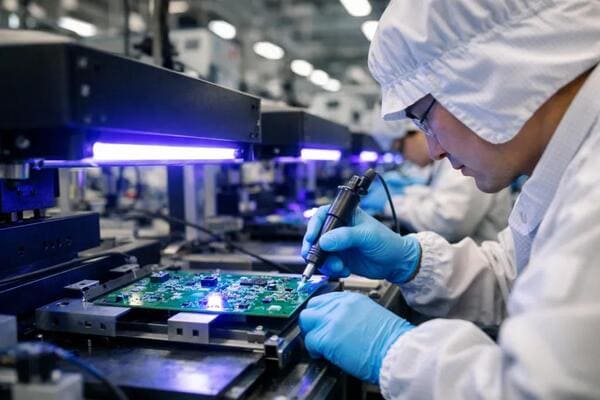
UV adhesives cure quickly under ultraviolet light. That makes them popular in fast production lines.
They are often used to hold parts in place before soldering or for bonding small optical components. For areas that UV light cannot reach, dual-cure versions are used so the adhesive still fully hardens.
Electrically Conductive Adhesives
This type uses conductive fillers, usually silver, so it can carry current.
It is useful when soldering is not suitable, especially for heat-sensitive parts or flexible boards. No flux is needed, which keeps the process cleaner.
One thing to note is resistance. It is higher than solder, so this adhesive is better for low-current or signal applications.
Thermally Conductive Adhesives
These adhesives are designed to move heat away from components.
They are commonly used to attach heat sinks to parts like power ICs, MOSFETs, and LEDs. The fillers help transfer heat while still keeping electrical insulation.
Performance depends on thermal conductivity. Lower values are fine for light use, while high-power designs need stronger grades above 3 W/m·K.
How to Choose the Right Adhesive for PCB Projects
No single adhesive for PCB assembly works perfectly across all scenarios. The right choice depends on several factors:
Operating temperature range: If your board will experience extreme heat or cold, silicone or high-temperature epoxy formulations are more suitable than standard one-part systems.
Substrate compatibility: Always verify the adhesive is rated for your specific board material. FR-4 is the most common, but polyimide, PTFE, and ceramic substrates each have different surface energy characteristics that affect adhesion.
Cure method and process constraints: Heat-sensitive components may not survive oven curing. UV-cure adhesives speed up production but require accessible bond lines. Two-part room-temperature systems offer the most flexibility but the slowest throughput.
Electrical requirements: Determine whether the adhesive must be insulating, conductive, or simply neutral. Placing a conductive adhesive in the wrong location can create unintended current paths.
Environmental exposure: Moisture, solvents, UV radiation, and vibration all degrade adhesive bonds over time. Choose a formulation rated for the end-use environment and consider pairing it with a conformal coating for additional protection.
Practical Tips for Applying PCB Adhesive
Even the best adhesive performs poorly if applied incorrectly. Keep these best practices in mind:
Clean the PCB surface before application. Flux residues, oils, and dust reduce adhesion significantly. Isopropyl alcohol wiped with a lint-free cloth is the standard pre-treatment for most substrates.
Apply in small, controlled deposits. Excessive adhesive can spread under components, wick into pads, and cause soldering defects or bridging. Precision dispensing equipment or syringes with fine tips help maintain accurate bead placement.
Respect pot life and shelf life. Two-part and UV-cure adhesives especially have limited working times once mixed or exposed. Always check manufacturer datasheets and store materials according to the specified temperature requirements.
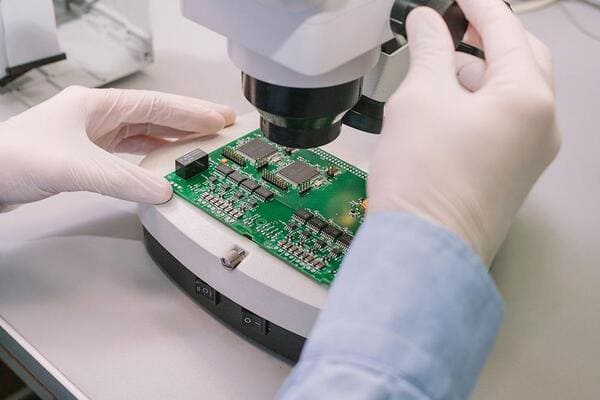
Perform adhesion tests before committing to production. Peel and shear strength testing on representative samples confirms the selected adhesive meets the mechanical demands of your application.
Starting with a Quality PCB Makes All the Difference
Adhesive selection is only one part of the reliability equation. The quality of the PCB itself sets the foundation. A board with inconsistent copper plating, rough surface finish, or contaminated laminates will undermine even the most carefully chosen adhesive. That is why many engineers and procurement teams turn to established manufacturers who maintain tight process controls.
PCBgogo is a well-regarded PCB manufacturer known for consistent board quality across a wide range of specifications — from standard FR-4 double-layer boards to complex high-density interconnect (HDI) designs. Engineers who start with cleanly fabricated, properly finished boards find that adhesive bonds seat correctly the first time, reducing rework and accelerating time to market. If you are planning your next PCB project, requesting a quote from PCBgogo is a straightforward way to ensure the board side of your assembly is in good hands before you even think about adhesive selection.
Common Mistakes to Avoid When Using Adhesive for PCB Assembly
Even experienced assemblers run into adhesive-related problems. The most frequent issues include:
Using general-purpose adhesives instead of electronics-grade formulations. Standard hardware-store adhesives often contain solvents or chemicals that damage PCB laminates, corrode copper traces, or outgas harmful vapors under heat.
Skipping compatibility checks between the adhesive and solder mask. Some adhesive chemistries swell or degrade solder mask materials, especially LPI (liquid photoimageable) coatings. Always verify compatibility.
Over-applying to compensate for poor bonding. More adhesive does not mean stronger adhesion. Excess material creates cleanup problems and can interfere with adjacent components or electrical contacts.
Ignoring curing conditions. Undercured adhesive has a fraction of its rated strength and chemical resistance. Follow the manufacturer's recommended time, temperature, and UV intensity exactly.
Conclusion
Choosing the right PCB adhesive is a decision that touches every layer of your product's performance — from assembly yield to long-term field reliability. By understanding the key adhesive types (epoxy, silicone, UV-curable, electrically conductive, and thermally conductive), matching formulation properties to your application requirements, and following sound application practices, you can significantly reduce the risk of adhesive-related failures.
Keep in mind that adhesive for PCB assembly performs best on boards that are themselves manufactured to a high standard. Investing in quality fabrication from the start — and selecting adhesive chemistry that suits your specific operating conditions — is the combination that delivers reliable, long-lasting electronics.
FAQ: PCB Adhesive
Q1. What is PCB adhesive used for?
A. It is used to hold components in place, improve mechanical stability, and protect the board during assembly and operation.
Q2. Why is PCB adhesive important in electronics manufacturing?
A. It helps prevent component movement during soldering and reduces the risk of failures like detachment or weak joints.
Q3. What types of PCB adhesives are commonly used?
A. The main types include epoxy, silicone, UV-curable, electrically conductive, and thermally conductive adhesives.
Q4. How do I choose the right PCB adhesive?
A. It depends on temperature range, curing method, electrical needs, and the operating environment of the product.
Q5. Can PCB adhesive affect circuit performance?
A. Yes. The wrong adhesive can cause electrical issues, weak bonding, or damage under heat and vibration.
Q6. Does PCB quality affect adhesive performance?
A. Yes. A clean, well-made PCB helps adhesive bond more reliably and reduces production issues. High-quality PCB factories like PCBgogo provide stable board surfaces that improve bonding consistency and assembly yield.