日本語
日本語
 한국어
한국어

How to Choose Machined Keyboard Material: FR4 vs Aluminum vs PP
QUICK ANSWER
The machined keyboard material depends on the target feel and build method. FR4 gives controlled flex and easy PCB-style routing, aluminum provides the firmest support and crispest response, and polypropylene (PP) creates the softest, most muted experience. For most prototypes, FR4 offers the safest balance of cost, precision, and iteration speed.
A keyboard plate looks simple until unwanted movement changes switch seating, stabilizer alignment, and sound across a row. Material choice also changes machining, dimensional control, assembly risk, and PCB procurement.
This guide compares FR4, aluminum, and PP, then shows how to release plate and PCB files without manufacturing guesswork.
Key Takeaways
FR4 balances flex and control. A 1.5 to 1.6 mm plate suits many MX-style prototypes and follows familiar PCB routing processes.
Aluminum prioritizes rigidity. 6061 aluminum supports switches firmly, but machining, deburring, and finishing increase small-batch cost.
PP prioritizes compliance. Its low stiffness suits soft builds whose mounts control plate travel.
Plate and PCB files must agree. Switches, stabilizers, mounting points, and connectors need one controlled revision.
Prototype the complete assembly. Test the plate, PCB, foam, case, and fasteners together before volume production.
What Is a Machined Mechanical Keyboard Plate
A machined mechanical keyboard plate is the structural sheet that locates the switches above the PCB and transfers key force into the case or mounting system. It is separate from the electrical PCB, although an FR4 plate uses the same glass fiber and epoxy laminate family as common circuit boards.
Many MX-style switches target about 1.5 mm plate thickness, often with tolerance near 0.1 mm. Standard PCB laminate is commonly 1.6 mm nominal, so check FR4 against the exact switch drawing. Excess thickness can prevent retention clips from engaging, while loose cutouts allow rotation.
Mounting also changes the load path. Compare materials with thickness, cutouts, mounting points, foam, and case construction held constant.
Where Mechanical Keyboard Plates Are Used
Mechanical keyboard applications use the plate differently because layout size, switch access, and structural span change the amount of support the assembly needs.
Compact 40 and 60 percent boards. Short spans make FR4 and PP practical, but universal cutouts reduce local stiffness.
65 and 75 percent custom keyboards. Flex cuts, gasket tabs, and mounting points matter as much as material.
Tenkeyless and full-size boards. Long spans favor aluminum or well-supported FR4 to limit sag.
Hot-swap keyboards. The plate must take switch removal force without bending socket pads.
Hand-wired prototypes. Without a PCB below, rigidity, edge support, and wiring access become primary constraints.
These use cases show why the next decision should compare mechanical behavior and manufacturing behavior together.
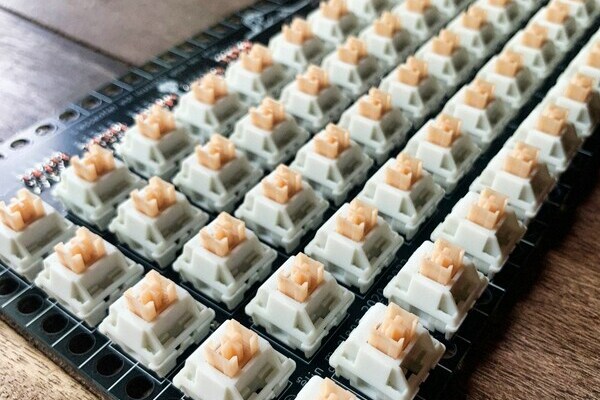
How FR4, Aluminum, and PP Behave as Keyboard Plate Materials
FR4, aluminum, and PP create distinct stiffness and damping profiles, so the right machined keyboard material is the one that matches the complete structure and intended typing response.
FR4 Keyboard Plates
FR4 is a woven glass-reinforced epoxy laminate that combines moderate stiffness with efficient routing in PCB fabrication equipment. Representative laminate data puts in-plane flexural modulus around 21 to 24 GPa, although actual behavior varies with glass weave, resin system, thickness, and cut direction.
At 1.5 or 1.6 mm, FR4 is less rigid than aluminum but more controlled than PP. It usually sounds focused. Specify clean routing and edge inspection because cut edges expose glass fibers.
Aluminum Keyboard Plates
Aluminum is a light metal plate material chosen for high rigidity, accurate machining, and durable surface finishes. Common 6061-T6 sheet has an elastic modulus near 68 GPa and density near 2.7 g per cubic centimeter, making it roughly three times as stiff as representative FR4 by modulus before geometry and cutouts are considered.
A 1.5 mm plate provides firm support and a crisp response. Specify alloy, temper, flatness, burr limits, edge break, finish, and whether dimensions apply before or after anodizing.
PP Keyboard Plates
Polypropylene is a low-density thermoplastic used when a soft, flexible, and muted plate response is the goal. Typical PP grades have density around 0.90 g per cubic centimeter and flexural modulus from about 0.9 to 2.3 GPa, far below aluminum and FR4.
Long PP plates need case, gasket, or tab support. Cutting heat and clamping can move thin sheet, so identify critical openings and review tolerances with the machinist. Validate switch retention on a coupon before approving the full plate.
The table below compares the three materials under the same design assumptions.
| Material | Typical thickness | Relative stiffness | Typing and sound tendency | Manufacturing notes | Recommended use |
|---|---|---|---|---|---|
| FR4 | 1.5 to 1.6 mm | Medium | Controlled flex, focused sound | CNC routing, exposed glass fiber edges, solder mask optional | Prototypes, gasket builds, balanced designs |
| 6061 aluminum | About 1.5 mm | High | Firm response, crisp sound | CNC or precision cutting, deburr, inspect flatness, finish after machining | Rigid builds, large layouts, premium finishes |
| PP | Often 1.5 mm or design-specific | Low | Soft response, muted sound | Control heat and clamping, verify openings with a coupon | Flexible gasket builds and sound-focused experiments |
How Material Choice Changes Plate Price
Plate price is the combined cost of stock material, machine time, setup, finishing, inspection, scrap risk, and order quantity. A low-cost sheet can still create an expensive plate if it needs slow cutting, special fixturing, or multiple finishing steps.
As of 2026, typical per-plate prices for 60% to 75% layouts are shown below in US dollars. Ready-made prices apply to common layouts, while one-off prices assume a production-ready DXF or STEP file. Shipping, taxes, design work, and PCB assembly are excluded.
| Material | Prototype cost | Volume cost drivers | Costs that buyers miss |
|---|---|---|---|
| FR4 | $8 to $18 | Panel utilization, routing distance, thickness, edge quality | Copper removal, cosmetic mask, small internal radii, separate plate and PCB setup |
| 6061 aluminum | $20 to $45 | Machine time, alloy, tool changes, deburring, anodizing, flatness inspection | Finish rejects, color matching, protective packaging, post-finish dimensional change |
| PP | $12 to $30 | Sheet thickness, fixturing, feed strategy, cutout count, scrap from distortion | Prototype coupons, slower machining, dimensional relaxation, protective handling |
FR4 often wins for one prototype because its workflow resembles PCB production. Aluminum improves when setup is spread across a batch. PP stock is inexpensive, but process development for thin sheet can erase that advantage.
What to Check When Buying a Mechanical Keyboard PCB
A reliable mechanical keyboard PCB order starts with one controlled mechanical stack and a complete manufacturing package, because the plate, PCB, case, switches, sockets, and stabilizers must locate each other correctly.
One coordinate system. Export plate DXF and PCB Gerber data from one revision. Confirm the intended pitch, commonly 19.05 mm, before release.
Verified spacing. Many MX-style assemblies use about 5.0 mm from plate top to PCB top. Check the selected switch, socket, and stabilizer drawings.
Complete mechanics. Show gasket tabs, screw holes, connectors, USB cutouts, encoders, and stabilizer clearances. Identify plated and nonplated PCB holes.
Hot-swap support. Check socket orientation and access. Switch removal should load the plate and supported PCB, not bend socket pads.
Production files. Provide Gerbers, drills, stackup, outline, BOM, centroid data, assembly drawings, firmware notes, and test requirements under one revision code.
Inspection plan. Request bare board electrical test plus checks for diode polarity, sockets, USB, programming, and matrix scanning.
Once these inputs are stable, material selection becomes a deliberate product decision rather than a late attempt to correct fit or sound.
How to Choose the Right Material for Your Build
Choose the plate by ranking feel, layout span, mounting method, production stage, and finish requirements in that order, then confirm the decision with a full assembly prototype.
Choose FR4 for balanced prototypes. Use it for moderate flex, fast iteration, and coordinated plate and PCB sourcing.
Choose aluminum for firm support. Use it for large layouts, frequent switch changes, or a visible anodized finish.
Choose PP for maximum softness. Use it when the mount controls travel. Prototype the longest row and spacebar area first.
Ignore isolated sound clips. Keycaps, switches, foam, case, desk, and recording setup can outweigh the plate difference.
Freeze geometry before cosmetics. Approve an engineering sample before anodizing, decorative mask, or volume machining.
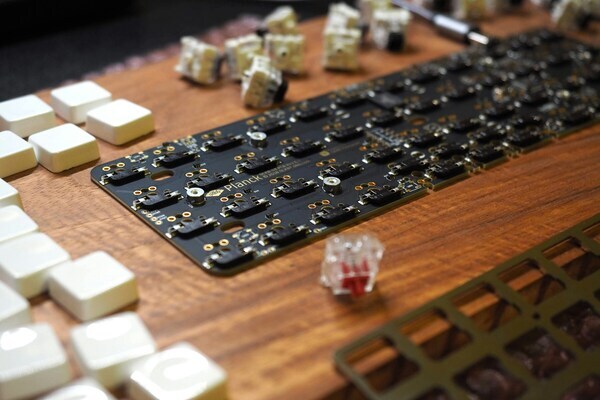
Why PCBgogo Fits Mechanical Keyboard PCB Projects
Mechanical keyboard projects benefit from a manufacturing partner that can review the PCB and the FR4 plate as one mechanical system, then keep fabrication, sourcing, assembly, inspection, and delivery under coordinated control.
Engineering review. PCBgogo provides DFM review to expose conflicting outlines, drills, routing features, and fabrication notes before production.
FR4 capability. Standard and high Tg FR4, multilayer stackups, surface finishes, and custom routing support both a routed plate and an electrical PCB.
One-stop assembly. Fabrication, component sourcing, SMT, through-hole work, inspection, and testing reduce handoffs for sockets, controllers, diodes, connectors, and LEDs.
Layered quality control. Available methods include solder paste inspection, automated optical inspection, X ray, flying probe, and customer-defined functional testing.
Production continuity. PCBgogo supports prototypes through volume orders, with expedited options for qualifying projects after file and material review.
Published ISO 9001 certification and UL recognition add process discipline. Submit the plate drawing, PCB data, BOM, assembly notes, and test plan together so the quotation reflects the complete build.
PCBgogo - Reliable, High-Quality PCB Manufacturing
Save time and money with an all-in-one solution for PCB fabrication, assembly, and parts. Reduce vendor coordination, avoid split shipments, and get consistent, reliable quality.
Get Free Quote >
Conclusion
FR4 is the most versatile starting point for many custom keyboards, aluminum is the better choice when rigidity and finish dominate, and PP suits designs built around deliberate flex and damping. Lock the plate and PCB to one mechanical stack, prototype the complete assembly, and ask PCBgogo to review the released files before production so cost, quality, and delivery are based on the same revision.
Frequently Asked Questions
Is FR4 the Same Material as a Mechanical Keyboard PCB
FR4 is the insulating laminate used in many PCBs, but the two parts differ. The plate locates switches; the PCB carries circuitry and components.
What Plate Thickness Works for MX Style Switches
About 1.5 mm is common for MX-style mounting, while FR4 is often 1.6 mm nominal. Check the switch drawing and finished thickness tolerance.
Does Aluminum Always Sound Louder Than FR4 or PP
No. Aluminum often sounds crisper and PP more muted, but the case, foam, mounting pressure, switches, keycaps, and desk can change the result.
Can a PCB Manufacturer Make an FR4 Keyboard Plate
Yes, PCB processes can route an unpopulated FR4 plate from a dedicated file. Specify thickness, openings, finish, copper requirements, edge quality, and inspection criteria.
Should the Plate and PCB Be Ordered Together
Yes, when possible. If another shop makes the aluminum or PP plate, release the same-dated drawing and verify both first articles together.