日本語
日本語
 한국어
한국어

Renewable Energy PCB: Requirements, Applications, and Manufacturing Guide
KEY DEFINITION A renewable energy PCB is a printed circuit board designed for power conversion, voltage regulation, and system monitoring in solar, wind, and energy storage systems. It is built to withstand long-term outdoor exposure, including temperature cycling, vibration, and humidity over 10 to 20 years of service life. These boards typically use heavy copper traces for high-current handling, thermal vias for heat dissipation, and high-reliability substrate materials to ensure stable performance in harsh renewable energy environments.
A solar panel sitting on a roof for fifteen years through every heat wave and downpour looks simple from the outside. The board controlling it underneath is doing anything but simple work.
This guide covers what renewable energy systems actually require from a PCB, where these boards show up across solar, wind, and hydropower applications, the challenges shaping how they get manufactured, and what to look for in a manufacturing partner.
What Renewable Energy Systems Require From a PCB
Renewable energy hardware asks more of a PCB than most consumer electronics ever will, and four requirements show up across nearly every application.
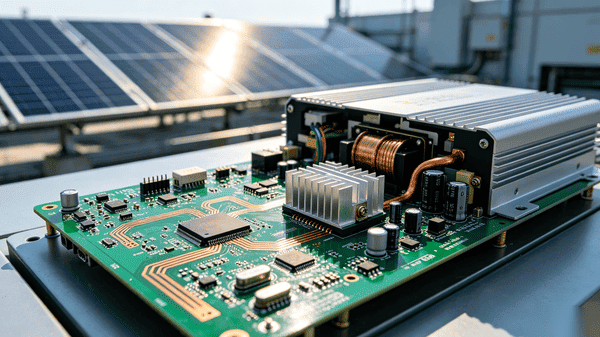
High current handling: Solar inverters, wind converters, and storage systems often carry large current loads, which means traces need enough copper, sometimes 2 ounce weight or higher, to avoid resistive heating and voltage drop.
Thermal endurance: Components inside solar inverters and wind converters can see surface temperatures in the 140 to 185 degree Fahrenheit range during normal operation, which calls for thermal vias, heat sinks, and substrates rated for sustained heat rather than brief spikes.
Long-term environmental durability: Outdoor-deployed boards face a decade or more of UV exposure, humidity, and temperature cycling, so materials and coatings need to hold up over a 10 to 20 year service life rather than a typical 3 to 5 year consumer product lifespan.
Precise voltage regulation and monitoring: Inverters and battery management systems depend on stable voltage regulation and accurate sensor feedback to convert and distribute power safely, since a regulation failure can cascade into damaged components or unsafe operation.
These requirements play out differently depending on which renewable energy technology the board is built into.
Applications of Renewable Energy PCBs
Solar, wind, and hydropower systems each lean on PCBs for a different combination of power conversion, control, and monitoring.
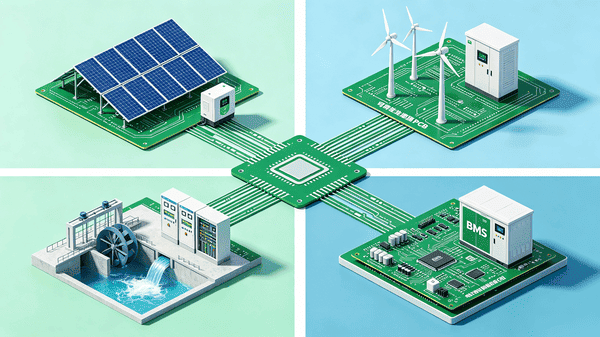
Solar energy systems: PCBs interconnect solar cells within panels and manage the conversion of sunlight into electricity, while inverter boards convert that DC output into grid-compatible AC power, with modern designs reaching conversion efficiencies above 95 percent.
Wind energy systems: Turbine control boards manage blade pitch and power conversion from variable-speed mechanical rotation into stable AC power, regulating voltage and frequency to maintain grid stability as wind conditions change.
Hydropower systems: PCBs control electricity generation from flowing water in both small-scale and utility hydropower installations, stabilizing voltage fluctuations and synchronizing output with the grid for smooth, continuous operation.
Energy storage systems: Battery management system boards monitor individual cell voltage and temperature, balancing charge across cells to protect the pack during both charging and discharge cycles.
Each of these applications faces its own version of the same underlying manufacturing challenge: building a board that survives the field.
Challenges and Future Trends in Renewable Energy PCB Manufacturing
Manufacturing PCBs for renewable energy means solving for durability and current handling at the same time as cost, and a few challenges and trends are shaping how the industry responds.
Environmental stress testing: Boards destined for outdoor solar and wind installations increasingly go through accelerated thermal cycling and humidity testing before production, since a field failure a decade into a panel's life is far more costly than catching a weak design early.
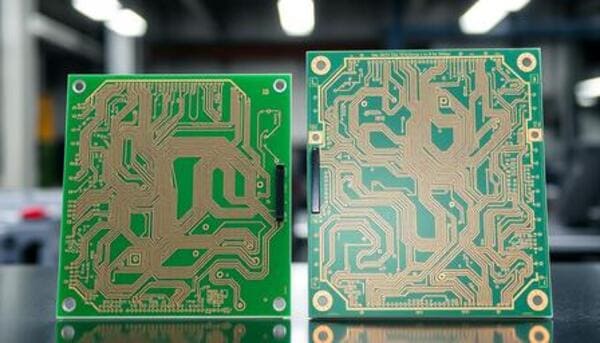
Heavy copper and thick substrate adoption: As systems scale to higher power output, more designs are shifting to heavy copper PCBs and thicker substrates to handle current loads that would overheat a standard-weight board.
Rigid-flex and HDI adoption: Compact inverters and portable battery packs are pushing more designs toward rigid-flex construction and higher density interconnect technology to fit growing component counts into smaller enclosures.
Smart grid integration: As grid infrastructure adds more real-time monitoring and communication, more renewable energy boards need controlled impedance routing and high-frequency design to keep data transfer between distributed components accurate.
Sustainable materials and processes: Given the industry's environmental positioning, more manufacturers are shifting toward RoHS-compliant materials and lower-impact production processes without sacrificing the durability these boards need.
Why Renewable Energy Projects Choose PCBgogo
A successful renewable energy PCB project means solving several key challenges on one board. It must handle high current, strong heat, and more than ten years of reliable use. Even if a design looks perfect on paper, it can still fail in real use if the manufacturing process cannot keep key parameters and tolerances stable.
PCBgogo has more than 10 years of PCB manufacturing experience. We focus on heavy copper boards, multilayer boards, and HDI boards. This allows us to support a wide range of high-reliability applications, from consumer electronics to industrial and energy systems. A strong process control and quality system ensures consistent performance across different production batches. We also provide stable and reliable delivery times to keep your project on schedule.
At the start of each project, our engineering team reviews your power needs, thermal design, and long-term reliability goals. Based on this, we build a manufacturing plan that fits your real application needs. If you are working on a renewable energy PCB project, feel free to contact our team. We will work with you to find the best solution.
Final Takeaway
A renewable energy PCB has to do more than route signals, it has to survive a decade or more of heat, current, and weather while keeping a solar, wind, or hydropower system running reliably. Getting the current handling, thermal management, and material selection right at the design stage is what determines whether that board still performs after ten years in the field.
Frequently Asked Questions
What makes a PCB suitable for renewable energy applications?
A renewable energy PCB needs heavier copper traces for high current handling, thermal management features like vias and heat sinks, and materials or coatings rated to survive outdoor temperature cycling, humidity, and UV exposure for 10 to 20 years.
Why do solar inverter PCBs need such high conversion efficiency?
Every percentage point of conversion loss in a solar inverter directly reduces the usable energy output of the system, so modern inverter PCB designs target efficiencies above 95 percent to maximize the return on a solar installation.
How are PCBs used differently in wind versus hydropower systems?
Wind turbine PCBs primarily manage blade pitch control and convert variable-speed rotational energy into stable AC power, while hydropower PCBs focus more on stabilizing voltage from continuous flowing water input and synchronizing that output with the grid.
Do renewable energy PCBs need special certifications?
Most renewable energy PCB manufacturers build to ISO 9001:2015 for quality management and IPC-A-610 for workmanship standards, with IPC-6012 Class 2 commonly applied given the extended service life these boards need to support.
How does heavy copper PCB construction help renewable energy systems?
Heavy copper PCBs use thicker copper layers, often above standard 1 ounce weight, to carry higher current loads without excessive resistive heating, which makes them well suited to high-power applications like solar trackers and wind turbine power converters.