日本語
日本語

Why is the SMT Rework Essential for PCBA Mass Production?
In the high-stakes world of mass-produced Printed Circuit Board Assembly (PCBA), perfection is the goal, but reality often presents challenges. No matter how advanced the equipment or how strict the quality control, a small percentage of defects—such as component misalignment, cold solder joints, incorrect parts, or damaged chips—is virtually inevitable. This is where SMT rework becomes the ultimate "life raft" for the production line.
The SMT rework process refers to the specialized technology and equipment used to repair defective units, restoring them to meet original quality standards. For high-volume production, this capability is critical. It drastically reduces scrap rates and saves significant manufacturing costs, particularly for high-value boards used in automotive electronics and medical devices, where the cost of disposal is incredibly high.
More Than Just a Manual Fix: The Complexity of Rework
Many assume that rework is simply a matter of "desoldering a part by hand and putting it back on." In reality, professional SMT rework is a high-tech, specialized craft. The core difficulty lies in the precise control of temperature and mechanical force: you must remove the defective component without damaging the PCB substrate or the surrounding sensitive parts.
Using the common "BGA (Ball Grid Array) Rework" as an example, let's look at the sophisticated workflow involved:
1. Defect Detection and Localization
Before any physical work begins, AOI (Automated Optical Inspection) or X-ray machines are used to pinpoint the exact failure—whether it is a specific micro-crack in a BGA solder ball or a failure within the chip itself. Precision at this stage prevents collateral damage to healthy components.
2. Specialized Fixture Securing
The PCB is secured onto a specialized rework station fixture. This ensures even heat distribution across the board, preventing the PCB from warping due to localized high temperatures. High-end stations, such as those used by PCBGOGO, often feature vacuum suction to keep small boards perfectly stable during operation.
3. Precision Heating and Desoldering
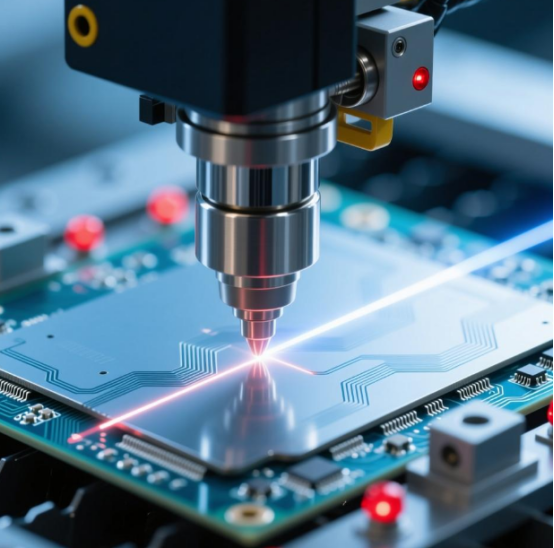
The rework head adjusts its temperature profile and airflow based on the specific BGA size and package. It heats both the top and bottom of the chip simultaneously. Once the solder reaches its liquidus state, a vacuum nozzle gently lifts the chip.
The Risk: If the temperature is too low, the pads may be torn off during removal. If it is too high, the PCB substrate or adjacent components may suffer thermal damage.
4. Site Cleaning and Pad Restoration
After the chip is removed, residual solder and flux remain on the pads. These must be meticulously cleaned using a soldering iron and desoldering wick to ensure a perfectly flat surface. If there is minor pad damage, specialized pad repair pastes are used for restoration.
5. Component Replacement and Re-soldering
Fresh solder paste is applied, and the rework station’s optical alignment system is used to place the new BGA chip with micron-level accuracy. The heating head then runs a reflow cycle to solder the part. Finally, a post-rework X-ray inspection is performed to ensure a void-free, perfect connection.
Why It Is the "Life Raft" of Mass Production
Let’s look at the economics. A high-value automotive PCB might cost $100 or more. In a production run of 10,000 units, even a tiny 0.5% defect rate results in a $5,000 loss if those boards are scrapped. By utilizing an effective SMT rework strategy, the vast majority of these units can be salvaged, bringing the final scrap rate down below 0.1% and saving thousands of dollars in material costs.
Beyond BGA chips, this process also covers the correction of misaligned connectors, lead forming, and manual solder touch-ups for resistors or capacitors.
Conclusion: Quality Meets Recovery
While SMT rework is a powerful tool, it does have limits. Boards with cracked substrates, severely lifted pads, or internal chip core damage cannot be saved and must be scrapped. To maintain the highest standards, PCBGOGO establishes rigorous rework criteria to distinguish between salvageable and non-repairable defects. This ensures that every repaired board performs just as reliably as a first-pass success.
In summary, the core value of the SMT rework process—repairing defects, reducing scrap, and saving costs—makes it an indispensable specialized technology in the PCB mass production cycle.