日本語
日本語
 한국어
한국어

Step-by-Step Guide to SMT Stencil Cleaning
In the world of Surface Mount Technology (SMT), the stencil is the unsung hero, responsible for depositing precise volumes of solder paste onto the PCB pads. However, the printing process inevitably leaves residual paste, leading to defects if not properly managed. SMT stencil cleaning is not just a chore—it’s a critical process that directly impacts print quality, yield, and overall manufacturing efficiency.
Why SMT Stencil Cleaning Is Essential
When a stencil is separated from the PCB after printing, some solder paste residue remains stuck to the aperture walls and the underside of the stencil. This issue, often called "solder paste clogging" or "smearing," leads to several severe print defects:
Incomplete Fills/Insufficient Paste: Clogged apertures prevent the correct volume of paste from being deposited, leading to weak or open solder joints.
Solder Bridging: Excess paste clinging to the stencil's underside can transfer onto the PCB, causing paste to connect adjacent pads, which results in short circuits.
Poor Print Definition: Residual paste can distort the shape of the deposited paste brick, leading to inconsistent joint quality.
Reduced Yield: All of the above defects necessitate costly rework or scrap, dramatically lowering the production yield.
Regular and effective stencil cleaning is the fundamental way to mitigate these risks and maintain a high-quality SMT assembly process.
Manual SMT Stencil Cleaning: Step-by-Step
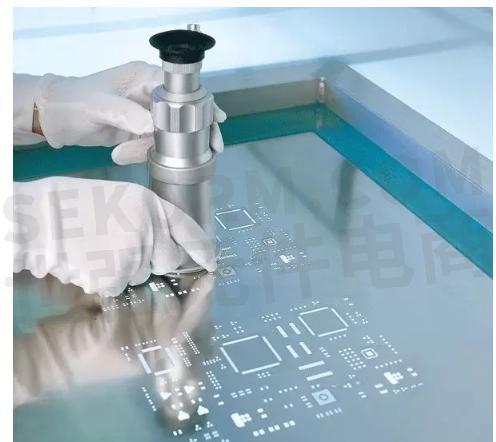
Manual stencil cleaning is typically performed between print cycles (underside wipe) or when the stencil is removed from the printer for storage or batch changeover (full cleaning).
Underside Wipe (During Production)
Stop Printing: Halt the printing cycle momentarily.
Solvent Application: A lint-free wipe or paper soaked in an appropriate stencil cleaning solvent (often an IPA-based cleaner or specialized paste remover) is positioned underneath the stencil.
Wipe: The print head or squeegee carriage moves the solvent-soaked material across the entire underside surface of the stencil, effectively removing trapped paste.
Full Cleaning (Off-line)
Rinsing: Use an initial rinse or scraper to remove the bulk of the remaining solder paste from the stencil surface.
Soaking: Immerse the stencil in a specialized SMT stencil cleaner or solvent bath to dissolve and loosen the stubborn, dried paste inside the apertures.
Scrubbing/Wiping: Gently scrub the stencil apertures with a soft, non-abrasive brush or wipe to ensure all residue is fully removed. Be careful not to damage the aperture walls.
Final Rinse and Drying: Rinse the stencil with clean solvent or deionized water to remove any chemical residue. Use compressed air or a clean, lint-free cloth to thoroughly dry the stencil before reuse or storage.
Automated and Ultrasonic Cleaning Methods
For high-volume production, manual cleaning is too slow and inconsistent. Automated methods offer superior speed, consistency, and cleanliness.
Automated Stencil Cleaning (In-line)
Automated stencil wiping is integrated directly into the SMT printer.
How it Works: The printer has an internal wiping system that automatically moves a roll of cleaning paper (typically pre-soaked or dry-wiped with a vacuum assistance) across the underside of the stencil after a set number of print cycles. This process is continuous and critical for maintaining quality during long production runs.
Key Benefit: Consistent cleaning pressure and timing reduce human error and minimize production downtime.
Ultrasonic Stencil Cleaning (Off-line)
This method is highly effective for deep cleaning stubborn, dried-on paste.
How it Works: The stencil is placed in a tank filled with a specialized aqueous (water-based) or solvent cleaning solution. Ultrasonic transducers generate high-frequency sound waves (>20 kHz) within the tank. These waves create millions of microscopic bubbles that rapidly form and collapse (a process called cavitation). The energy released by this cavitation provides an intense scrubbing action that blasts away solder paste residue trapped deep within the fine-pitch stencil apertures.
Key Benefit: Exceptional cleaning power, especially for fine-pitch stencils and deep cleaning highly contaminated stencils.
Automation or Manual Cleaning: When to use them?
The choice between manual and automated/ultrasonic cleaning depends heavily on your production scale, the complexity of your PCBs, and your quality requirements.
Recommendation: For modern SMT assembly focused on high yield and quality, a combination is best: use automated in-line wiping during production to maintain quality, and utilize off-line ultrasonic cleaning for periodic deep cleaning of the stencil to ensure perfect aperture walls.
Maintaining High-Quality SMT Assembly Through Proper Stencil Cleaning
SMT stencil cleaning is arguably as important as the printing process itself. By ensuring apertures are completely free of residual solder paste, manufacturers can significantly reduce defects like bridging and insufficient paste, leading to higher first-pass yield and reliable electronic products.
Whether you rely on manual wipes or state-of-the-art ultrasonic systems, committing to a rigorous cleaning protocol is non-negotiable for achieving high-quality SMT assembly. Trusted partners in electronics manufacturing, such as PCBGOGO, emphasize quality at every stage, understanding that a clean stencil is the foundation of a perfectly manufactured PCB.