日本語
日本語
 韩語
韩語

Solder Paste vs. Solder Wire: A Complete Comparison Guide
Choosing between solder paste and solder wire is one of the most fundamental decisions in electronics assembly. Get it right, and your process runs smoothly. Get it wrong, and defect rates climb, rework costs rise, and reliability suffers. The good news is that the choice follows clear logic: each material has a natural home, and understanding that home makes the decision straightforward. This guide walks through what each material is, where it excels, how it is used, and exactly when to reach for one over the other.
What Is Solder Paste?
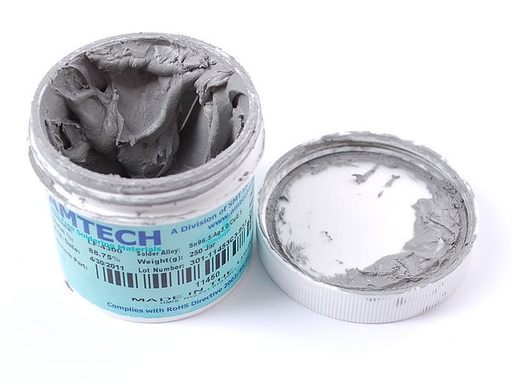
Solder paste is a thick, grey, semi-viscous mixture of microscopic solder alloy particles — typically ranging from 20 to 45 microns in diameter — suspended in a flux medium. The flux serves a dual purpose: it chemically cleans metal oxide layers from the pad and component surfaces, and it holds the paste in position until heat is applied.
In surface mount technology (SMT) assembly, solder paste is printed onto PCB pads through a laser-cut stainless steel stencil, then components are placed on top, and the entire board passes through a reflow oven. As the temperature profile rises and peaks — typically around 240–260 °C for lead-free SAC alloys — the paste melts, the flux burns off, and a solid electrical and mechanical solder joint forms on cooling.
Solder paste comes in several alloy families. Tin-lead (Sn63/Pb37) melts at a single eutectic temperature of 183 °C, offering excellent wettability and a forgiving process window. Lead-free SAC305 (Sn96.5/Ag3.0/Cu0.5) is the dominant RoHS-compliant choice, melting around 217–220 °C. Low-temperature bismuth-based alloys (such as Sn42/Bi57/Ag1, melting near 138 °C) are used for heat-sensitive components and flexible circuits. Paste types also vary by flux chemistry — no-clean formulas leave a benign residue requiring no post-process wash, water-soluble pastes require deionized water cleaning after reflow but offer superior oxide removal, and RMA (rosin mildly activated) pastes suit high-reliability aerospace and defense applications.
What Is Solder Wire?
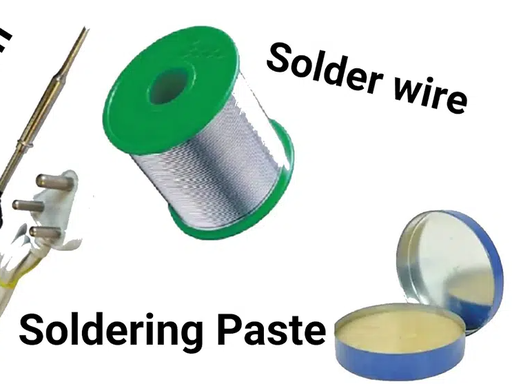
Solder wire is a solid, flexible strand of solder alloy, typically with a rosin or no-clean flux running through its hollow core. As the iron melts the wire onto a joint, the flux core activates first, cleaning the metal surface to ensure the molten solder bonds properly.
Wire diameters range from around 0.5 mm for fine electronics work up to 1.5 mm or larger for heavier joints. Alloy compositions mirror those available in paste form — leaded 63/37 and 60/40, lead-free SAC305, and specialty silver-loaded formulations for audio or high-reliability applications. Eutectic 63/37 wire (melting at exactly 183 °C with no plastic phase transition) is particularly valued for hand soldering because joints solidify instantly, reducing the risk of movement-induced cold joints.
Unlike solder paste, solder wire requires no special storage conditions. While paste must be refrigerated between 2 and 10 °C and used within six to twelve months of manufacture, wire is stable at room temperature for years. This makes it far more practical for workshops, field repair teams, and low-volume operations.
Solder Paste vs. Solder Wire: Key Differences at a Glance
| Feature | Solder Paste | Solder Wire |
|---|---|---|
| Form | Thick paste (alloy powder + flux) | Solid wire (often flux-cored) |
| Application | Stencil, dispenser, or syringe | Handheld soldering iron |
| Best Use | SMT, automated assembly | Through-hole, repair, prototyping |
| Precision | Very high (stencil-controlled) | Moderate (operator-dependent) |
| Equipment | Stencil printer + reflow oven | Soldering iron + tip |
| Storage | Refrigerated (2–10 °C), 6–12 months | Room temperature, multi-year |
| Cost (small-scale) | Higher setup cost | Low — iron + spool sufficient |
| Production Volume | High-volume ideal | Low-volume / one-off ideal |
When to Use Solder Paste
Solder paste is the right choice in three primary scenarios:
Surface-Mount Technology (SMT) Assembly
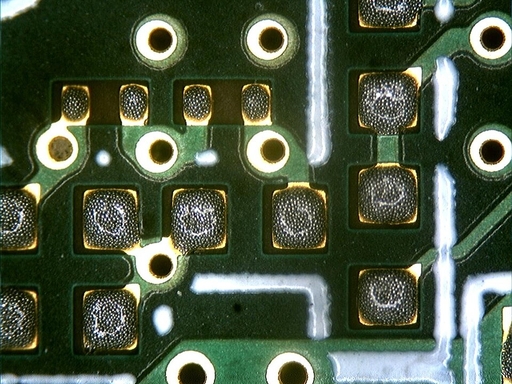
Any time you are working with surface-mount components — chip resistors, capacitors, SOICs, QFPs, BGAs, or any device without through-board leads — solder paste is the correct medium. Its stencil-applied deposition ensures consistent solder volume on every pad, including extremely fine-pitch locations. For 0402 or 0201 passives, and for 0.5 mm pitch ICs, paste delivered through a precision stencil is the only practical way to achieve repeatable, void-free joints at scale. Solder wire cannot deposit the precise, controlled volumes these components demand.
High-Volume and Automated Production
In a modern SMT line, solder paste is applied by an automated stencil printer in seconds per board, components are placed by pick-and-place machines at tens of thousands of parts per hour, and the full board is reflowed in a single oven pass. The result is consistent, fast, and scalable. Attempting this workflow with wire would require a soldering technician at every joint — impractical for anything beyond a handful of boards. When throughput and consistency matter, paste has no substitute.
Fine-Pitch and High-Density Designs
Closely spaced leads on QFP or QFN packages, or the micro-pads beneath BGA arrays, demand that solder is applied in exactly the right quantity to exactly the right location. Paste and stencil technology provides this control. Too much solder bridges pins; too little creates open joints. Stencil apertures are engineered to deposit the exact volume required, and 3D solder paste inspection (SPI) machines verify every deposit before a component is placed — eliminating the majority of downstream defects before they can occur.
When to Use Solder Wire
Solder wire belongs in three core scenarios:
Through-Hole Component Assembly
Through-hole components — electrolytic capacitors, connectors, transformer pins, power resistors, and similar parts with leads that pass through the PCB — are naturally suited to wire soldering. The technician heats the pad and lead with a soldering iron, then feeds wire into the joint until it flows cleanly through the hole and forms a fillet on both sides. The resulting joint is mechanically robust, capable of shear strengths exceeding 10 MPa, and well-suited to components that experience insertion force or vibration.
Repair, Rework, and Field Service
When a joint fails, a component needs replacement, or a board comes back from the field with damage, solder wire is the tool of choice. A technician can add precise amounts of solder to a single joint without disturbing neighboring components, control heat on a joint-by-joint basis, and complete repairs with only an iron, wire, and desoldering braid or pump. This flexibility is impossible to replicate with paste, which requires a stencil and reflow heat source.
Prototyping and Low-Volume Projects
For a prototype board, a one-off repair, or a hobbyist project, the setup cost of paste-based assembly — stencils, paste jars, reflow oven or hot air setup — is difficult to justify. A quality soldering iron, a spool of 0.8 mm rosin-core wire, and a steady hand are all that is needed to build functional, reliable circuits. The learning curve is also shorter: beginners can achieve acceptable joints with wire and an iron far more quickly than mastering stencil printing and reflow profiling.
How to Choose: A Practical Decision Framework
If you are still uncertain which material fits your situation, these four questions will guide the decision:
What type of components are you soldering? Surface-mount parts → paste. Through-hole parts → wire. Mixed boards → often both, in sequence.
What is your production volume? More than 10–20 boards with the same design → evaluate paste and reflow. Single boards, prototypes, or repairs → wire.
What equipment do you have or can justify? Reflow oven and stencil capability → paste becomes viable. Soldering iron only → wire.
What are your quality standards? High-reliability applications (aerospace, medical, defense) may mandate paste-based SMT assembly with full SPI and X-ray verification. General-purpose repairs and prototypes are well-served by wire.
Storage, Handling, and Shelf Life
One underappreciated difference between these two materials is storage. Solder wire is stable at room temperature — keep it in a low-humidity environment, away from direct sunlight, and a spool can last for years without degradation. Solder paste is perishable. Most manufacturers specify refrigerated storage at 2–10 °C and a shelf life of six to twelve months from manufacture. Paste left at room temperature ages quickly: the flux loses activity, the alloy powder can oxidize, and viscosity changes affect printability. Always warm refrigerated paste to room temperature for at least an hour before use, and stir or mix it per the manufacturer's specification before printing. Using expired or improperly stored paste is a leading cause of print defects and insufficient wetting.
Can You Use Both on the Same Board?
Yes — and this is common practice. Mixed-technology PCBs carry both surface-mount and through-hole components on the same substrate. The standard process sequence is: print solder paste, place SMT components, reflow, then hand-solder through-hole parts with wire. Some advanced processes use selective soldering machines to automate the wire-equivalent step for through-hole parts after SMT reflow, but the fundamental material split remains the same: paste for SMT, wire (or wave solder) for through-hole.
It is also perfectly valid to use solder wire for touch-up or rework on a board originally assembled with paste. After reflow, individual joints that fail inspection can be reworked manually with wire and an iron — the two materials are chemically compatible as long as leaded and lead-free alloys are not mixed (which introduces reliability risks due to differing melting points and metallurgical interactions).
Conclusion
The solder paste vs. solder wire question is ultimately about matching material to method. Solder paste dominates wherever precision, automation, and volume are priorities — SMT assembly, fine-pitch components, and high-throughput production lines. Solder wire remains indispensable wherever manual control, flexibility, and low setup cost are what matters — through-hole assembly, repairs, field service, and prototyping.
Neither material is universally superior. Many professional engineers and manufacturers use both every day, each in its proper context. Understanding that context — the component type, the process method, the volume, and the equipment available — is all you need to make the right call every time.