日本語
日本語

SMD Resistors: The Complete Guide to Sizes, Codes, and Selection
An SMD resistor — short for Surface-Mount Device resistor, is a tiny passive component soldered directly onto a PCB surface to control current flow. Simple in concept, yet fundamental to nearly every piece of modern electronics, from the smartphone in your pocket to the control units inside a car.
For electrical engineers, PCB designers, and electronics enthusiasts alike, mastering SMD resistors is essential. This guide breaks down everything you need to know: types, sizes, marking codes, key specs, and how to choose the right one for your design
What Is an SMD Resistor?
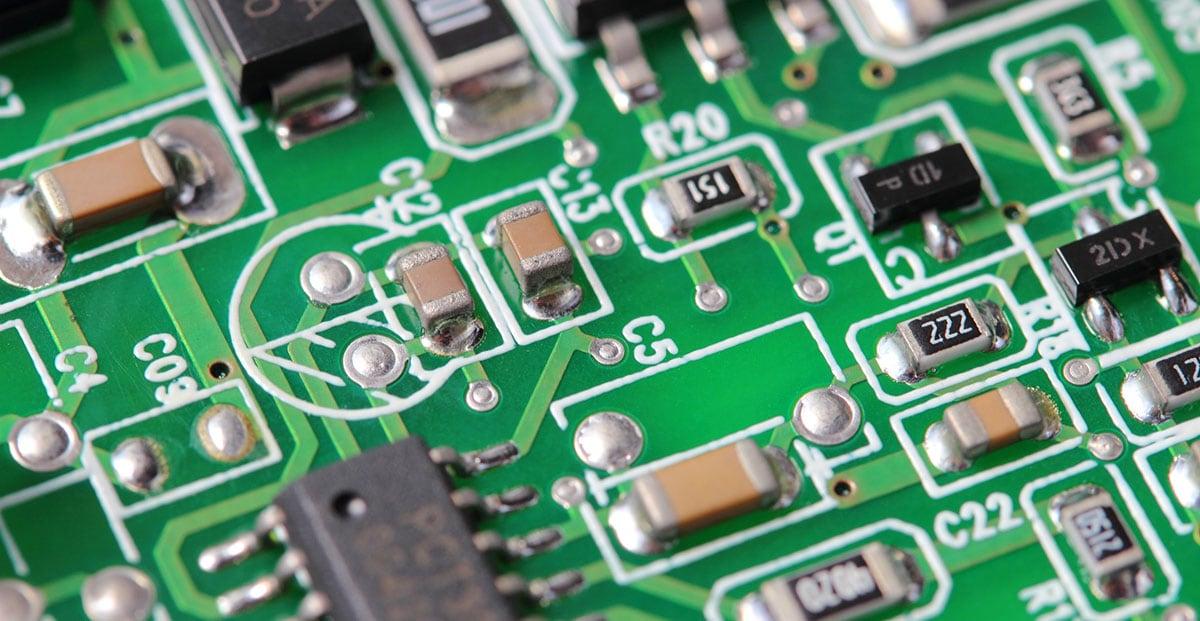
An SMD resistor is a small resistor that is mounted directly on the surface of a PCB. Unlike traditional through-hole resistors, which have long wire leads that go through the board, SMD resistors sit flat on the surface and are soldered onto copper pads. This design makes them fully compatible with automated pick-and-place assembly, dramatically reducing production time and cost.
This seemingly simple difference has enormous implications:
· Smaller footprint — SMD resistors occupy dramatically less PCB space
· Automated assembly — They're compatible with high-speed pick-and-place machines
· Better high-frequency performance — Lower parasitic inductance and capacitance compared to through-hole types
· Lower production costs — Faster machine-based soldering reduces labor expenses
Today, SMD resistors are used in almost every type of electronic product you can think of, from smartphones and laptops to medical devices, cars, and industrial equipment. In modern electronics, they have basically become the standard choice
SMD Resistor Sizes: The Complete Size Chart
One of the first things engineers and hobbyists need to understand is SMD resistor sizing. Sizes follow a standardized four-digit code system defined by EIA/JEDEC standards. This code directly represents the resistor's physical length and width.
How the Size Code Works
SMD resistor sizes are usually shown using a four-digit code. The first two digits represent the length, and the last two digits represent the width (in hundredths of an inch).
undefined
The table below shows the most common SMD resistor sizes and their metric equivalents for quick reference.
| Imperial Code | Metric Code | Length (mm) | Width (mm) | Height (mm) | Power Rating |
|---|---|---|---|---|---|
| 01005 | 0402 | 0.40 | 0.20 | 0.13 | 1/32W (0.031W) |
| 0201 | 0603 | 0.60 | 0.30 | 0.25 | 1/20W (0.05W) |
| 0402 | 1005 | 1.00 | 0.50 | 0.35 | 1/16W (0.062W) |
| 0603 | 1608 | 1.55 | 0.85 | 0.45 | 1/10W (0.10W) |
| 0805 | 2012 | 2.00 | 1.20 | 0.45 | 1/8W (0.125W) |
| 1206 | 3216 | 3.20 | 1.60 | 0.55 | 1/4W (0.25W) |
| 1210 | 3225 | 3.20 | 2.50 | 0.55 | 1/2W (0.50W) |
| 1812 | 4532 | 4.50 | 3.20 | 0.60 | 3/4W (0.75W) |
| 2010 | 5025 | 5.00 | 2.50 | 0.60 | 3/4W (0.75W) |
| 2512 | 6332 | 6.30 | 3.20 | 0.60 | 1W |
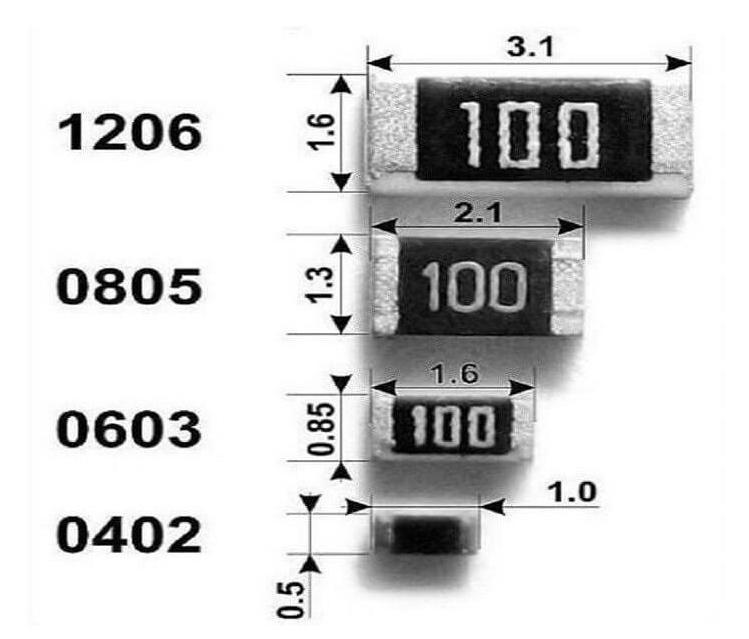
Note: Every size also has a metric equivalent (e.g., 0603 imperial = 1608 metric), though the imperial codes are used far more commonly in datasheets and BOM documents.
Choosing the Right SMD Resistor Size
01005 and 0201 — Ultra-miniature packages used in the most space-constrained applications like hearing aids and advanced wearables. Requires specialized automated assembly equipment; essentially impossible to solder by hand.
0402 — Common in compact consumer devices and mobile phones. Still very small, but appears frequently in professional and semi-professional designs. Manual handling is possible but difficult.
0603 — One of the most widely used sizes in modern electronics. It offers a good balance between small footprint and manageability. Used in smartphones, tablets, wearables, and IoT modules. Rated for 0.1W.
0805 — Slightly larger than 0603, making it easier to handle during manual assembly and rework. Rated for 0.125W–0.25W. A popular choice for hobbyists and prototyping.
1206 — A robust general-purpose size offering better thermal performance (0.25W). Easier to solder by hand. Commonly used in power management circuits and LED drivers.
1210, 1812, 2010, 2512 — High-power packages used when significant heat dissipation is required. Found in power electronics, motor controllers, and high-current sensing circuits.
Smaller sizes = more compact PCB, harder to handle, lower power capacity. Larger sizes = easier assembly, better power handling, greater board area consumed.
SMD Resistor Types
Not all SMD resistors are created equal. Several construction technologies exist, each suited to different applications.
Thick-Film Resistors
The most common type, made by printing a resistive paste onto a ceramic substrate and firing it at high temperature. They are cost-effective, widely available, and suited for general-purpose use. Tolerance is typically ±1% to ±5%.
Thin-Film Resistors
Manufactured by depositing a thin metallic alloy film onto a ceramic substrate using vacuum sputtering. They offer significantly better precision, lower noise, and more stable temperature performance than thick-film types. Tolerance can reach ±0.1% or better.
Metal-Oxide Resistors
A robust resistor type made from a metal oxide layer deposited on a ceramic core, offering strong resistance to high temperatures and long-term stability. Best for: Automotive systems, industrial equipment, and high-temperature environments.
Metal-Film and Metal-Oxide Resistors
These provide better thermal stability and reliability than carbon types. Metal-oxide resistors are especially resistant to high temperatures, making them suitable for demanding environments.
Wire-Wound Resistors
Built by winding resistive wire around a ceramic core. Capable of handling significantly higher power levels. However, their wound structure introduces inductance, making them unsuitable for high-frequency circuits.
Current-Sense Resistors
A specialized variant with very low resistance values (milliohms range) and tight tolerances, designed specifically for measuring current flow via Ohm's law (V = IR).
Key Specifications to Understand
Resistance Value
Expressed in ohms (Ω), kilohms (kΩ), or megaohms (MΩ). Always verify the value using the marking code and cross-reference with the datasheet.
Tolerance
How closely the actual resistance matches the marked value, expressed as a percentage:
Y or R× 0.01X or S× 0.1A× 1B or H× 10C× 100D× 1,000E× 10,000F× 100,000
Power Rating (Wattage)
The maximum power a resistor can continuously dissipate without damage. Exceeding this causes the resistance value to drift, the body to crack, or the component to burn out.
Calculate required power using:
· P = I2 × R (when current is known)
· P = V2 / R (when voltage is known)
Always select a resistor with a power rating at least 2× your calculated dissipation for a safety margin.
Temperature Coefficient of Resistance (TCR)
Describes how much the resistance changes per degree Celsius change in temperature, measured in ppm/°C (parts per million per degree Celsius).
· Traditional SMD resistors: ±100 to ±200 ppm/°C
· Modern precision resistors: ±10 to ±25 ppm/°C
Lower TCR = more stable performance across temperature extremes. Critical for automotive, aerospace, and outdoor applications.
SMD Resistor Applications by Industry
Consumer Electronics
0603 and 0805 resistors dominate smartphones, tablets, and laptops. They manage power distribution, protect circuits from overcurrent, implement pull-up/pull-down networks, and handle signal conditioning.
Automotive Systems
Modern vehicles contain hundreds of SMD resistors in engine control units (ECUs), transmission control modules, ADAS sensors, infotainment systems, and LED lighting drivers. Automotive-grade resistors require tight tolerances (±1% or better), AEC-Q200 qualification, and operation from ?40°C to +155°C.
Medical Devices
Patient monitoring equipment, implantable devices, and diagnostic instruments rely on precision thin-film SMD resistors. Accuracy is safety-critical; a drifting resistor value in a glucose meter or cardiac monitor can have serious consequences.
Industrial Automation
Robotics, PLCs, and factory equipment use SMD resistors across a wide power range. Current-sense resistors are particularly important in motor drive circuits, where accurate current measurement directly impacts control performance.
Telecommunications and 5G
Base station amplifiers and RF front-ends require resistors with very low TCR and minimal parasitic effects. Thin-film resistors with low inductance are preferred for high-frequency signal paths.
IoT and Wearables
Aggressive miniaturization drives demand for 0402 and 0201 packages. Low power consumption is also critical, making resistance accuracy important for current control in battery-powered designs.
Practical Tips for Working with SMD Resistors
Soldering SMD Resistors by Hand
· Use a temperature-controlled iron set to 300–350°C with a fine chisel or conical tip
· Apply a small amount of flux to the pads before placing the component
· Tin one pad first, then place and reflow the component; solder the second pad last
· Tweezers with reverse-action (self-closing) are easier to use than standard ones
· For 0402 and smaller, a hot air station is more reliable than an iron
Reading Markings in the Field
· Keep a magnifying loupe (10×) or USB digital microscope nearby
· Use a DMM (digital multimeter) in resistance mode to measure value directly — always remove from circuit first
· Cross-reference with BOM, reel label, or assembly drawing when markings are absent
Avoiding Common Mistakes
· Wrong size footprint — Always verify the package code matches the PCB land pattern
· Under-rated power — Calculate worst-case power dissipation before selecting a part
· Ignoring TCR — For precision analog designs, TCR matters as much as initial tolerance
· Tombstoning — A common reflow defect where one end lifts off the pad; prevented by symmetric pad design and careful solder paste volume control
How to Select the Right SMD Resistor: A Checklist
When choosing an SMD resistor for your design, work through these parameters in order:
1. Required resistance value — Determine from circuit calculations
2. Tolerance — How precise does it need to be? (±1% for most designs; ±0.1% or better for precision)
3. Power rating — Calculate P = V2/R or P = I2R; derate by 50%
4. Package size — Balance between space constraints and assembly capability
5. TCR — Critical for temperature-varying environments
6. Type — Thick-film (general), thin-film (precision), wire-wound (high power), current-sense (measurement)
7. Qualification — Does it need AEC-Q200 (automotive), IATF 16949, or other certifications?
8. Availability and cost — Check distributor stock; standard E24/E96 values have the best availability
Frequently Asked Questions
Q: What does "0 Ohm" SMD resistor mean? A 0Ω resistor (marked "000" or "0") is essentially a wire link in resistor form. It's used to bridge traces on a single-layer board, create optional circuit connections, or serve as jumpers in assembly.
Q: Can I replace a smaller SMD resistor with a larger one of the same value? Electrically yes, if the resistance and ratings match. But the larger package must physically fit the PCB footprint — the land pads must align. You cannot mount a 1206 where a 0402 pad was designed.
Q: Why do some SMD resistors have no markings? Packages below 0402 often have no printed markings because the component body is simply too small. The value must be confirmed via the tape-reel label, BOM, or measuring with a multimeter.
Q: What is the difference between E24 and E96 series resistors? The E-series defines standardized resistance values. E24 provides 24 values per decade (used for ±5% and ±1% parts), while E96 provides 96 values per decade (used for ±1% precision parts). E192 covers ultra-precision ±0.5% and tighter components.
Q: How do I know if an SMD resistor has failed? Measure resistance with a multimeter out-of-circuit. A failed resistor may read open circuit (infinite resistance), short circuit (0 Ω when it shouldn't be), or a value far outside the expected tolerance band. Visually, cracking or burn marks are telltale signs.
Conclusion
SMD resistors are one of the basic parts used in almost every modern electronic circuit. Picking the right one usually comes down to a few things: resistance value, tolerance, power rating, temperature stability, and package size.
From tiny 01005 parts used in wearables to larger 2512 resistors in power circuits, each size has its own job. Once you get familiar with the codes and what they mean in real use, it becomes much easier to choose the right part for a PCB.