日本語
日本語
 한국어
한국어

Reflow Soldering Full Guide: Process, Benefits, and Best Practices
Reflow soldering is one of the most critical processes in modern Surface Mount Technology (SMT) assembly. As PCB designs become smaller and more complex, reflow soldering ensures precise, stable, and repeatable results—making it the preferred method for high-quality electronics manufacturing.
This guide explains what reflow soldering is, how the process works, its key advantages, and the best practices that help manufacturers achieve consistent soldering quality.
What Is Reflow Soldering?
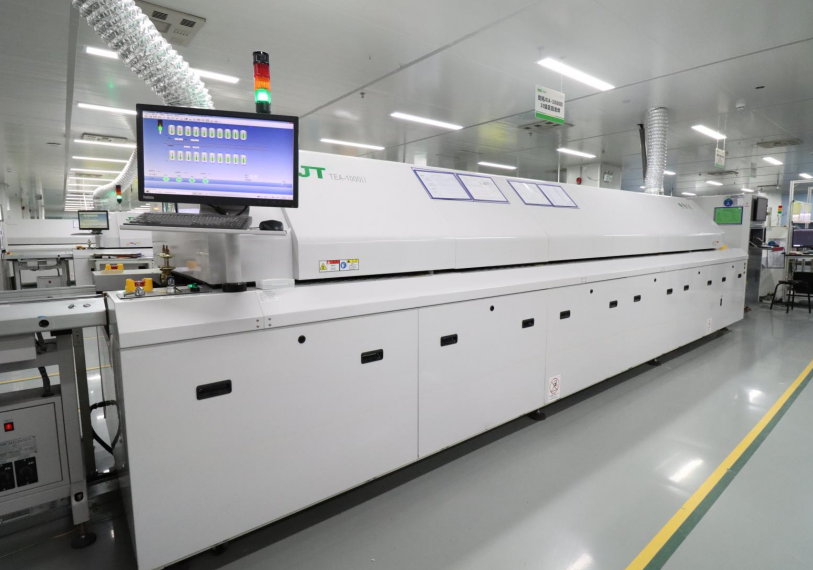
Reflow soldering is a PCB assembly process in which solder paste is applied to component pads, SMD components are placed, and the entire board is heated using a controlled thermal profile until the solder melts and “reflows.” Once cooled, the solder solidifies, forming strong and reliable electrical connections.
Reflow soldering is commonly used in manufacturing:
Consumer electronics
Automotive electronic modules
Industrial automation equipment
Communication devices
High-density multilayer PCBs (HDI, micro-BGA, 01005 components)
How Reflow Soldering Works (Step-by-Step)
1. Solder Paste Printing
A stainless-steel or laser-cut SMT stencil deposits precise amounts of solder paste onto each pad.
Key factors: stencil material, aperture design, paste viscosity, print pressure, alignment accuracy.
2. Component Placement
Pick-and-place machines position SMD components onto the printed paste with high speed and accuracy.
Key factors: nozzle type, placement speed, packaging format, fiducial alignment.
3. Reflow Oven Heating
The PCB travels through a multi-zone reflow oven following a programmed thermal profile.
A standard reflow profile includes:
Preheat – gradual temperature ramp
Soak – stabilizes board and activates flux
Reflow (peak) – solder melts and wets pads
Cooling – solidifies solder joints
4. Solder Joint Formation
As the solder cools, it forms uniform, reliable joints that secure the electrical and mechanical connection of each component.
Why Reflow Soldering Is Widely Used
Supports Ultra-Small Components
Ideal for fine-pitch packages, 0201/01005 passives, QFN, and micro-BGAs.
Highly Repeatable and Stable
Consistent heating profiles minimize defects and improve overall product quality.
Scalable for High-Volume Production
Reflow soldering is compatible with fully automated SMT assembly lines.
Suitable for High-Density PCB Designs
Unlike wave soldering, reflow soldering handles complex, multilayer, and compact layouts with ease.
Common Reflow Soldering Defects and How to Prevent Them
1. Solder Bridging
Cause: Excess paste or incorrect stencil aperture design
Solution: Optimize aperture size, reduce paste volume, and adjust peak temperature.
2. Tombstoning
Cause: Uneven heating causing one side of a small component to lift
Solution: Improve thermal balance, refine pad design, and maintain uniform paste thickness.
3. Voids
Cause: Outgassing of flux or paste during reflow
Solution: Use low-void paste, adjust soak time, improve pad finish (ENIG, OSP).
4. Cold Solder Joints
Cause: Insufficient peak temperature or poor wetting
Solution: Increase peak temperature or time above liquidus; check paste quality.
Key Factors That Influence Reflow Soldering Quality
1. Solder Paste Selection
Lead-free vs. leaded (RoHS compliance)
Alloys like SAC305, Sn63Pb37
Flux activity level
Storage conditions and handling procedures
2. Reflow Oven Type
Convection reflow oven – most widely used
Vapor phase reflow – excellent thermal uniformity
Infrared reflow – less common due to uneven heating risks
3. Thermal Profile Optimization
A reliable profile ensures:
Proper flux activation
Consistent wetting
Reduced oxidation
Smooth cooling for strong joints
4. PCB Design Considerations
Pad geometry and spacing
Balanced copper distribution
Heat-absorbing ground planes
Adequate component separation
Conclusion
Reflow soldering remains the industry standard for assembling high-density and high-precision PCB designs. By optimizing solder paste selection, stencil design, placement accuracy, and thermal profile control, manufacturers can significantly improve product reliability and yield.
For reflow-ready PCBs, precision SMT stencils, and full SMT assembly services, PCBGOGO delivers professional manufacturing solutions with fast lead times and high-quality standards—ensuring your projects move from prototype to production smoothly.