日本語
日本語

PCB Stackup Design: The Core to Boosting Multilayer PCB Performance
In today’s high-density electronics landscape, multilayer PCBs have become standard across consumer electronics, industrial control systems, and automotive applications. A board’s electromagnetic compatibility, signal integrity, and thermal performance all depend on one foundation: its PCB stackup design. Contrary to the idea that stackup is merely layer stacking and lamination, it is a structured engineering process that balances electrical behavior, manufacturability, and cost.
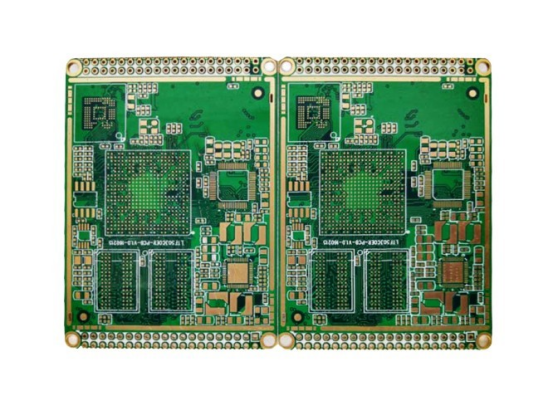
What PCB Stackup Design Really Means
At its core, stackup design arranges conductive layers, dielectric layers, ground planes, and power planes in a calculated sequence with defined thickness ratios. The goal is to ensure signal, power, and ground systems operate in coordination rather than conflict.
For example, in PCBGOGO’s years of experience producing multilayer boards for consumer electronics, a classic 6-layer smartphone motherboard structure might be:
L1 Top Signal
L2 Ground
L3 Inner Signal
L4 Inner Signal
L5 Power
L6 Bottom Signal
This configuration leverages the low impedance characteristics of power and ground planes to provide reliable return paths for high-speed signals. At the same time, it maintains a balanced structure that reduces warpage during lamination. That balance is one of the reasons PCBGOGO has consistently achieved yields above 98% in multilayer PCB manufacturing.
The Impact of Layer Spacing on Signal Integrity
Interlayer spacing is one of the most sensitive variables affecting signal transmission. According to IPC-6012, for high-frequency applications, the distance between the high-speed signal layer and its reference plane should typically fall within 0.10–0.20 mm. Proper spacing helps reduce transmission loss and electromagnetic emissions.
A practical example comes from PCBGOGO’s work on PCBs for 5G base stations. For circuits operating above 25 GHz, the spacing between signal and ground was precisely controlled to 0.12 mm, and prepreg material with a low dielectric constant (Dk = 2.8) was used to decrease dispersion and attenuation. This provided the stability required for high-frequency base station systems.
Tailoring Stackup to Application Scenarios
The right stackup must be built around real-world product conditions rather than theory alone.
Automotive PCBs face high temperatures, vibration, and EMI. For radar systems, PCBGOGO often uses a tightly coupled layout of “Signal – Ground – Power,” increasing ground copper thickness to 2 oz to enhance thermal conductivity and anti-interference performance.
Consumer electronics prioritize lightweight construction. Here, stackup design focuses on balancing total thickness and layer count. Using 0.1 mm ultrathin core materials and slim prepregs enables thinner, lighter boards without sacrificing reliability.
This is why stackup design should never be isolated from product environment, manufacturing capability, or component density. A structure that succeeds in a laptop may be entirely unqualified for an inverter or EV radar module.
The Shift Toward Precision and Customization
As high-speed connectivity and AI accelerate market demands, stackup design is becoming more refined and customized. With simulation-driven planning, PCBGOGO evaluates signal integrity (SI) and power integrity (PI) during the design phase to validate key metrics before fabrication. This proactive approach helps customers avoid rework, reduce prototype cycles, and shorten the path to scalable production.
In short, a robust PCB stackup is not just a design formality; it is a multiplier for product performance and a direct reflection of a manufacturer’s technical depth.
Why PCB Stackup Design Matters
| Engineering Target | Stackup Impact Area |
|---|---|
| EMI Control | Ground reference, plane layout |
| Signal Integrity | Layer spacing, dielectric selection |
| Thermal Performance | Copper weight, power plane architecture |
| Yield and Reliability | Symmetry, lamination stress balance |
| Total Cost | Material sets, structure complexity |
A high-quality PCB stackup is the foundation that makes every subsequent stage—routing, impedance control, manufacturing, and assembly—more controllable and predictable.