日本語
日本語

PCB Backdrilling vs Blind Via: How to Choose the Right Solution for Your PCB
When designing high-density, high-speed PCBs, engineers often ask: "Should we use backdrilling or blind vias?" The answer isn’t absolute—it depends on your product’s requirements: cost, production volume, signal performance, and layer count. Here’s a detailed, practical comparison to help you make the best choice.
1. Understanding the Core Difference
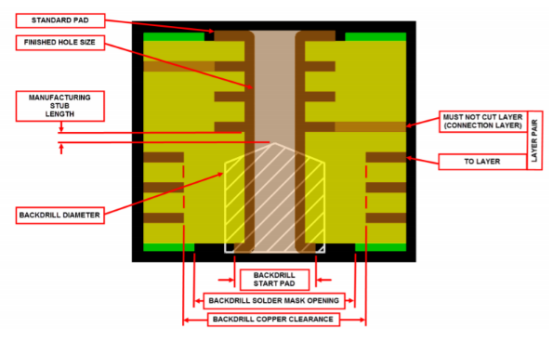
PCB Backdrilling:
Drill a through-hole first → copper plating → drill again to remove excess copper.
Essentially, “drill full first, then subtract,” creating a pseudo-blind via.
Blind Via:
Drill directly to a target inner layer (e.g., top layer to layer 2) in a single step.
Essentially “drill only what’s needed,” forming a via without a second drilling step.
2. Comparison Across 5 Key Dimensions
| Dimension | PCB Backdrilling | Blind Via |
|---|---|---|
| Cost | Lower (30%-50% cheaper than blind vias) | Higher (especially for multi-layer PCBs) |
| Accuracy | Moderate (±0.005mm) | High (±0.003mm) |
| Volume Suitability | Small to medium batches (100–1000 pcs) | Large batches (≥1000 pcs) |
| Signal Performance | Good (parasitic capacitance ≤0.1pF) | Excellent (parasitic capacitance ≤0.08pF) |
| Process Complexity | Low (simple workflow, easy to control) | High (requires precise alignment, complex workflow) |
3. How to Choose: 3 Practical Scenarios
Scenario 1: High-Speed PCB (≥1GHz) + Small Batch → Backdrilling
Example: 5G modules, server test boards
For a 1.5GHz comms PCB, 300 pcs batch: backdrilling saved 40% cost and maintained reflection loss at -28dB.
Blind vias would be more expensive and require special tooling.
Scenario 2: High-Density PCB (≥12 Layers) + Large Batch → Blind Via
Example: smartphone motherboards, high-end drone controllers
Blind vias offer higher precision, stable signal performance, and cost advantages as batch size grows.
For less than 12 layers, backdrilling can still meet requirements—no need to default to blind vias.
Scenario 3: Cost-Sensitive + Moderate Accuracy → Backdrilling
Example: industrial control PCBs, standard consumer electronics
Signal ≤500MHz, positioning tolerance ≤0.01mm
Backdrilling balances performance and cost, avoiding unnecessary expense.
4. Two Practical Tips for Selection
Start with a DFM Review:
Let your PCB manufacturer evaluate your design, layers, via size, and signal frequency.
At PCBGOGO, free DFM reviews provide recommendations: “Backdrilling sufficient?” or “Blind via required?”
Prototype Verification:
If uncertain, produce a small batch (e.g., 50 pcs) to test signal performance and reliability.
If the backdrilled prototype meets specs, no need to upgrade. Otherwise, consider blind vias.
Final Thoughts: Match the Process to Your Needs
Choosing between backdrilling and blind vias is about matching your design requirements:
Small batch, high-speed, cost-sensitive → Backdrilling
Large batch, high-density, high-precision → Blind via
Don’t blindly pursue “higher-tech” options—pick what suits your product. Manufacturers with both capabilities, like PCBGOGO, can provide tailored solutions, balancing performance, cost, and production time.