日本語
日本語

More Than a Heat Sink: How High-Thermal-Conductivity PCB Materials Became the Guardian of Electric Vehicle's "Power Brain"
In the world of electronics, heat is the enemy. It degrades performance, shortens lifespans, and, in high-power applications, can lead to catastrophic failure. Nowhere is this more apparent than in the fast-paced, high-stakes realm of electric vehicles (EVs). The "brains" of an EV—the Vehicle Control Unit (VCU), Battery Management System (BMS), and On-Board Charger (OBC)—are generating immense amounts of heat. Traditional PCB materials simply can't keep up. This is where high-thermal-conductivity PCB materials step in, evolving from a simple component into a critical guardian of performance and reliability.
So, what exactly does "high thermal conductivity" mean for a PCB, and how has the industry broken through the limitations of conventional materials?
The Significance of Thermal Conductivity (W/m·K)
Thermal conductivity, measured in watts per meter-kelvin (W/m·K), is a material's ability to conduct or transfer heat. Think of it as a highway for heat: a higher W/m·K value means a wider, faster road for heat to travel away from sensitive components.
The traditional workhorse of the electronics industry, FR-4, has a low thermal conductivity of around 0.2-0.4 W/m·K. It's a great electrical insulator but a poor thermal conductor, a bit like a narrow, winding country road. For low-power consumer electronics, this is usually fine. But for the massive power demands of EVs, it's a dead end.
The Material Evolution: From FR-4 to Metal and Beyond
To tackle this heat problem, the industry has developed a range of advanced materials, each with its own advantages and manufacturing challenges.
High-Tg Materials: These materials, like some specialized FR-4 variants, offer better resistance to heat. While they don't necessarily improve thermal conductivity much, they can handle higher operating temperatures without losing structural integrity. This is a step up, but still not a complete solution for major heat dissipation.
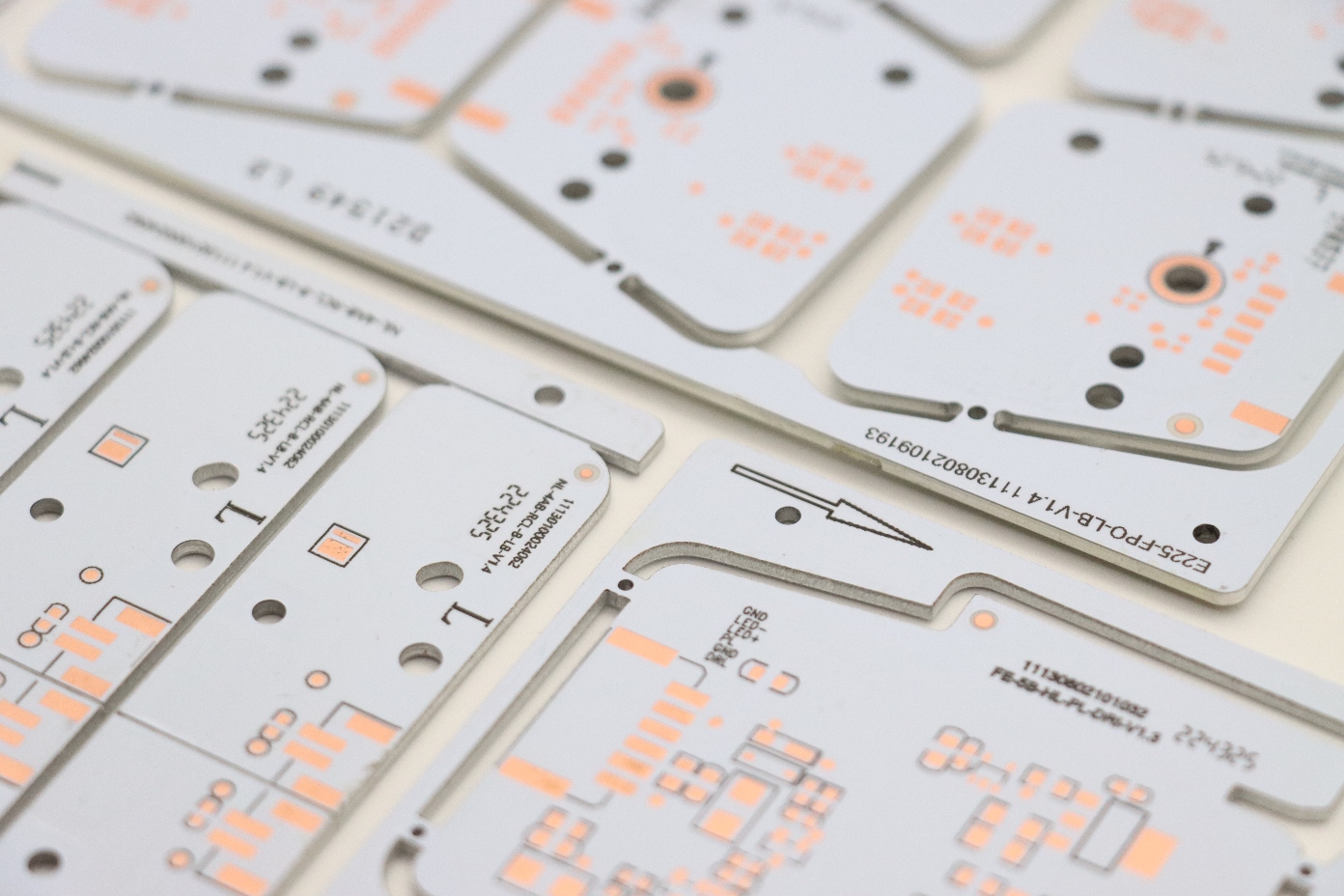
Metal-Core PCBs (MCPCBs): This is a huge leap forward. Aluminum PCBs (typically 1-3 W/m·K) and Copper PCBs (3-9 W/m·K) use a metal base plate as a built-in heat sink. These are far more efficient at moving heat away from components. They've become standard for applications like high-power LED lighting and some EV systems. However, their single-layer or simple two-layer structure can limit circuit complexity.
Ceramic Substrates: For the most demanding applications, ceramic materials like alumina (20-30 W/m·K) and aluminum nitride (170-220 W/m·K) offer exceptional thermal conductivity. They also have excellent high-frequency properties and thermal stability. The trade-off? Their specialized manufacturing process and higher cost make them suitable for high-end power modules and aerospace applications.
Insulated Metal Substrates (IMS) & Thermally Conductive Laminates: This is where the innovation truly lies. Materials like insulated metal substrates and thermally conductive PP (prepreg) filled with ceramic powders are bridging the gap. By incorporating ceramic fillers into the insulating layer, they can achieve thermal conductivity values ranging from 2 W/m·K to 8 W/m·K, and even higher. This approach combines the structural benefits of FR-4 with the thermal performance of a metal core, allowing for more complex multilayer designs.
Beyond Materials: Engineering the Thermal Path
While material choice is crucial, it's only half the battle. We also use advanced design and manufacturing techniques to optimize heat flow.
Thermal Vias: We drill small holes, or vias, and fill them with copper to create a direct thermal path from a component's heat pad down to a ground plane or a metal core. A high density of these thermal vias is critical.
Via in Pad: This technique places a thermal via directly under a component's pad. This reduces thermal resistance and provides a super-efficient path for heat to escape, a common practice in power electronics.
Buried Copper Blocks: For extremely high-power devices, we can embed thick copper blocks within the PCB layers. These blocks act as highly efficient heat spreaders and sinks, pulling heat away from critical areas.
A Statement from PCBGOGO
We at PCBGOGO recognize that the future of electronics, from EVs to renewable energy systems, hinges on our ability to manage heat. We are no longer just a "PCB manufacturer"; we are a key partner in thermal management solutions. We've invested heavily in a diverse range of high-thermal-conductivity materials, from standard aluminum and copper substrates to advanced, thermally conductive PP laminates, to meet the evolving needs of our customers.