日本語
日本語
 韩語
韩語

Automotive PCB Design, Standards, and Manufacturing Guide
KEY DEFINITION An automotive PCB is a printed circuit board designed to operate reliably under extreme conditions, including temperatures from -40°C to 150°C, continuous vibration, and high humidity. It is used in critical vehicle systems such as ABS, airbags, engine control units (ECU), and ADAS modules. These boards are validated under automotive-grade standards such as IATF 16949, AEC-Q100, and IPC-6012DA, ensuring long-term durability and safety where even a single failure can impact vehicle performance and occupant protection.
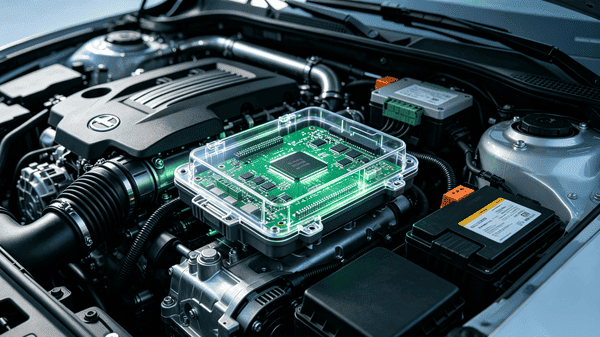
Pop the hood on any modern car and the engine is no longer the most complicated part. That title belongs to the dozens of circuit boards quietly running everything from the brakes to the infotainment screen.
This guide covers what makes automotive PCBs different from standard boards, the design factors that determine reliability, the standards manufacturers build to, where these boards show up across a vehicle, and the production challenges unique to automotive-grade electronics.
What Makes Automotive PCBs Different From Standard Boards
Automotive PCBs face a combination of stress factors that most consumer electronics never encounter, and each one shapes how these boards get designed and built.
Extreme temperature swings: Boards mounted near an engine block can see operating temperatures from negative 40 up to 150 degrees Celsius, far beyond the range a typical consumer PCB is rated for.
Constant vibration and mechanical stress: Continuous road vibration and mechanical shock can fatigue solder joints and loosen components over years of operation, which standard mounting techniques are not built to withstand.
Safety-critical failure consequences: A board controlling ABS, airbag deployment, or engine management cannot fail quietly, since a single defect can directly affect occupant safety rather than just inconvenience a user.
Long service life expectations: Vehicles are expected to operate reliably for a decade or more, which means automotive PCBs need a much longer design life than a phone or laptop board built for a 3 to 5 year replacement cycle.
These pressures are exactly why automotive PCB design starts with material selection rather than circuit layout.
Materials and Design Factors for Reliable Automotive PCBs
Building a board that survives automotive conditions comes down to a handful of material and layout decisions made early in the design process.
High Tg substrate selection: Standard FR-4 rated to a glass transition temperature of 170 degrees Celsius or higher works for less demanding applications, while polyimide substrates rated up to 260 degrees Celsius are common in engine control units and powertrain systems facing more extreme heat.
Thermal management: Thermal vias, copper planes, and heat sinks pull heat away from high-power circuits, which matters most in areas where current density can reach 10 amps per square millimeter.
Vibration resistance: Flexible PCB sections, conformal coatings, and additional mounting points around heavy components help absorb road vibration and prevent solder joint fatigue over years of operation.
Controlled impedance for high-speed signals: ADAS and radar systems depend on consistent impedance, often held within plus or minus 10 percent tolerance, to keep high-speed signals from degrading over long traces.
EMI mitigation: Careful component placement and trace routing keep high-frequency circuits separated from power lines, reducing electromagnetic interference between systems like infotainment and the engine's ignition circuitry.
Getting these factors right on paper still depends on which standards the finished board needs to be qualified against.
Industry Standards Automotive PCBs Must Meet
Automotive electronics are governed by a stack of standards covering quality systems, component reliability, and board-level performance, not a single blanket certification.
IATF 16949: The quality management system standard specific to automotive manufacturing, evolved from the earlier ISO/TS 16949, covering traceability and process discipline across every stage of production.
AEC-Q100: A failure mechanism based stress test qualification for integrated circuits, used to confirm that components can withstand automotive-grade temperature, humidity, and electrical stress.
IPC-6012DA: The automotive addendum to the base IPC-6012 rigid PCB performance specification, adding requirements like tighter hole position tolerance and more rigorous thermal and humidity testing.
ISO 26262: The functional safety standard for road vehicles, applied to safety-critical systems where a hardware or software failure could directly affect occupant safety.
These standards apply differently depending on where in the vehicle a given board is doing its job.
Where Automotive PCBs Are Used Across a Vehicle
Automotive PCBs show up in nearly every system a modern vehicle relies on, and the demands on the board shift depending on the application.
Engine control units: These boards manage fuel injection, ignition timing, and emissions control while operating in one of the hottest zones in the vehicle, which typically pushes designs toward polyimide or other high-temperature substrates.
Safety systems: ABS controllers and airbag deployment modules demand the highest reliability tier in the vehicle, since these boards have to function correctly on the first and only time they are called on.
ADAS and radar systems: Driver assistance features depend on high-speed signal integrity and precise impedance control to process radar and camera data accurately in real time.
Battery management systems in EVs: Electric vehicle battery packs rely on PCBs to monitor individual cell voltage and temperature, balancing charge across cells while managing far higher current loads than a traditional combustion vehicle's electronics ever see.
Infotainment and connectivity: Dashboard displays, navigation, and connectivity modules carry comparatively lower safety stakes, which often allows for more cost-driven material choices like standard high Tg FR-4.
A side-by-side shows how requirements shift across these applications.
| Application | Typical Substrate | Reliability Priority | Key Demand |
|---|---|---|---|
| Engine Control Unit | Polyimide / High Tg FR-4 | High | Thermal stability |
| Safety Systems (ABS, Airbag) | High Tg FR-4 / Polyimide | Highest | Functional safety |
| ADAS / Radar | High-frequency laminate | High | Signal integrity |
| EV Battery Management | Heavy copper / High Tg | High | Current handling |
| Infotainment | Standard High Tg FR-4 | Moderate | Cost efficiency |
Building boards that hit every one of these targets at production volume is where the real manufacturing challenge starts.
Why Automotive Projects Choose PCBgogo
Sourcing automotive PCBs means working with a manufacturer who can hold tight tolerances across thousands of units, not just a handful of prototypes, since a defect that slips through mass production becomes a far more expensive problem once it reaches a vehicle in the field.
At PCBgogo, we manufacture high Tg, heavy copper, and multilayer boards built for the thermal cycling, vibration, and current demands automotive applications put on a PCB, with the process control needed to hold consistent quality across production runs and dependable turnaround so your project stays on schedule. Every project starts with our engineering team reviewing your specific material, layer, and reliability requirements, so the manufacturing approach is built around what your design actually needs. If you are sourcing an automotive PCB project, get in touch with our team and we will work with you to map out the right approach.
Final Takeaway
An automotive PCB has to survive a decade of heat, vibration, and humidity while controlling systems where failure is not an option, which is why material selection and standards compliance matter just as much as the circuit design itself. Matching the right substrate, design margin, and manufacturing partner to each application is what separates a board that passes qualification from one that actually holds up in the field.
Frequently Asked Questions
What temperature range do automotive PCBs need to withstand?
Automotive PCBs are commonly rated for temperatures from negative 40 to 125 degrees Celsius, with boards mounted near the engine sometimes needing to handle spikes up to 150 degrees Celsius.
What is the difference between IATF 16949 and AEC-Q100?
IATF 16949 is a quality management system standard covering how a manufacturer runs its production processes, while AEC-Q100 is a component-level stress test qualification confirming individual parts can withstand automotive-grade environmental conditions.
Why do EV battery management PCBs need heavier copper than standard automotive boards?
Battery management systems in electric vehicles carry significantly higher current loads than traditional combustion vehicle electronics, so heavier copper traces are needed to avoid resistive heating and voltage drop across the board.
Do all automotive PCBs need polyimide substrate?
No. Polyimide is reserved for high-heat zones like engine control units, while lower-stakes applications such as infotainment systems commonly use standard high Tg FR-4 to balance cost against the actual thermal demands of that location in the vehicle.
How does ISO 26262 affect automotive PCB design?
ISO 26262 applies to safety-critical systems and requires documented risk analysis, design verification, and testing throughout development, which means boards used in systems like ABS or airbags need a more rigorous design and validation process than a non-safety-critical board.