日本語
日本語
 한국어
한국어

AI Glasses Flexible PCB Reliability Design Guide: From Base Materials to Reinforcement
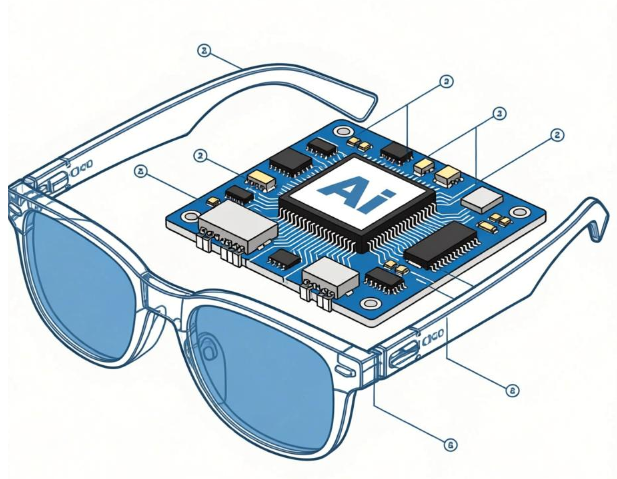
AI glasses rely on extremely thin and bendable flexible PCBs (FPCs) routed through the temple–frame hinge area—one of the most mechanically stressed zones of the entire device. Each time a user puts on or removes the glasses, this hinge undergoes bending between 0° and 90°, accumulating tens of thousands of flex cycles over the product’s lifetime.
Traditional FPCs often fail after 50,000 bend cycles, with fracture rates exceeding 15%. One well-known smart glasses brand reported that FPC breakage accounted for more than 20% of after-sales repairs, creating annual losses of over ¥3M.
PCBGOGO, with 8+ years of custom flexible PCB development, has engineered FPCs for AI glasses capable of surviving 100,000 cycles at a 1mm bend radius with a failure rate of ≤0.5%, already deployed by 20+ AR/VR manufacturers.
This guide breaks down the core reliability design factors—from material selection to layout optimization and reinforcement structure—helping hardware engineers eliminate bend-related failures.
1. Understanding the Failure Mechanisms
Flexible PCB reliability for AI glasses is governed primarily by IPC-6012 requirements, especially Section 3.4 for flexible substrates. Two mechanisms dominate failures:
1.1 Stress Concentration During Bending
Stress concentration frequently occurs at:
Trace corners
Pad edges
Vias located inside the bend area
A 90° corner has a stress concentration factor above 2.5 (target ≤1.5). PCBGOGO fatigue tests show that an FPC with sharp corners can reach 40% fracture rate after only 30,000 bends.
1.2 Material Fatigue
Material quality determines long-term endurance:
Standard PI films lose 50% tensile strength after 50,000 cycles at a 1mm radius.
DuPont Kapton? HN (0.05mm) loses only 15%, meeting IPC-TM-650 2.4.31.
Copper type matters:
Rolled-Annealed (RA) copper: fracture rate ≤1% after 100,000 bends
Electro-Deposited (ED) copper: fracture rate >20%
(per GB/T 2036-2019)
RA copper’s grain structure is elongated, making it radically more resistant to cyclic flexing.
2. Four-Step Reliability Design Method
2.1 Base Material Selection
To maximize bending endurance:
PI base film:
DuPont Kapton HN
Thickness: 0.05–0.1 mm
Tensile strength: ≥150 MPa
Copper foil:
Rolled-annealed copper (RA)
Thickness: 18–35 μm
Pad area copper: 35 μm (1 oz) for abrasion resistance
Coverlay:
PI film 0.03–0.05 mm
Adhesion ≥0.8 N/mm
Meets IPC-6012 3.2
2.2 Routing Optimization
Reduce stress where it matters:
Use rounded corners
Corner radius ≥0.1 mm
Align traces parallel to the bending direction
Minimum spacing: 0.1 mm
Avoid vias in the bend zone
If required: via diameter ≤0.15 mm, spacing ≥0.3 mm
2.3 Reinforcement Structures
Proper reinforcement prevents stress from spreading into the active bend area:
FR-4 stiffeners (0.2–0.3 mm)
Placed at both sides of the bend region
Overlap ≥1 mm
Epoxy bonding at 80°C ±5°C for 60 min
Steel stiffener plates (SUS304)
Thickness: 0.1 mm
Attached with high-adhesion double-sided tape
Adhesion ≥1.2 N/mm
2.4 Process Controls
Manufacturing precision directly affects fatigue life:
Etching:
Alkaline etching
Etching factor ≥3:1
Minimize edge burrs (burrs increase stress)
Coverlay lamination:
Temperature: 180°C ±10°C
Pressure: 15 kg/cm2
Duration: 30 min
Bubble ratio ≤0.5%
3. Reliability Validation Tests
3.1 Bend-Cycle Test (IPC-TM-650 2.4.31)
Bend radius: 1 mm
Angle: 0–90°
Speed: 30 cycles/min
Total: 100,000 cycles
Pass condition: resistance change ≤10%
Test equipment: PCBGOGO JPE-Bend-500
3.2 Thermal Cycling Test
Temperature range: –40°C to +85°C
1000 cycles
Dwell time: 2h high temp + 2h low temp
Pass: no delamination, no trace fracture
Equipment: PCBGOGO JPE-TH-300
3.3 Abrasion Resistance Test
Eraser hardness: 60 ± 5 Shore A
Pressure: 500 g
100 cycles
Pass: no exposed copper
Standard: IPC-TM-650 2.5.4.2
Conclusion
The key to reliable AI glasses FPC design is minimizing stress concentration and selecting materials with strong fatigue resistance. By using DuPont Kapton PI, RA copper, rounded trace routing, and proper stiffeners—and validating with 100,000-cycle bend tests—engineers can significantly improve field reliability.
PCBGOGO offers a complete solution for flexible PCB fabrication + reliability testing, helping AR/VR device manufacturers build durable, long-life wearable electronics.