日本語
日本語
 한국어
한국어

5G Nationwide vs 5G Ultra Wideband: What the Icons Actually Mean
QUICK ANSWER 5G Nationwide is Verizon's standard 5G network, built on low-band spectrum that reaches nearly the entire country but delivers speeds close to 4G LTE. 5G Ultra Wideband uses mid-band C-band and high-band mmWave spectrum, reaching a smaller footprint but delivering multi-gigabit speeds and near-zero lag.
Open the network settings on a Verizon phone in two different rooms of the same building, and the 5G icon can change. In one spot it just says "5G." In another, it says "5G UW." That's not a glitch.
Here's what 5G Nationwide and 5G Ultra Wideband actually are, how their coverage and speed compare, and why other carriers describe the exact same split with completely different names.
What Is 5G Nationwide?
5G Nationwide is Verizon's baseline 5G network, built primarily on the carrier's low-band spectrum around 700 MHz, the same frequency range that has carried its 4G LTE service for years. It runs through a technique called Dynamic Spectrum Sharing, which lets 4G and 5G traffic share the same channel instead of requiring separate airwaves.
Because low-band signals travel long distances and pass through walls, trees, and hills fairly easily, Nationwide is built to match Verizon's existing 4G LTE footprint, which the carrier states covers more than 99% of the U.S. population. The tradeoff is speed: in most locations, Nationwide performs close to 4G LTE rather than delivering a dramatic jump, since it's still sharing a relatively narrow, low-frequency channel.

What Is 5G Ultra Wideband?
5G Ultra Wideband is Verizon's high-performance 5G tier, delivered over two much higher frequency ranges: mid-band C-band spectrum and high-band millimeter wave, or mmWave. The Federal Communications Commission auctioned 280 MHz of C-band spectrum in the 3.7 to 3.98 GHz range through Auction 107, which drew more than $81 billion in gross bids; Verizon came away with an average of 161 MHz of that spectrum nationwide. Its mmWave holdings sit even higher, in the 28 GHz and 39 GHz bands.
That extra spectrum translates into peak download speeds above 4 Gbps and upload speeds above 200 Mbps in ideal conditions, well beyond the 30 to 35 Mbps that's typical of 4G LTE. Coverage has grown quickly: Ultra Wideband reached about 175 million people in 2022 and was reported at close to 250 million by late 2024 as Verizon lit up more C-band markets. The catch is range. C-band and especially mmWave signals lose strength faster over distance and struggle with obstacles, so Ultra Wideband is concentrated in cities, stadiums, airports, and other dense areas rather than spread evenly across the map.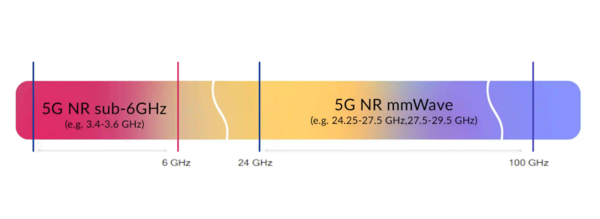
5G Nationwide vs 5G Ultra Wideband at a Glance
The two networks trade coverage for speed in opposite directions, which shows up clearly when their specs sit side by side.
| Feature | 5G Nationwide | 5G Ultra Wideband |
|---|---|---|
| Spectrum band | Low-band, around 700 MHz | Mid-band C-band (3.7–3.98 GHz) and high-band mmWave (28/39 GHz) |
| Typical speed | Close to 4G LTE | 4+ Gbps peak download, 200+ Mbps peak upload |
| Coverage footprint | Matches Verizon's 4G LTE reach, 99%+ of the population | Roughly 250 million people as of late 2024, concentrated in cities |
| Signal range | Long range, strong indoor penetration | Shorter range, weaker through walls and foliage |
| Plan requirement | Included with most 5G-capable plans | Requires a premium unlimited plan and a UW-capable device |
What Actually Separates the Two Networks
The real difference between Nationwide and Ultra Wideband comes down to where each one sits on the radio spectrum. Lower frequencies travel farther and pass through obstacles more easily; higher frequencies can carry far more data but don't travel as far or penetrate buildings as well.
Low-band, around 700 MHz: the foundation of 5G Nationwide. It behaves much like the spectrum that has carried 4G LTE for over a decade, favoring reach and reliability over raw throughput.
C-band, 3.7 to 3.98 GHz: the mid-band workhorse behind most of today's Ultra Wideband coverage. It strikes a balance between range and speed, which is why Verizon's C-band buildout is what pushed Ultra Wideband's population coverage from roughly 175 million to nearly 250 million in just two years.
mmWave, 28 GHz and 39 GHz: the shortest-range, highest-speed layer. It's what powers the multi-gigabit demos in stadiums and dense downtown blocks, but it can be blocked by something as simple as a wall, a pane of glass, or heavy foliage.
Together, these three bands are what let a single phone show three different connection states depending on exactly where it's standing.
Where You'll Actually Notice the Difference
The gap between Nationwide and Ultra Wideband isn't just theoretical. It shows up in specific, everyday situations depending on where a phone happens to be.
Rural roads and small towns: almost always running on Nationwide's low-band signal, since Ultra Wideband's shorter-range spectrum hasn't been built out there and likely won't be for economic reasons.
Downtown offices and city blocks: a common spot to pick up C-band Ultra Wideband, where speeds noticeably outpace 4G LTE for the first time.
Stadiums, arenas, and airports: purpose-built targets for mmWave, since large crowds packed into a small area are exactly the scenario high-band spectrum was designed to handle.
Video calls and cloud gaming: where the gap is most noticeable, since Ultra Wideband's added capacity and lower lag prevent the stutter that low-band Nationwide can show under heavy network load.
Why Other Carriers Call It Something Else
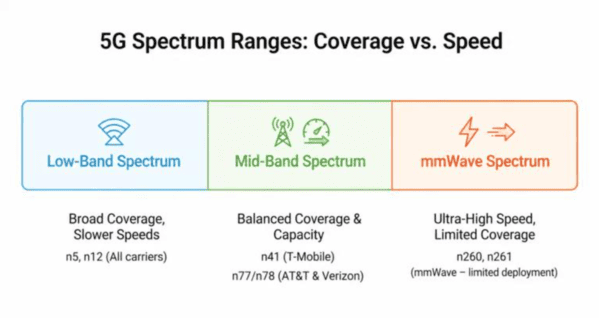
Verizon didn't invent the idea of splitting 5G into a broad, moderate-speed layer and a faster, shorter-range layer. T-Mobile and AT&T follow the same basic pattern; they just use different marketing names for it.
T-Mobile's Ultra Capacity: its mid-band and mmWave tier, functionally similar to Verizon's Ultra Wideband, built mainly on 2.5 GHz mid-band spectrum plus some mmWave in select areas.
T-Mobile's Extended Range: the low-band counterpart to Ultra Capacity, playing the same role that 5G Nationwide plays on Verizon.
AT&T's 5G+: AT&T's label for its mmWave and C-band spectrum, positioned the same way as Ultra Wideband, while its standard "5G" icon covers the carrier's low-band layer.
The underlying technology across all three carriers is built from the same low-band, mid-band, and high-band building blocks. Only the branding on the icon changes.
Frequently Asked Questions
What does "5G UW" mean on my phone screen?
It means the phone is connected to Verizon's 5G Ultra Wideband network, the carrier's mid-band C-band and mmWave service. A plain "5G" icon without the UW tag means the phone is on the slower Nationwide layer instead.
Is 5G Ultra Wideband available everywhere?
No. Ultra Wideband is concentrated in cities, stadiums, and other high-traffic areas because C-band and mmWave signals don't travel as far as the low-band spectrum used for Nationwide. Coverage keeps expanding, but it still trails Nationwide's reach by a wide margin.
Do I need a different plan to get Ultra Wideband speeds?
Yes. Verizon reserves full Ultra Wideband access for its higher-tier unlimited plans, and a UW-capable phone is required as well. 5G Nationwide, by contrast, comes included with most 5G plans.
Is 5G Nationwide just 4G LTE with a new name?
Not exactly. It runs on genuine 5G technology and uses Dynamic Spectrum Sharing to operate over the same low-band spectrum as 4G LTE, so real-world speeds land close to 4G in most places. Latency and network efficiency can still be modestly better.
Is Verizon's 5G Ultra Wideband the same as T-Mobile's Ultra Capacity or AT&T's 5G+?
They aren't identical networks, but they serve the same purpose. Each carrier dedicates mid-band and high-band spectrum to its fastest 5G tier and simply brands it under a different name.
Will Ultra Wideband eventually replace Nationwide?
Unlikely, at least not fully. Nationwide's low-band spectrum is what makes wide rural and indoor coverage possible, so Verizon is expected to keep expanding Ultra Wideband's footprint on top of Nationwide rather than replacing it outright.
The Bottom Line
5G Nationwide and 5G Ultra Wideband aren't competing products; they're two layers of the same network, built for different jobs. Nationwide keeps a phone connected almost everywhere at speeds close to 4G, while Ultra Wideband trades coverage for a real leap in speed wherever it reaches. The icon on the screen is simply reporting which layer the phone is standing in at that moment.